Should a Guest Room Have a Full-Length Mirror?
Yes, a full-length mirror is usually a worthwhile addition to a guest room. It gives visitors a practical place to check an outfit, makes getting dressed easier when the bathroom is occupied, and can help a compact bedroom feel visually brighter and more open. It is not essential in every room, but it is one of those modest conveniences guests tend to appreciate precisely because they do not have to ask for it.
The key is choosing a mirror that fits the room rather than squeezing an oversized statement piece into a space that already feels busy. Placement, proportions, reflected views, and secure installation matter as much as the frame itself.
Why a full-length mirror is especially useful for guests
A guest bedroom has to perform slightly differently from an everyday bedroom. Visitors arrive without access to all the routines and conveniences they have at home, so small practical details carry more weight. A full-length mirror lets someone get dressed, check proportions, adjust a jacket, or see whether shoes work with an outfit without relocating to a hallway or bathroom.
It is particularly helpful when several people are sharing a home. A guest can finish getting ready in the bedroom while someone else uses the bathroom mirror. That small bit of independence makes mornings less awkward without requiring additional furniture or plumbing.
There is also a visual benefit. Large mirrors reflect both natural and artificial light and can create a stronger sense of depth, which is useful in modest bedrooms. Crate & Barrel’s current mirror guidance similarly describes full-length bedroom mirrors as useful for dressing and for making a room appear more open. Crate & Barrel discusses bedroom mirror placement and scale here.
A guest-room mirror works best when it feels like part of the room, not an object that had nowhere else to go.
Choose the location before choosing the mirror
Start with placement. A beautiful mirror is not particularly useful if a nightstand blocks the lower half or a door swings directly into it.
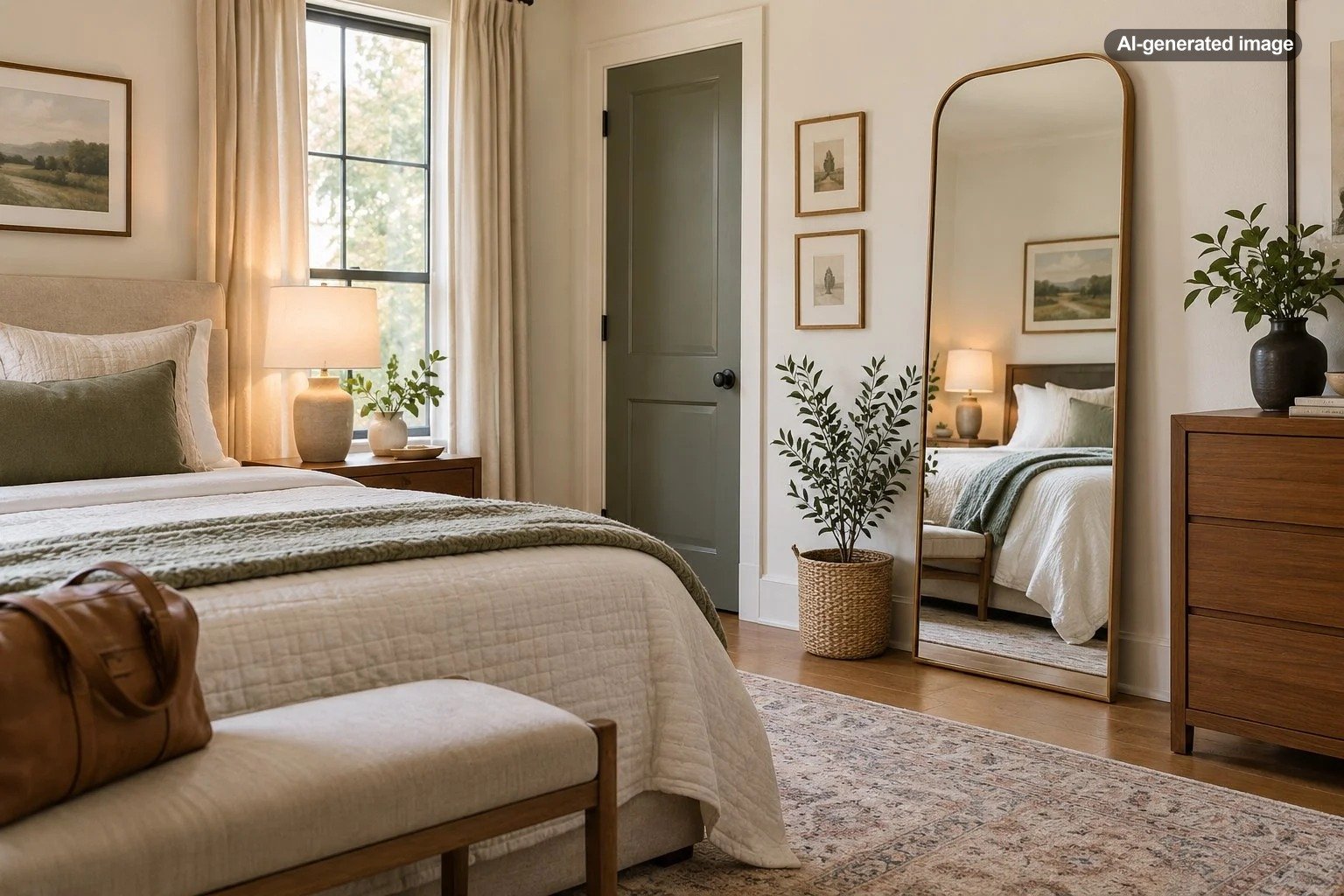
Ideally, a guest should be able to stand several feet back and see most or all of their reflection without moving furniture. Good locations often include an open wall near the dresser, a wall beside the closet, the inside or outside of a suitable closet door, or an unused corner where a securely installed floor mirror can sit without narrowing the walkway.
Also consider what the mirror reflects. A mirror opposite a window can distribute daylight pleasantly through the room. One pointed directly at a cluttered open closet, television, utility corner, or bathroom door may simply duplicate the least attractive part of the space.
Before you decide
- Make sure the mirror will not interfere with the bedroom door, closet door, drawers, or luggage stand.
- Check that a guest can step back far enough to use it comfortably.
- Look at the reflected view from both the bed and doorway.
- Confirm how the manufacturer intends the mirror to be mounted, supported, or restrained.
- Leave comfortable walking space around beds and furniture rather than forcing the mirror into a narrow passage.
Wall-mounted, leaning, or door-mounted?
All three approaches can work, but they solve different problems.
| Mirror type | Works well when | Main tradeoff |
|---|---|---|
| Wall-mounted | Floor space is limited and there is a suitable open wall | Requires appropriate mounting and creates a more permanent location |
| Leaning floor mirror | The room has generous floor area and the mirror is designed for leaning use | Takes up more physical space and may require anti-tip restraint |
| Door-mounted | The guest room is compact and usable wall space is scarce | Can rattle, limit door movement, or feel visually utilitarian |
A wall-mounted mirror is often the cleanest answer for a smaller guest room because it keeps the floor clear. A narrow vertical rectangle can provide the necessary function without visually dominating the room.
A floor mirror can feel more substantial and decorative, especially in a larger bedroom. However, do not assume that every large mirror can simply be leaned against a wall. Product instructions vary. Some floor mirrors are specifically designed to lean and include anti-tip hardware, while other mirrors are intended to hang vertically. Follow the instructions supplied with the particular mirror rather than improvising an installation method.
How large should a guest-room mirror be?
You do not need the largest mirror the wall can hold. For guest-room use, the goal is to provide a useful head-to-toe view while maintaining sensible proportions with the surrounding furniture.
A tall, relatively narrow mirror often works beautifully beside a dresser or closet because it creates vertical emphasis without consuming an entire wall. In a broad room with larger furniture, a more substantial frame can provide visual balance. In a tight bedroom, a slim wall-mounted mirror usually looks calmer than a wide floor mirror pressed between furniture.
Before buying, outline the proposed dimensions on the wall with removable painter’s tape. Then stand at the room entrance, sit on the bed, open the closet, and pull out nearby drawers. This simple exercise makes it much easier to judge whether the mirror will feel appropriately scaled.
Match the frame to the room without overdecorating
A mirror introduces another material, finish, and strong geometric shape, so it deserves the same attention as a lamp or bedside table. That does not mean the frame must perfectly match the furniture.
Natural wood can soften an otherwise crisp room, while black or dark metal can add definition to pale walls. A frameless or very slim frame works well where the existing furniture already has considerable visual detail. If the guest room includes several wood tones, choosing a related but not identical finish often looks more intentional than trying to create a near-match.
Affiliate disclosure: CraneManor.com may earn a commission when you purchase through links on this page. This does not affect the price you pay. Learn more.
For a room where a natural wood frame would complement the existing furniture, the Keane wood-framed mirror is one example of the large floor-mirror approach. As with any substantial mirror, confirm its dimensions, delivery access, and installation or anti-tip requirements before deciding whether it suits the room.
When a full-length mirror may not be the right choice
Some guest rooms simply do not have the space. If the only possible location would squeeze the walkway beside the bed, interfere with a closet, or create an awkward obstacle for luggage, skip the floor mirror and look for a wall- or door-mounted alternative.
A smaller mirror can also be adequate in a room used mainly for occasional overnight visitors rather than longer stays. For example, a generous mirror above a dresser may handle basic grooming even if it does not provide a full head-to-toe view.
Accessibility is another consideration. Do not place a leaning mirror where it reduces an already narrow route through the room. A secure wall-mounted mirror can preserve floor clearance and may be the cleaner solution for a bedroom designed to accommodate different mobility needs.
Do not overlook secure installation
Large mirrors are heavy and fragile, and installation instructions differ considerably among products. If the manufacturer supplies mounting or anti-tip hardware, use it as directed. Do not substitute an improvised hanging arrangement simply because another mirror in the house was installed differently.
Crate & Barrel’s current guidance for wood floor mirrors specifically recommends anti-tip hardware for heavier standing mirrors, and some of its floor-mirror product pages state that particular models are intended to lean rather than hang. Its floor-mirror guidance provides additional context.
If you are uncertain whether the wall construction, mounting hardware, or proposed location can safely support a large mirror, follow the manufacturer’s instructions and use an appropriately qualified installer rather than guessing.
So, should you put one in the guest room?
In most guest rooms, yes. A full-length mirror provides genuine everyday usefulness, can improve the room’s visual depth, and requires relatively little space when mounted thoughtfully.
Choose the location first, then select a mirror whose size and installation method actually fit that location. In a generous bedroom, a decorative floor mirror can become part of the room’s design. In a small guest room, a simple wall-mounted version may be the smarter choice. Either way, the best mirror is the one guests can use easily without having to navigate around it.
FAQ
Where is the best place for a full-length mirror in a guest room?
An open wall near the closet or dresser is often convenient. The ideal location provides enough distance for viewing, does not interfere with doors or drawers, and reflects a reasonably pleasant part of the room.
Should a guest-room mirror face the bed?
It can, but it does not need to. Consider how the reflected view looks from the bed. If the reflection feels distracting, another wall may produce a calmer arrangement.
Is a floor mirror better than a wall mirror?
Neither is universally better. Floor mirrors can provide more decorative presence, while wall-mounted mirrors preserve floor space and often work better in small bedrooms.
Can I simply lean any large mirror against the wall?
No. Use a mirror only in the orientation and installation method permitted by its manufacturer. Some floor mirrors are designed for leaning and include restraint hardware; others are designed to hang.