Should You Use Fabric Softener on Bath Towels?
Fabric softener can make bath towels feel smoother and smell more fragrant, but there is a tradeoff: regular use can leave conditioning ingredients on the fibers and reduce the towel’s ability to absorb water. If absorbency is your priority, the simplest answer is to skip fabric softener on most towel loads.
That does not mean one accidental dose ruins a set of towels, nor does it mean anyone who enjoys a little softener must banish it from the laundry room forever. The more useful approach is to understand what softener does, why towels are a special case, and how washing and drying habits affect softness just as much.
Why Fabric Softener Can Be a Problem for Towels
Fabric softener is designed to condition fibers rather than clean them. Its ingredients can coat or lubricate fibers so fabrics feel smoother, generate less static, and often carry fragrance after washing. Those characteristics can be pleasant on certain clothing and linens.
A bath towel, however, has a very specific job: it needs to take up water quickly. The loops that give terry towels their familiar texture also create a large surface area for absorbing moisture. Repeated deposits from softening products can interfere with that performance, making a towel feel pleasantly slick while becoming less effective at drying skin.
This is why towel care sometimes seems contradictory. The product that makes a towel feel softer to the hand can make it less useful in practice. A fluffy towel that merely moves water around is not much of an achievement.
The best towel care protects the qualities you actually bought the towel for: absorbency, comfortable texture, and dependable drying.
Does That Mean You Should Never Use Fabric Softener?
Not necessarily. The decision depends on what you value most and how often you use it. If you want your everyday bath towels to remain as absorbent as possible, avoiding both liquid softener and routine dryer-sheet use is the straightforward choice.
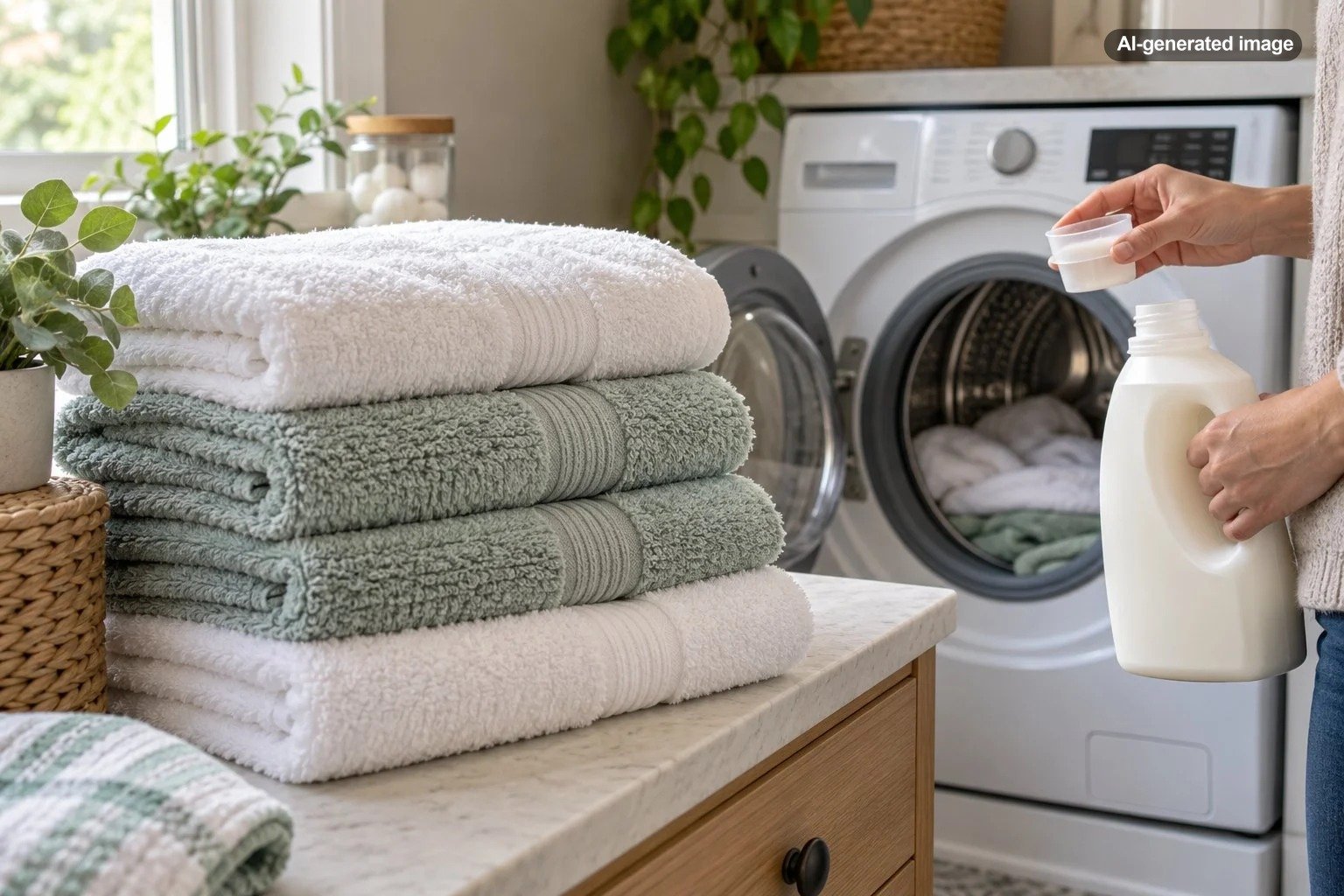
If you care more about fragrance or a conditioned feel, occasional use may be an acceptable tradeoff. Use only the amount directed on the softener packaging, put liquid softener in the appropriate dispenser rather than pouring it directly onto dry towels, and check the towel’s care label before adding anything beyond detergent.
More is not better. Excess laundry products of many kinds can leave residue behind, so increasing the dose in hopes of producing unusually soft towels can work against the result you want.
| Approach | Main advantage | Main tradeoff |
|---|---|---|
| Skip fabric softener | Prioritizes towel absorbency | Towels may not have the conditioned feel or fragrance you prefer |
| Use softener occasionally | Provides some fragrance and smoother feel | Repeated residue can still build over time |
| Use softener every wash | Consistent conditioned feel | Most likely to work against maximum absorbency |
Why Towels Sometimes Feel Stiff Even Without Fabric Softener
If towels emerge from the laundry feeling rough, fabric softener is not the only possible solution. Stiffness can also be related to detergent residue, a washer packed too tightly for effective rinsing, mineral-rich water, aggressive drying, or the natural change in texture that happens as towels age.
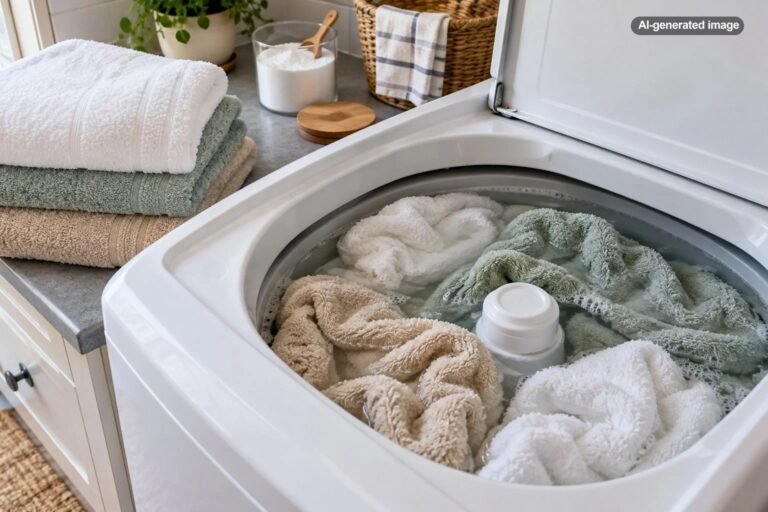
Start with the simplest possibilities. Follow the detergent manufacturer’s dosing directions rather than automatically filling the dispenser to its maximum line. Give bulky towels enough room to move through the wash. Select a cycle appropriate for towels and use the warmest water permitted by the care label rather than assuming every towel needs the hottest possible setting.
The dryer matters too. Towels need enough space to tumble. A densely packed dryer can slow drying and prevent the movement that helps separate and fluff the towel loops. At the other extreme, repeatedly subjecting towels to more heat and drying time than necessary can be hard on fibers over the long term.
A Simple Routine for Soft, Absorbent Bath Towels
You do not need an elaborate collection of laundry additives to maintain good towels. A consistent routine usually matters more than chasing a particular scent or an exceptionally plush feel after every wash.
What to do
- Check the care label. Follow the manufacturer’s instructions for water temperature, drying, and any prohibited treatments.
- Use an appropriate detergent dose. Too much detergent does not automatically mean cleaner towels and can make thorough rinsing more difficult.
- Leave room in the washer. Bulky towels need space for water and detergent to circulate.
- Skip routine fabric softener. This is the easiest way to prioritize absorbency.
- Dry with enough room to tumble. Avoid cramming the dryer drum tightly with heavy towels.
- Remove towels when they are dry. Do not keep adding heat simply because a longer cycle is available.
What About Dryer Sheets and Dryer Balls?
Dryer sheets deserve similar consideration because they are also designed to condition fabrics. If your goal is maximum towel absorbency, routinely using dryer sheets with towels may not be the best match.
Dryer balls are a different approach. They tumble with the load rather than applying the same kind of conditioning coating and can help keep laundry moving and separated in the dryer. They are a reasonable option for households that want to simplify towel care while avoiding added fragrance. As with any laundry accessory, follow the instructions for your dryer and the product itself.
If static is the concern, remember that bath towels generally behave differently from lightweight synthetic clothing. You may discover that a towel-only load simply does not need the same static-control products you use elsewhere in the laundry.
When Occasional Fabric Softener May Make Sense
There is room for preference. Guest towels that are used infrequently, for example, may be chosen as much for their hand feel and presentation as for maximum everyday performance. Someone who strongly prefers fragranced laundry may also consider the slight absorbency tradeoff worthwhile.
The key word is sparingly. There is little reason to treat every towel load automatically if you are satisfied with the texture and fragrance after ordinary washing and drying.
How to Tell Whether Your Current Routine Is Working
Judge towels by performance rather than by laundry-room tradition. After a shower, a good bath towel should take up moisture readily rather than seeming to push droplets across the skin. It should smell clean when fully dry, and it should not feel unusually slick or heavily coated.
If towels are becoming less absorbent, temporarily eliminate fabric softener and dryer sheets and simplify the wash routine. Check detergent dosing, make sure the machine is not overloaded, and allow the towels to rinse and tumble properly. Improvement may take more than one wash if residue has accumulated gradually.
If the towels remain scratchy despite sensible washing, age and fiber wear may simply be part of the story. Towels are hardworking household textiles. No laundry additive can indefinitely restore fibers that have physically worn down.
Frequently Asked Questions
Will one use of fabric softener ruin bath towels?
No. Using fabric softener once does not automatically ruin a towel. The larger concern is repeated use and gradual residue that can work against absorbency.
Can I use less fabric softener instead of eliminating it?
If you prefer the feel or fragrance, moderate occasional use is a reasonable compromise. Follow the product directions rather than guessing at a reduced or increased dose, and monitor whether the towels remain absorbent.
Why are my towels hard after washing?
Possible contributors include excess detergent residue, overloading, mineral-rich water, drying habits, and normal fiber wear. Fabric softener may disguise some roughness temporarily without addressing the underlying laundry routine.
Should I use fabric softener on expensive towels?
Price does not change the basic principle. Follow the manufacturer’s care label first. If preserving absorbency is important, avoiding routine softener is generally the more conservative approach.
Is fragrance-free towel care possible without fabric softener?
Yes. Detergent and proper washing are responsible for cleaning; fabric softener is optional. Households that prefer little or no added fragrance can simply leave softener out of the towel routine.
The Bottom Line
For most bath towels, fabric softener is better treated as an occasional preference than an essential laundry step. It can create a smoother feel and add fragrance, but those benefits come with a practical compromise because repeated conditioning can reduce the absorbency towels are meant to provide.
If your towels already feel comfortable and dry well, there is no compelling reason to add another product to the load. Use the correct amount of detergent, give bulky towels enough room to wash and tumble, follow their care labels, and let good laundry technique do most of the work.