Can a Dirty Evaporator Coil Cause High Indoor Humidity?
Yes, a dirty evaporator coil can contribute to high indoor humidity. The coil inside an air-conditioning system is supposed to cool the passing air below its dew point so water vapor condenses on the coil and drains away. When dust and debris interfere with airflow or insulate parts of the coil, the system may cool and dehumidify less effectively.
However, a dirty coil is only one possible cause. Short cooling cycles, an oversized air conditioner, a clogged filter, drainage trouble, duct leakage, excessive outdoor-air infiltration, and unusually high moisture production indoors can create similar symptoms. The useful next step is to look at the complete pattern rather than assume that every clammy room needs coil cleaning.
How an evaporator coil removes humidity
An evaporator coil does two jobs at once during normal cooling operation. Refrigerant inside the coil absorbs heat from the indoor air, while the cold coil surface causes some airborne moisture to condense into liquid water. That water falls into a drain pan and leaves through the condensate line.
This process depends on a workable balance of coil temperature, airflow, cooling capacity, and run time. The air has to remain in contact with enough cold coil surface for condensation to form. The system also has to operate long enough for collected water to reach the pan and drain away.
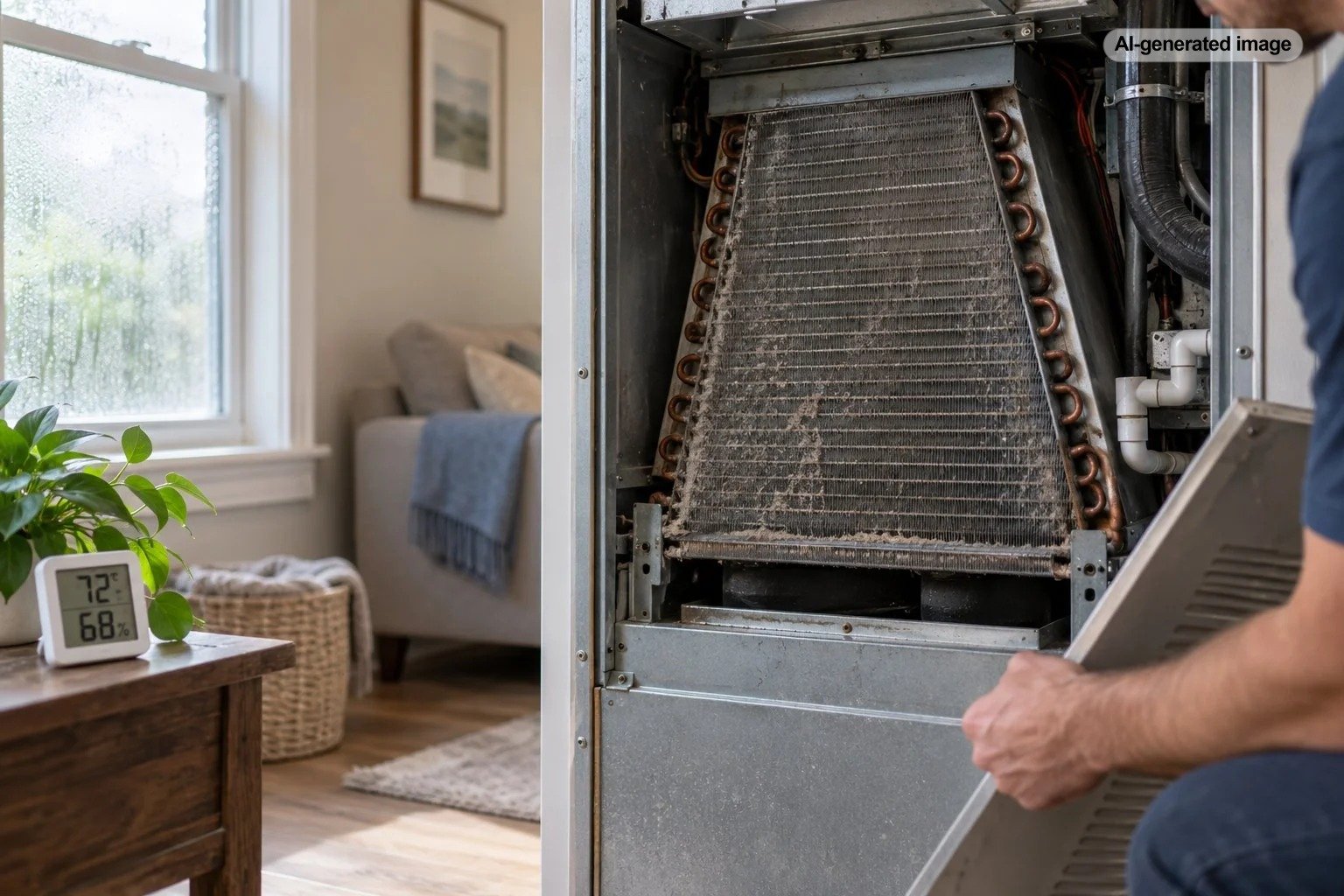
Dirt can disturb that balance in several ways. A coating of dust acts as insulation on the coil fins, while heavier accumulation blocks passages through which air should move. Air may bypass obstructed portions or accelerate through the remaining open areas. The result can be uneven heat transfer and less reliable moisture collection.
Signs the coil may be involved
High humidity alone cannot identify a dirty evaporator coil. A combination of symptoms makes the possibility more credible:
- Supply airflow feels weaker than it normally does.
- The system runs for long periods but struggles to reach the thermostat setting.
- Rooms feel sticky or clammy even while the air is cool.
- Cooling performance has declined gradually rather than suddenly.
- Ice or frost appears on refrigerant tubing or accessible parts of the indoor unit.
- The air handler or nearby ductwork produces unusual musty odors.
- The filter becomes heavily loaded or has been missing, damaged, or installed incorrectly.
A severely restricted coil can become cold enough for condensation on it to freeze. Ice then restricts airflow further, creating a cycle of declining performance. Frost is not proof that dirt is the cause, however; refrigerant and blower problems can also lead to icing and require qualified diagnosis.
Rule out the simpler causes first
Begin with observations that do not require opening refrigerant equipment or reaching into an air handler. This narrows the problem while avoiding damage to delicate coil fins, wiring, and drainage components.
What to do
- Record the humidity. Compare readings over several days and in more than one room instead of relying only on how the air feels.
- Inspect the return-air filter. Replace a dirty disposable filter with the correct size and type specified for the system. Do not operate the equipment without a filter.
- Check accessible registers. Confirm that supply and return openings are not blocked by furniture, rugs, boxes, or closed dampers.
- Observe the cooling cycles. Note whether the system runs steadily, starts and stops every few minutes, or operates nearly continuously without satisfying the thermostat.
- Look for drainage clues. Water around the indoor unit, an overflowing pan, or an activated condensate safety switch deserves prompt attention.
- Consider other moisture sources. Showering, cooking, clothes drying, plumbing leaks, outdoor-air leakage, and open windows can overwhelm normal moisture removal.
Affiliate disclosure: CraneManor.com may earn a commission when you purchase through links on this page. This does not affect the price you pay. Learn more.
A small humidity monitor can make this process less subjective. A compact digital hygrometer can help track room temperature and relative humidity, although it cannot diagnose a dirty coil, detect mold, or determine why humidity is elevated.
Other problems that can mimic a dirty coil
An oversized system: A unit with more cooling capacity than the home needs may reach the thermostat setting quickly and shut off before adequate dehumidification occurs. Cleaning cannot correct equipment sizing.
A dirty filter or blower problem: Either can reduce airflow across an otherwise clean coil. The symptom may resemble coil contamination because the entire air-moving system works as a connected path.
Incorrect fan operation: If the indoor fan runs continuously after the compressor stops, moisture remaining on the coil may evaporate back into the airstream. System design and control settings vary, so an HVAC professional should determine whether fan behavior is contributing to the problem.
Condensate trouble: A blocked line, poorly draining pan, or installation problem can leave water where it should not remain. That does not necessarily raise whole-home humidity by itself, but it signals a moisture-management failure that should be corrected.
Duct or building-envelope leakage: Leaky return ducts in an attic, garage, crawl space, or other humid area can draw moisture-laden air into the system. Gaps around doors, windows, penetrations, and attic access points can also add more outdoor moisture than the air conditioner can comfortably remove.
Refrigerant or control faults: Improper refrigerant charge, sensor trouble, or other mechanical defects can impair cooling and dehumidification. These are not appropriate guess-and-recharge projects; they require trained service and proper diagnostic instruments.
Should you clean the evaporator coil yourself?
Routine homeowner maintenance and internal coil cleaning are not the same task. Replacing an accessible filter, keeping registers clear, and gently removing debris from an outdoor condensing unit according to its manual may be reasonable owner tasks. Accessing an indoor evaporator coil can involve sharp cabinet edges, delicate aluminum fins, electrical components, condensate controls, and restricted service spaces.
Aerosol cleaners are not interchangeable, and residue, overspray, or excessive water can create additional problems. Scrubbing can bend fins and reduce airflow. Do not chip ice from a frozen coil or continue operating a system that repeatedly freezes.
A qualified HVAC technician can inspect both sides of the coil, measure airflow and temperature behavior, examine the blower and filter arrangement, check drainage, and assess refrigerant operation. That broader evaluation matters because cleaning a visibly dirty surface will not solve an oversized system, leaking return duct, failing blower, or persistent source of outdoor moisture.
How to prevent the problem from returning
The best prevention strategy protects the whole airflow path. Use a filter that fits the rack without gaps, install it in the correct direction, and inspect it regularly. Replacement timing depends on filter type, system use, dust conditions, pets, renovations, and manufacturer guidance; a universal calendar interval is less useful than periodic inspection.
Keep return grilles unobstructed and avoid closing multiple supply registers in an attempt to redirect cooling. Restricted airflow can work against system performance. During professional maintenance, ask whether the evaporator coil, blower, drain pan, and condensate line are clean and operating normally rather than requesting coil cleaning as an isolated service.
Humidity records are particularly helpful in warm, humid climates. EPA guidance recommends keeping indoor relative humidity below 60 percent and ideally in the 30 to 50 percent range when possible. A persistent reading above that range is a reason to investigate moisture sources and HVAC performance, not automatic proof of mold or coil contamination.
Frequently asked questions
Will cleaning a dirty coil immediately lower humidity?
It may improve moisture removal if coil contamination was restricting airflow or heat transfer, but the result depends on the rest of the system. Humidity may remain high if the equipment short-cycles, ducts leak, drainage is impaired, or outdoor moisture continues entering the home.
Can a dirty evaporator coil make the house smell musty?
Moisture and debris in HVAC equipment can contribute to odors, but a musty smell does not identify one source. Inspect for plumbing leaks, wet building materials, drain problems, and other moisture conditions as well as the cooling system.
Does lowering the thermostat remove more humidity?
Not reliably. A lower setting may increase run time in some situations, but it does not correct contamination, airflow faults, sizing problems, or moisture infiltration. It can also make surfaces colder without resolving the underlying humidity source.
Do I need a whole-home dehumidifier?
Possibly, but only after obvious HVAC and moisture problems are addressed. A dehumidifier can be appropriate when a correctly operating cooling system cannot manage the home’s latent moisture load, especially in a humid climate or during mild weather when little cooling is needed.
The practical conclusion
A dirty evaporator coil can cause or worsen high indoor humidity because it interferes with the airflow and heat-transfer conditions needed for dependable condensation and drainage. Still, it should be treated as one suspect in a connected system. Check the filter, registers, humidity pattern, run time, and visible drainage conditions, then arrange professional evaluation when symptoms persist or warning signs appear.