

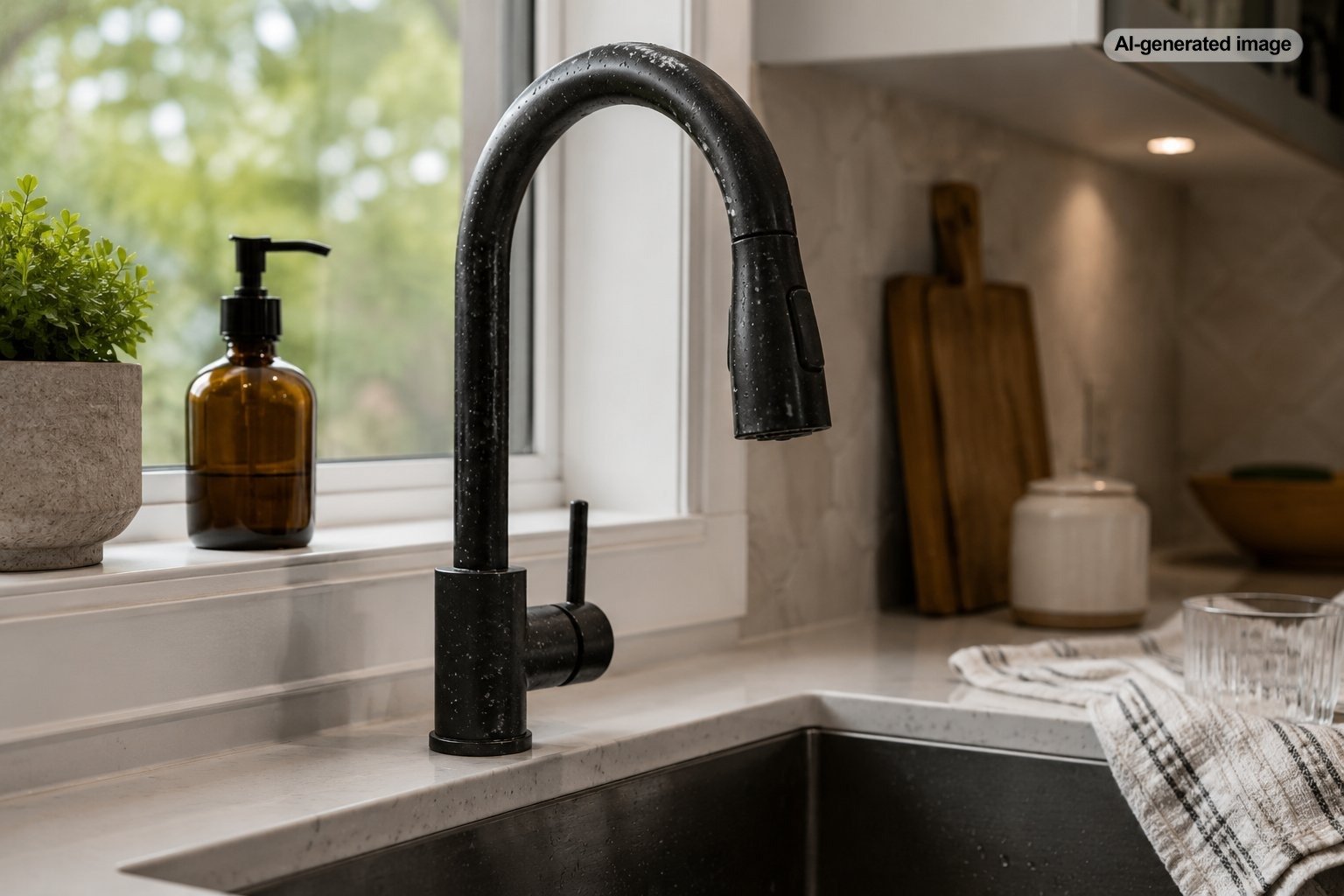
Do Black Kitchen Faucets Show Water Spots?
Yes, black kitchen faucets can show water spots. The amount you notice depends on the faucet’s finish, your water hardness, the shape of the fixture, and how often droplets are allowed to dry on it.
Matte black usually disguises fingerprints and light smudges better than polished metal, but pale mineral residue can contrast sharply against a dark surface. In a home with hard water, a black faucet may therefore look clean during daily use yet develop visible white or gray speckles around the spout, handle, aerator, and base.
Why water spots appear on black faucets
Water spots are usually not damage to the black color itself. They are deposits left behind after water evaporates. Dissolved minerals remain on the surface, producing pale dots, rings, or a slightly chalky film.
The effect is often most obvious near the aerator, where splashing is frequent, and along horizontal surfaces where water can sit. Faucets with flat-topped spouts, squared handles, or broad bases may collect more droplets than smoothly rounded designs.
Kitchen activity also matters. Wet hands, rinsed produce, a pull-down sprayer, and water bouncing from dishes can cover the faucet several times a day. Soap residue, grease, and fine food splatter may combine with mineral deposits, making ordinary water spots look heavier than they are.
Does matte black hide spots better than other finishes?
Matte black often hides fingerprints better than polished chrome, but it does not make dried minerals invisible. In fact, the visual contrast between a deep black surface and white mineral residue can make neglected buildup easy to see.
| Finish | What it tends to reveal | Typical upkeep impression |
|---|---|---|
| Matte black | Pale mineral spots and soap film | Usually forgiving of fingerprints but benefits from drying |
| Glossy black | Water spots, fingerprints, and fine smears | More reflective and often more visually demanding |
| Polished chrome | Fingerprints, streaks, and dried droplets | Easy to polish but quick to show handling |
| Brushed metal | Heavy buildup more than individual marks | Often the most forgiving for busy kitchens |
Not all black finishes are made in the same way. The visible coating may be applied through different manufacturing processes, and approved cleaning methods can vary. A cleaner that is harmless on one faucet may dull, discolor, or weaken another faucet’s finish. The care instructions supplied with the exact model should take priority over generic cleaning advice.
How to keep a black faucet from looking spotted
Prevention is easier than removing a hardened crust. You do not need to polish the faucet after every glass of water, but removing obvious droplets at the end of a sink session can make a noticeable difference.
What to do
- Keep a soft microfiber cloth nearby. Wipe the faucet when you finish washing dishes or cleaning the sink.
- Use mild soap for routine cleaning. A small amount of gentle dish soap diluted in warm water is often enough for fingerprints, grease, and light residue.
- Rinse away the soap. Use a separate damp cloth so detergent does not dry into a hazy film.
- Dry the entire fixture. Pay attention to the aerator, handle joints, sprayer connection, and base.
- Check the manufacturer’s care guide. Confirm which cleaners and tools are approved before treating stubborn mineral deposits.
Avoid rough scrubbers, abrasive powders, stiff brushes, and scouring pads. Even when they remove a spot, they may change the sheen or create fine scratches that become more noticeable under kitchen lighting.
Acidic cleaners, including vinegar-based mixtures, are frequently suggested for mineral deposits. However, acids are not appropriate for every coated or matte fixture. Do not soak a black faucet in vinegar or apply a strong descaling product unless the faucet manufacturer specifically allows it. Also prevent cleaner from pooling around seams, handles, and the base.
What to do about stubborn white buildup
Begin with the gentlest method. Hold a cloth dampened with warm water against the deposit briefly, then wipe without aggressive pressure. Follow with mild soap if grease or kitchen residue is present. Rinse and dry the surface completely.
If the spot remains, identify the faucet brand and model before escalating. Look for the official care instructions or contact the manufacturer. This is particularly important when the finish is under warranty or when the faucet has a specialty coating.
The removable aerator may need separate attention if mineral buildup is affecting the water stream. Follow the faucet manual for removal, cleaning, and reinstallation because aerator construction differs by model. Protect the finish from metal tools if a wrench is required.
Are black faucets a poor choice for hard-water homes?
Not necessarily. A black faucet can still be a practical choice when its appearance suits the kitchen and the household is comfortable with occasional wiping. The tradeoff is that pale deposits may be more noticeable than they would be on a softly brushed metal finish.
People who dislike visible marks and rarely wipe fixtures may be happier with brushed nickel, stainless-look, or another low-contrast finish. A household that already dries the sink and counters each evening may find matte black no more troublesome than other finishes.
Advantages
- Creates strong contrast against pale counters and backsplashes
- Usually disguises fingerprints better than glossy finishes
- Coordinates easily with black lighting, hardware, and appliances
- Can define the sink area without adding visual clutter
Tradeoffs
- White mineral residue can be conspicuous
- Cleaning products must be chosen carefully
- Scratches or chips may be visually obvious
- Flat surfaces can collect droplets
How to choose a lower-maintenance black faucet
Look beyond the color sample. A simpler silhouette with fewer ledges and crevices will generally be easier to wipe than a highly angular faucet with multiple joints. Rounded transitions, an accessible base, and a sprayer that docks neatly can reduce the places where water and residue collect.
Review the manufacturer’s written care instructions before purchasing. If the guidance is difficult to locate or requires an unusually narrow cleaning routine, consider whether that fits your household. It is also sensible to ask how the black finish is applied and what the warranty says about finish defects, without assuming that ordinary wear or cleaning damage will be covered.
Before you decide
- Consider whether your home has noticeable hard-water residue
- Compare matte and glossy samples in realistic lighting
- Choose a shape without unnecessary horizontal ledges
- Read the official cleaning instructions
- Decide whether you are willing to wipe the fixture regularly
- Check how easily replacement aerators and sprayer parts can be obtained
Frequently asked questions
Do black faucets show fingerprints?
Matte black generally hides fingerprints better than glossy black or polished chrome. Skin oils can still leave smudges, especially on handles that are touched repeatedly.
Can water spots permanently damage a black faucet?
Fresh spots are usually removable residue. Long-neglected mineral deposits may become harder to remove, and harsh cleaning attempts can damage the finish. Gentle, frequent care is safer than occasional aggressive scrubbing.
Can I use a magic eraser on a matte black faucet?
Do not assume it is safe. Melamine foam is mildly abrasive and may alter the sheen of a coated finish. Use it only when the faucet manufacturer explicitly approves it.
Should I choose black or brushed nickel for an active family kitchen?
Brushed nickel or a stainless-look finish is often more forgiving when the sink receives heavy use and no one routinely dries the faucet. Matte black may be the better design choice when contrast matters and light maintenance is acceptable.
What is the easiest daily routine?
Wipe away visible splashes with a clean microfiber cloth, especially around the aerator and base. That small step prevents much of the buildup that makes black fixtures look difficult to maintain.
Black kitchen faucets do show water spots, but the issue is manageable. Choose a well-designed fixture, follow its specific care instructions, and dry obvious splashes before they become mineral deposits. The finish will ask for a little attention, not a second job.