
How Do You Arrange Furniture When the TV Is Not Centered?
You do not need to center every piece of furniture directly in front of an off-center TV. Instead, arrange the room around a comfortable viewing zone, then use furniture, artwork, lighting, or shelving to make the television feel visually connected to the rest of the wall.
The most successful layouts usually treat the TV as one part of a larger composition rather than demanding perfect symmetry. Your sofa can face the general viewing area, chairs can turn slightly inward, and the surrounding decor can restore balance without requiring construction or a complete room redesign.
Begin With the Best Viewing Position
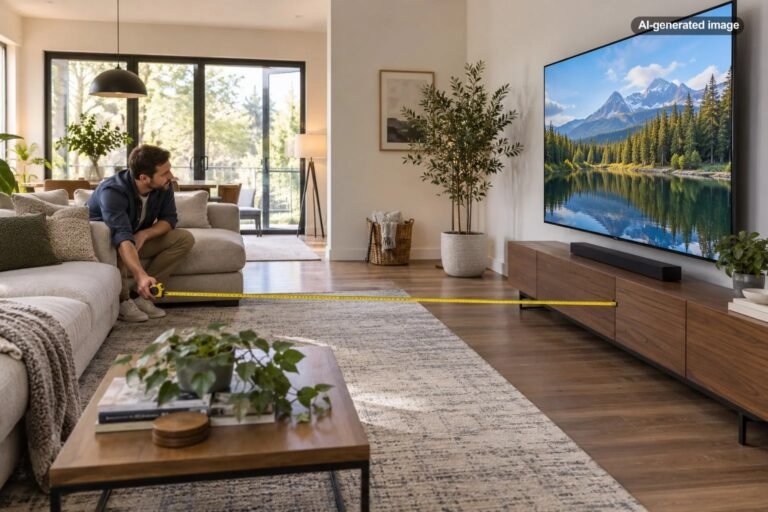
Before moving every chair in the room, identify where people actually watch television. The primary seat should have a reasonably direct view of the screen without requiring someone to keep their head sharply turned. A slight angle is usually comfortable; a dramatic sideways view is not.
Position the sofa so its center aligns with the main viewing zone rather than automatically aligning it with the center of the room. In some spaces, that means shifting the sofa several inches toward the TV. In others, it means angling the sofa slightly or using a sectional whose longer side faces the screen.
Keep normal walking routes in mind as you adjust the placement. A layout that creates a perfect TV view but blocks the path to a doorway, kitchen, patio, or hallway will feel awkward in daily use. Leave enough open floor space for people to pass without squeezing between the coffee table and seating.
Create a Seating Group, Not a Row
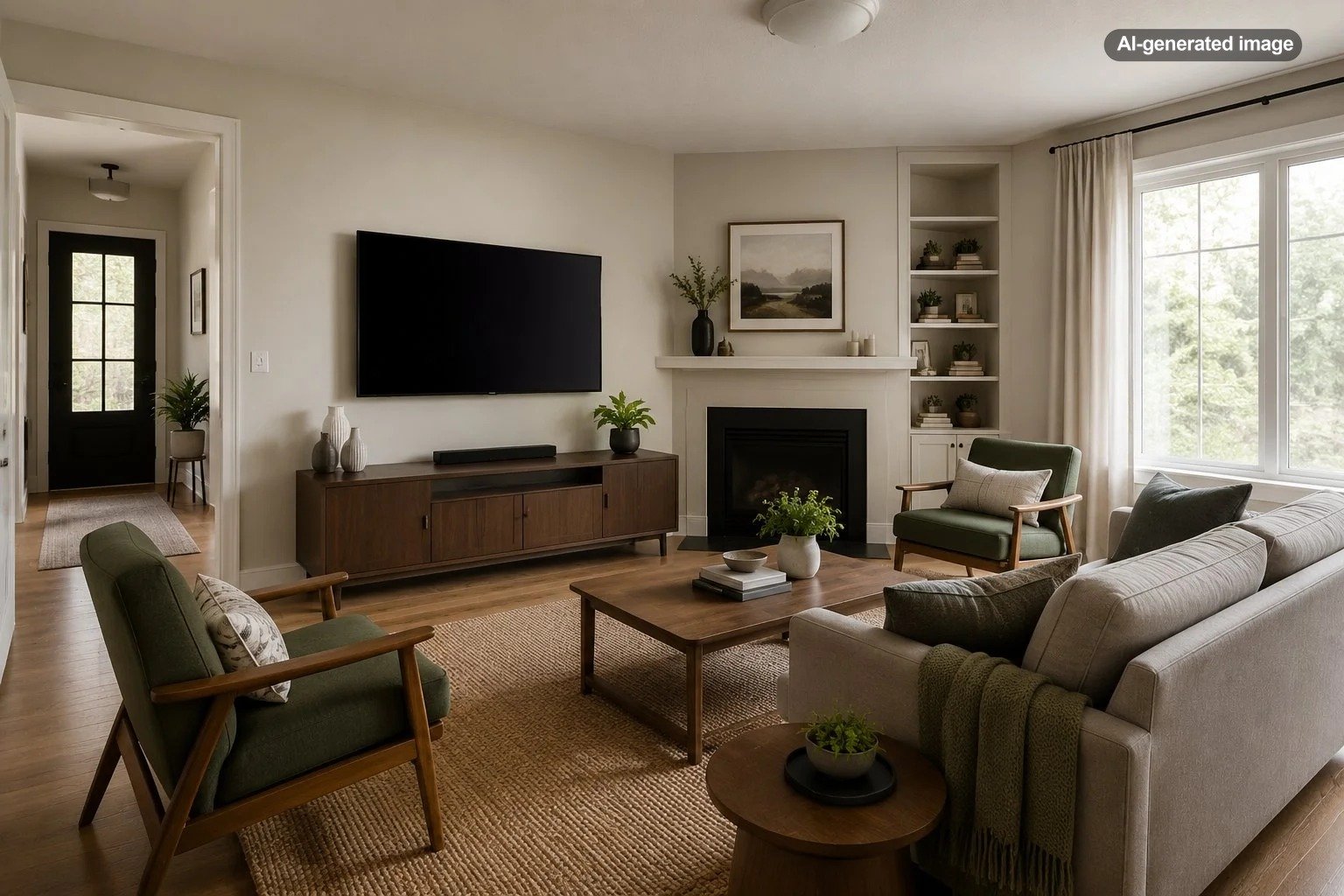
An off-center television becomes more noticeable when every seat is lined up rigidly against one wall. A more flexible seating group can make the room feel intentional. Place the sofa in the strongest viewing position, then add one or two chairs at a gentle angle toward both the sofa and the TV.
This arrangement supports conversation while allowing each seat to see the screen. Swivel chairs are especially practical in multipurpose rooms because they can face the sofa during conversation and turn toward the television when needed. A small ottoman can provide extra seating without making the arrangement feel permanently fixed.
Balance the Wall Around the Television
If the TV looks stranded on one side of the wall, add visual weight nearby. A low media console that extends beyond the television can help connect the screen to the broader wall. The console does not always need to be centered beneath the TV; it can be positioned to support the complete composition.
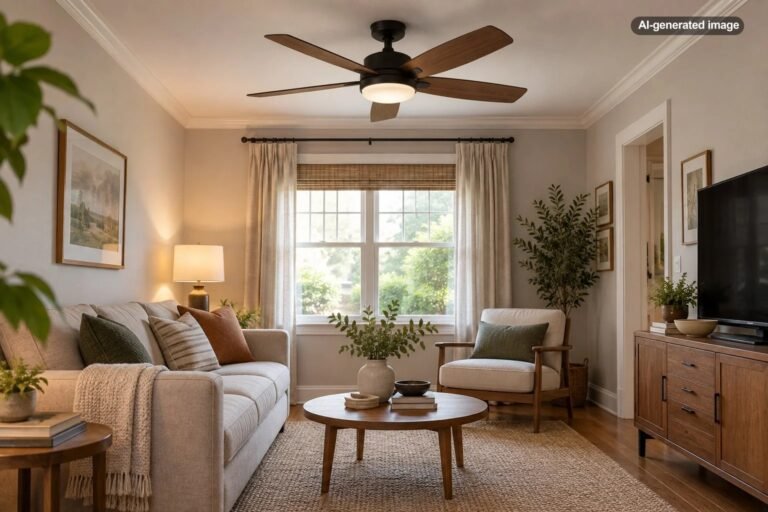
Artwork, framed photographs, shelves, a tall plant, or a floor lamp can fill the visually empty side. Choose elements with enough scale to matter. One tiny frame placed several feet from a large television will rarely create balance, while a coordinated group of two or three pieces can make the asymmetry look deliberate.
Try to avoid surrounding the television with so many objects that the wall becomes distracting. The goal is not perfect mirror-image symmetry. It is visual balance, which can be achieved with different objects that carry similar visual weight.
A balanced room does not require matching sides; it requires each side to feel intentionally considered.
Use the Rug and Coffee Table as the Center
The television does not have to determine the visual center of the entire room. In many living rooms, the area rug and coffee table form the true center of the seating arrangement. Align the rug with the sofa and chairs, then let the TV sit slightly outside that central axis.
Ideally, the front legs of the sofa and major chairs should rest on the rug, or the rug should be large enough to contain the entire seating group. This creates a clear zone and prevents the furniture from appearing scattered. The coffee table can then sit in the middle of that zone, reinforcing the relationship between the seats rather than highlighting the TV’s unusual position.
In a small room, a round or oval coffee table can be helpful because it softens an angled layout and allows easier movement. In a larger room, a rectangular table may provide stronger structure, especially when paired with a long sofa.
Choose Between a Straight and Angled Sofa
| Layout | Best for | Main tradeoff |
|---|---|---|
| Sofa kept straight | Formal rooms, narrow spaces, and layouts with strong architectural lines | Some seats may have a less direct view |
| Sofa shifted sideways | Rooms with enough clearance near walls and walkways | The room may feel uneven unless other furniture restores balance |
| Sofa placed at an angle | Open plans, flexible rooms, and conversational seating groups | It can consume more floor space |
| Sectional facing the TV zone | Family rooms and households needing generous seating | A large sectional can limit future layout changes |
Keeping the sofa straight is often the simplest choice. You can compensate for the TV’s position by shifting the sofa slightly, turning nearby chairs, or using a swivel mount where appropriate. Angling the sofa works best when the room has enough space behind it and the angle relates to another feature, such as a fireplace or open doorway.
Avoid placing the sofa diagonally simply because the TV is off-center. An angle should improve viewing, circulation, or conversation. If it creates an unusable triangular gap or makes the room feel cramped, a straight layout with flexible chairs will usually be more successful.
Work With Fireplaces, Windows, and Doorways
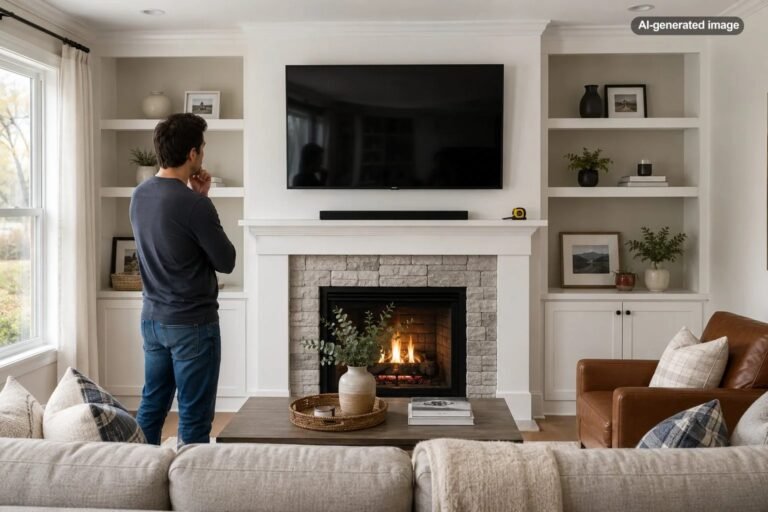
Televisions are often off-center because the room includes a fireplace, window, built-in cabinet, or doorway. Rather than fighting that architecture, decide which feature deserves to lead the room. A fireplace may remain the visual focal point while the television serves as a secondary focal point for everyday use.
When a fireplace and TV share a wall, distribute the seating so both can be enjoyed. The sofa might face the space between them, while chairs angle toward the fireplace. When windows limit wall space, keep tall furniture away from the glass and use lower pieces to maintain natural light.
Doorways and major traffic paths should remain clear. A chair placed in the perfect visual spot is not useful if everyone must walk around it. Test the route through the room after each major furniture move rather than waiting until the entire arrangement is complete.
Correct Common Layout Mistakes
One common mistake is pushing every piece of furniture against the walls. This can leave a large empty area in the middle while making the viewing distance unnecessarily long. Pulling the sofa forward, even modestly, can improve both comfort and room definition.
Another mistake is centering the sofa on the TV while ignoring the rest of the room. This may leave a chair, window, or fireplace disconnected from the arrangement. Evaluate the full seating group from the doorway and from the most frequently used entry point.
Also avoid using decor to disguise a layout that is physically uncomfortable. Artwork can balance the wall, but it cannot fix a blocked walkway or a seat that requires constant neck turning. Solve function first, then refine the visual composition.
Before you decide
- Confirm that the main seats have comfortable views of the screen.
- Preserve clear paths to doors and adjoining rooms.
- Use the rug to define the seating group.
- Add visual weight to the emptier side of the TV wall.
- Check that chairs support both conversation and viewing.
- Make sure the room still works when the television is off.
Frequently Asked Questions
Should the sofa be centered with the TV?
Not necessarily. The sofa should provide a comfortable view, but it may be shifted, angled slightly, or centered on the seating area instead of the television.
Can a TV be off-center above a media console?
Yes. An asymmetrical arrangement can look intentional when the remaining console space holds balanced decor, shelving, lighting, or another substantial visual element.
How much should chairs angle toward the TV?
Use the smallest angle that provides a comfortable view while preserving conversation. Chairs do not need to face the screen directly, especially if they swivel or can be moved easily.
What if the TV is beside a fireplace?
Treat the fireplace and television as related focal points. Aim the main seating toward the zone between them and use angled chairs to connect both sides of the room.
How do you make an off-center layout look intentional?
Repeat visual weight across the room with a substantial console, artwork, lighting, plants, or shelving. Keep the seating grouped around a rug and maintain clear, deliberate spacing between pieces.
An off-center TV is a layout constraint, not a design failure. Once comfortable viewing and circulation are settled, a thoughtful mix of asymmetry, balanced decor, and flexible seating can make the entire room feel composed.