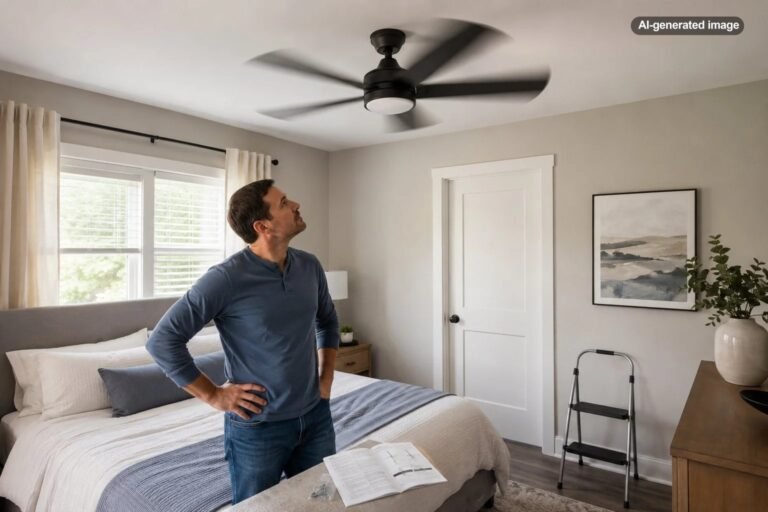
What Size Ceiling Fan Is Best for a Small Living Room?
For most small living rooms, a ceiling fan with a 36- to 42-inch blade span is a sensible starting point. The room’s actual square footage matters more than the label “small,” though: a compact 70-square-foot sitting room and a 140-square-foot living room may need noticeably different fan sizes.
ENERGY STAR’s current sizing guidance suggests a 29- to 36-inch fan for rooms up to 75 square feet and a 36- to 42-inch fan for rooms from 76 to 144 square feet. Once the room moves beyond that range, a slightly larger fan may make more sense. The goal is not simply to fit the biggest fan between the walls, but to choose a blade span that looks proportional and can circulate air effectively without crowding the ceiling.
Start with the room’s square footage
Measure the length and width of the living room and multiply those numbers to find the square footage. A 10-by-11-foot living room, for example, is 110 square feet. A 9-by-8-foot sitting room is only 72 square feet, even though both spaces might casually be described as small.
ENERGY STAR publishes the following general blade-span guidance:
| Room area | Suggested blade span | How it fits a small living room |
|---|---|---|
| Up to 75 sq. ft. | 29-36 in. | Useful for very compact sitting areas and small rooms |
| 76-144 sq. ft. | 36-42 in. | The most relevant range for many small living rooms |
| 144-225 sq. ft. | About 44 in. | Better for a room that is edging into medium-size territory |
| 225-400 sq. ft. | 50-54 in. | Generally beyond what most people mean by a small living room |
These are useful guidelines rather than a substitute for checking the instructions and dimensions of the particular fan you intend to install. Fan designs differ, and blade span is only one part of how a fan moves air.
Why a 42-inch fan is often the sweet spot
A 42-inch fan sits near the upper end of ENERGY STAR’s suggested range for rooms between 76 and 144 square feet. That makes it particularly practical for familiar small-living-room dimensions such as 10 by 10 feet, 10 by 12 feet, or 12 by 12 feet.
Visually, this size can also strike a useful balance. A much smaller fan may look underscaled over a normal sofa-and-coffee-table arrangement, while a substantially larger fan can dominate a compact ceiling and reduce the breathing room around the blade tips.
The best ceiling fan size is large enough to serve the occupied area without making the ceiling feel crowded.
That distinction matters in an open-plan home. A small living-room seating zone might be part of a much larger combined living and dining space. In that situation, sizing only from the sofa grouping may not produce the airflow you expect throughout the entire open area. Consider the space the fan is actually expected to serve.
Do not ignore the distance from the walls
A fan can be technically appropriate for the room’s square footage and still be a poor fit if its blades come too close to surrounding walls. ENERGY STAR advises installing ceiling fans at least 18 inches from walls. It also recommends mounting the fan in the middle of the room when practical.
This is one reason an oversized fan is not automatically better in a narrow living room. Imagine a room that is long but only 8 feet wide. A very broad blade span can consume much of the available ceiling width even when the total square footage looks adequate on paper.
Ceiling height changes the mounting decision
Blade span answers only half the sizing question. You also need to consider how far the fan will hang from the ceiling. ENERGY STAR says ceiling fans should be mounted so the blades are at least 7 feet above the floor, with 8 to 9 feet cited as a desirable installation height when the ceiling allows it.
In a small living room with an 8-foot ceiling, a low-profile or appropriately configured fan may preserve headroom better than a long downrod. A room with a taller ceiling may need a downrod to position the fan at a useful height rather than leaving the blades unnecessarily high above the occupied area.
Always follow the installation requirements supplied with the specific fan. If the existing ceiling location, electrical box, wiring, or mounting support is questionable, have the installation evaluated by a qualified professional rather than assuming an old light fixture location is automatically suitable for a ceiling fan.
Think about furniture placement as well as room dimensions
Living rooms are rarely empty rectangles. A ceiling fan usually makes the most sense when it relates to the part of the room where people spend time. In a conventional arrangement, that may mean centering it over or near the primary seating zone rather than aligning it with an architectural midpoint that leaves the fan visually disconnected from the furniture.
Likewise, avoid choosing a tiny fan purely because the furnishings are delicate or minimal. Proportion matters, but the fan still has a job to do. If the blade span is dramatically undersized for the room, the result can look timid and may not provide the circulation you expected.
Fan diameter is not the same thing as airflow
Two fans with the same blade span can perform differently. Motor design, blade shape, blade pitch, speed settings, and the fan’s overall engineering all affect how much air it can move. This is why blade diameter should be treated as a first-pass sizing tool rather than the only specification worth considering.
When comparing actual fans, review the manufacturer’s published airflow and efficiency information for the models under consideration. The U.S. Department of Energy regulates energy efficiency standards for covered ceiling fans, while ENERGY STAR provides consumer information and certified-product resources.
A ceiling fan also does not lower the room’s air temperature in the same way an air conditioner does. The Department of Energy explains that fans improve comfort through air movement and a wind-chill effect. That is why it makes sense to turn a fan off when the room is unoccupied rather than leaving it running in hopes of cooling the furniture.
Common sizing mistakes to avoid
- Buying from appearance alone: A dramatic oversized fan may look appealing online but feel cumbersome once placed in a compact room.
- Calling every small room a 36-inch-fan room: A 135-square-foot living room has different proportions from a 65-square-foot sitting room.
- Ignoring wall clearance: A blade span that works by square footage may still be too broad for a narrow room.
- Forgetting ceiling height: Blade diameter does not tell you whether a standard mount, low-profile configuration, or downrod is appropriate.
- Assuming larger always moves air better: Actual airflow depends on the complete fan design, not diameter alone.
- Centering on the floor plan rather than the occupied area: Furniture arrangement can influence where the fan is most useful and visually coherent.
Before you decide
- Measure the room’s length and width.
- Calculate the square footage.
- Check the distance from the proposed fan center to surrounding walls and architectural obstacles.
- Measure ceiling height and consider the required mounting method.
- Compare the manufacturer’s airflow information rather than relying on blade span alone.
- Confirm that the mounting location and electrical support are appropriate for the specific fan.
So what size should you choose?
If your living room is genuinely small, start by comparing its measurements with the 36- to 42-inch range. A room under 75 square feet may be better suited to a 29- to 36-inch fan, while many rooms from 76 to 144 square feet fall naturally into the 36- to 42-inch range. If you are around or above 144 square feet, looking at approximately 44 inches is reasonable.
From there, refine the choice using ceiling height, wall clearance, furniture placement, and the performance information for the actual fan. That produces a better result than choosing by diameter alone – and usually a more convincing visual fit for the room.
Frequently asked questions
Is a 52-inch ceiling fan too big for a small living room?
Often, yes. ENERGY STAR’s published sizing guidance places 50- to 54-inch fans in the 225- to 400-square-foot room range. A 52-inch fan can therefore look and feel oversized in a genuinely small living room, especially if wall clearance is tight.
Is a 42-inch ceiling fan enough for a living room?
It can be. ENERGY STAR suggests 36- to 42-inch fans for rooms from 76 to 144 square feet, which includes many compact living rooms. Check the fan’s actual airflow information as well as the blade span.
What if my living room is exactly 144 square feet?
A 42-inch fan is a reasonable size to consider, but you are also near the transition to the next size range. Room shape, ceiling height, clearances, and the particular fan’s performance can help break the tie.
Should a ceiling fan be centered over the room or the sofa?
ENERGY STAR generally recommends centering a fan in the room, but real living-room layouts sometimes make the primary occupied zone an important design consideration. Maintain proper clearances and follow the manufacturer’s installation requirements when deciding on placement.