
Are Custom Closets Worth the Investment?
Custom closets can be worth the investment, but their value rarely comes from shelves alone. The strongest return is usually a combination of better storage, easier daily routines, a cleaner-looking room, and a layout that uses awkward space more intelligently.
They tend to make the most sense for homeowners who have a persistent storage problem, plan to remain in the home for several years, and want a system designed around what they actually own. A custom installation is less compelling when the closet is standard-sized, the household may move soon, or a well-planned modular system can meet the same needs for considerably less commitment.
What You Are Really Paying For
A custom closet is not simply a collection of rods, drawers, and shelves. You are paying for a system designed around the dimensions of the room, the size of your wardrobe, your preferred way of organizing, and any architectural quirks that complicate the space.
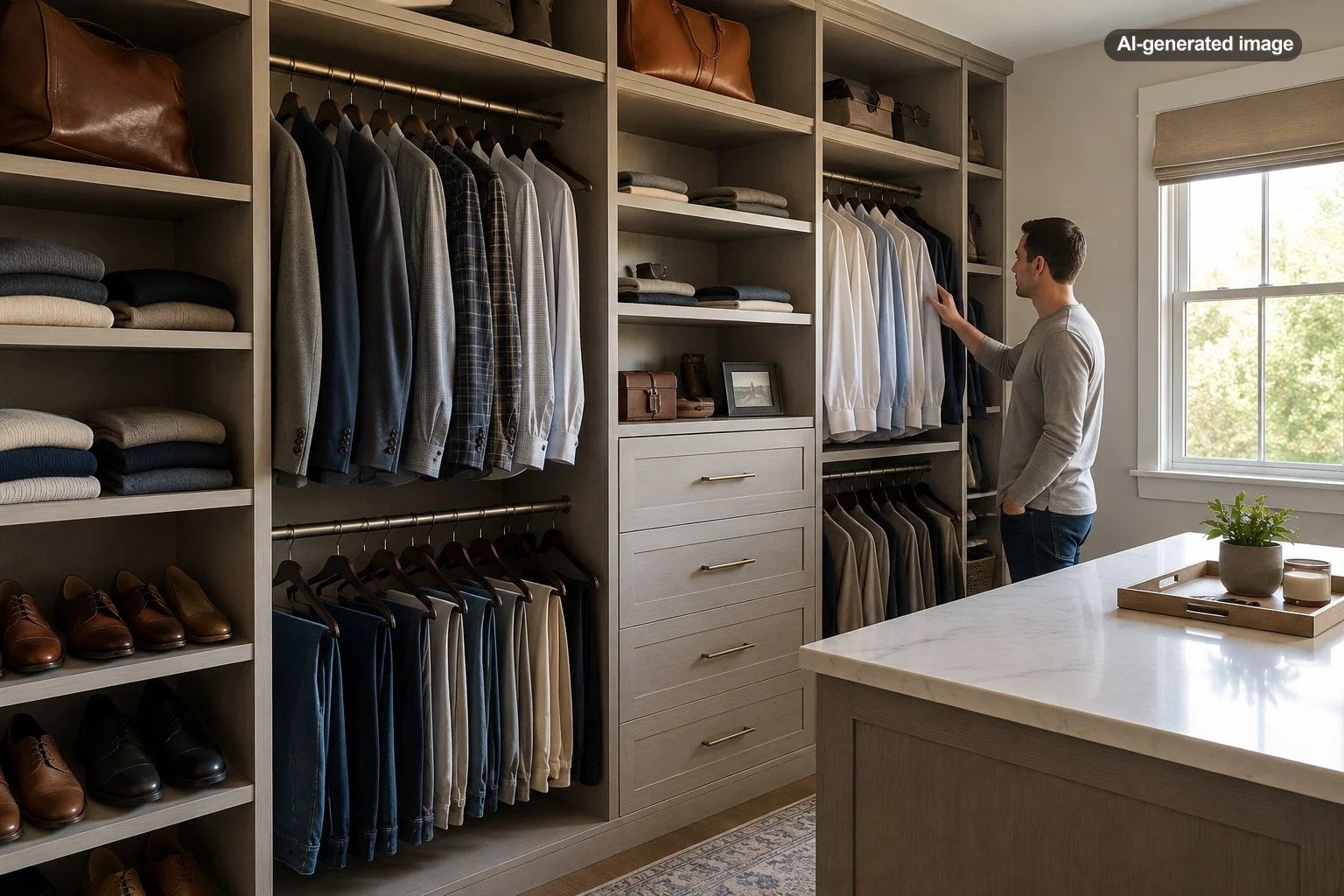
In a professionally planned closet, hanging sections can be positioned for the garments you own, shelves can be spaced for particular items, and corners can be handled intentionally rather than abandoned. Drawers, hampers, shoe storage, accessory trays, and adjustable components may also be integrated into one coherent layout.
That tailored fit matters most in closets with sloped ceilings, narrow returns, unusual wall lengths, deep corners, soffits, or doors that interfere with standard components. A simple rectangular reach-in closet is much easier to organize with modular pieces than a walk-in closet with several competing obstacles.
The best custom closet is not the one with the most features; it is the one that removes the most friction from an ordinary morning.
The Daily Value Can Be More Important Than Resale
Home improvements are often judged by what they may contribute at resale, but a closet is used too frequently to evaluate only as a future selling feature. A practical system can reduce searching, prevent folded items from collapsing into piles, make seasonal rotation simpler, and give frequently worn clothing a logical home.
The benefit is especially noticeable when two people share a closet, work wardrobes must remain organized, or the existing setup consists of one rod and one high shelf. Dividing the space according to actual needs can make a modest closet function better without increasing its footprint.
There is also a visual benefit. When storage categories have defined locations, fewer items migrate onto chairs, dressers, floors, and spare beds. That can make the bedroom feel calmer even when the closet doors are closed.
Custom Closets Versus Modular Systems
The choice is not always between a bare closet and an elaborate built-in. Modular systems now offer adjustable shelves, drawer units, hanging sections, baskets, and accessories in many sizes. For a standard closet, they can deliver excellent organization without the permanence or expense of a fully tailored installation.
| Consideration | Custom closet | Modular system |
|---|---|---|
| Fit | Designed for exact dimensions and obstacles | Uses standard component sizes |
| Appearance | Can resemble integrated cabinetry | Usually looks more like an added storage system |
| Flexibility | May include adjustable parts, but remains with the home | Often easier to reconfigure, relocate, or expand |
| Installation | Commonly measured, designed, and installed professionally | Often suitable for DIY installation |
| Best fit | Complex spaces and long-term homeowners | Standard closets, renters, and tighter budgets |
A modular system is often the more rational choice for a rental, a temporary home, a child’s rapidly changing wardrobe, or a secondary closet that does not need a built-in finish. Custom work earns its premium when standard components leave substantial gaps, waste corners, or fail to support the way the closet is used.
When a Custom Closet Is Most Likely to Be Worthwhile
The investment becomes easier to justify when several of the following conditions apply:
- The existing closet wastes a meaningful amount of vertical or corner space.
- The room has unusual dimensions that standard components cannot fit cleanly.
- Two people need clearly separated storage zones.
- Your wardrobe includes long garments, workwear, shoes, bags, or accessories that need dedicated storage.
- You expect to remain in the home long enough to enjoy the improvement.
- The bedroom lacks enough freestanding furniture for folded clothing.
- You value an integrated, cabinetry-like appearance.
Custom storage can also be useful in a small bedroom because built-in drawers may reduce the need for a large dresser. However, the closet should not be packed with so much cabinetry that hanging space becomes cramped or the walkway feels narrow.
When It May Not Be the Best Use of Your Budget
A custom closet may be unnecessary when the real problem is simply owning more than the available space can reasonably hold. New cabinetry can organize a wardrobe, but it cannot make unlimited belongings fit comfortably. Editing what is stored should come before designing compartments for it.
It may also be difficult to justify a permanent installation when you expect to move soon. A future buyer might appreciate organized storage, but personal enjoyment and improved function are more dependable reasons to proceed than an assumed resale payoff.
Highly specialized layouts deserve caution as well. Dozens of narrow shoe cubbies may be perfect for one household and frustrating for the next. Fixed compartments designed around a particular collection can become unusable when habits change.
Features That Improve Function Instead of Inflating the Project
Start with the essentials: appropriate hanging heights, enough shelf depth, sensible drawer placement, and clear access to everyday items. Decorative finishes and specialized accessories should come later.
Double hanging sections
Two vertically stacked rods can significantly improve capacity for shirts, jackets, folded trousers, and other shorter garments. At least one full-height section should remain available when the wardrobe includes dresses, long coats, or jumpsuits.
Adjustable shelving
Fixed shelves can look polished, but adjustable shelves are easier to adapt. They can accommodate changing stacks of sweaters, handbags, storage boxes, or shoes without leaving excessive empty space between categories.
Drawers at a comfortable height
Built-in drawers can replace or supplement a dresser, but their placement matters. Drawers should open without striking doors, islands, walls, or other drawers. Frequently used drawers are generally easier to manage when they do not require deep bending.
Storage that matches real inventory
A design should be based on a rough count of hanging garments, shoes, folded items, bags, and accessories. Estimating from memory often leads to too many display shelves and too little practical capacity.
Lighting and visibility
Good lighting makes colors, labels, and small items easier to see. Electrical work, new fixtures, or changes within a closet should be planned with appropriate professional guidance and local requirements in mind rather than improvised after cabinetry is installed.
How to Evaluate a Closet Proposal
Before you decide
- Measure the clothing and objects you actually need to store.
- Confirm which shelves and rods are adjustable.
- Check door swings, drawer clearances, outlets, vents, and access panels.
- Ask what materials, hardware, installation, trim, and removal work are included.
- Compare at least one simpler layout with the feature-heavy proposal.
- Consider whether the design would still function if your wardrobe changed.
- Review how the system will be cleaned, repaired, or modified later.
A useful design consultation should involve more than selecting finishes from samples. The designer should ask how the closet is used, which items are difficult to store, whether clothing is folded or hung, and which categories need the easiest access.
Pay particular attention to corners. A corner feature can appear impressive in a rendering while creating shelves that are too deep, narrow, or obstructed to use comfortably. Sometimes the best design intentionally leaves a small area open rather than filling every inch with cabinetry.
Will a Custom Closet Add Home Value?
A well-executed closet may make a bedroom feel more complete and can be an appealing feature for future buyers. However, resale value varies with the home, neighborhood, quality of the work, and expectations of the local market. It should not be treated as a guaranteed reimbursement for the project.
Neutral finishes, durable hardware, flexible components, and layouts that serve common wardrobe needs are generally less likely to feel overly personal. A system that is poorly installed, visually dated, or awkwardly specialized may provide less buyer appeal than a clean, adaptable design.
The most reliable return is the usefulness you receive while living in the home. If the closet saves time, reduces furniture needs, improves access, and keeps the bedroom more orderly for years, that practical value can be substantial even if the full cost is not reflected in a future sale.
The Bottom Line
Custom closets are worth the investment when customization solves a real storage limitation and the result will be used for a meaningful period of time. They are particularly effective in unusual spaces, shared closets, and rooms where integrated drawers or precise dimensions can replace less efficient furniture.
They are not automatically the best option. A thoughtful modular layout may provide nearly the same function in a standard closet, while decluttering and adding a second rod may solve a simpler problem. The right decision is the least complicated system that stores your belongings comfortably, remains adaptable, and makes daily life noticeably easier.
Frequently Asked Questions
Should I declutter before meeting with a closet designer?
Yes. You do not need to create a perfect capsule wardrobe, but removing items you no longer use produces a more accurate picture of the storage capacity you need.
Are custom closets only worthwhile in large walk-in closets?
No. A carefully planned reach-in closet can benefit greatly from double hanging sections, drawers, and adjustable shelves. The smaller the space, however, the more important it is to compare custom work with a simpler modular solution.
Should every section be built for a specific item?
No. Some dedicated storage is helpful, but too many fixed compartments can make the closet difficult to adapt. A mix of specialized and adjustable storage is usually more practical.
Can a custom closet replace a bedroom dresser?
It can when the design includes enough accessible drawer space for folded clothing. Confirm that adding drawers will not sacrifice hanging capacity you still need.