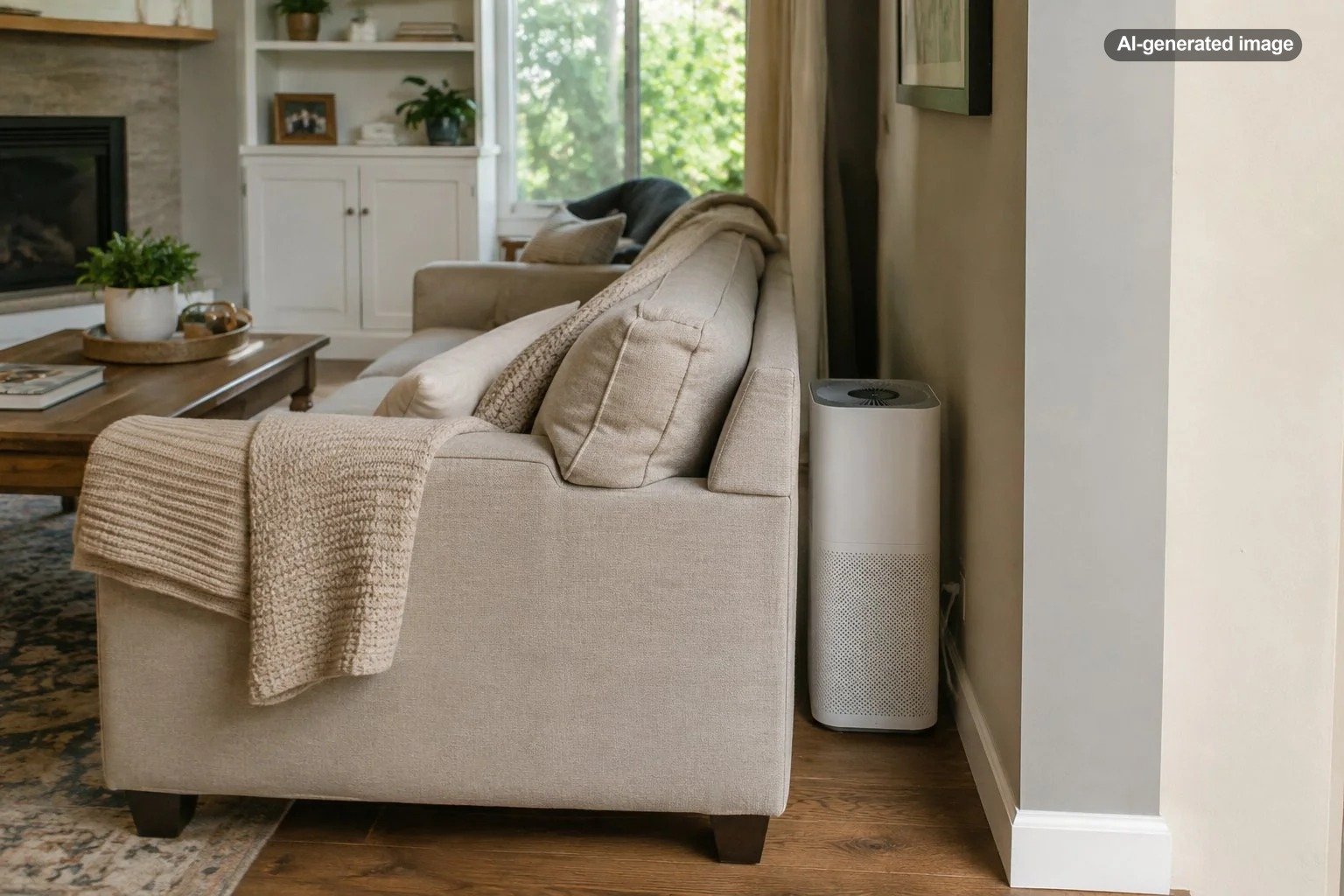
Can You Put an Air Purifier Behind a Sofa?
Yes, you can put an air purifier behind a sofa, but only when the furniture does not block the machine’s air intake or clean-air outlet. A purifier wedged tightly between a sofa and a wall may still turn on, make reassuring fan noises, and illuminate its display, yet circulate far less room air than intended.
The practical question is not whether the purifier is technically behind the sofa. It is whether air can move freely into the unit, through its filters, and back into the occupied part of the room.
Why a sofa can reduce purifier performance
Portable air purifiers rely on a fan to draw surrounding room air through one or more filters. The cleaned air then leaves through an outlet, which may be on the top, front, side, or back depending on the model. Furniture can interfere with either half of that process.
A sofa placed directly against an intake limits the volume of air the purifier can pull in. A sofa back positioned over a top outlet can trap the discharged air in a small gap. In both cases, the machine may repeatedly recirculate air from the hidden space behind the sofa rather than mixing filtered air throughout the living room.
The U.S. Environmental Protection Agency advises keeping portable air cleaners away from curtains and other objects that may block airflow. It also notes that a central position can work well, although an exact center-of-room location is not essential when air can move freely to and from the device.
A discreet purifier is useful only when discreet placement does not quietly defeat its airflow.
Check where your purifier breathes
Before deciding on a location, examine the unit rather than assuming every purifier moves air in the same direction. Some pull air through a broad front panel. Others draw from both sides, the rear, or openings around the entire body. Clean air may leave vertically through the top or horizontally through a front grille.
Consult the owner’s manual for model-specific placement instructions and minimum clearances. Those directions should take priority over a generic rule because the sofa may block one purifier while leaving another perfectly functional.
| Purifier design | Behind-sofa concern | Better placement approach |
|---|---|---|
| Rear intake | A nearby wall or sofa can restrict incoming air. | Leave the rear fully open or turn the intake toward the room. |
| Side intakes | Sofa arms, baskets, and curtains may block one side. | Keep both sides unobstructed. |
| Front intake | The sofa can cover the intake if the unit faces the upholstery. | Face the front toward open floor space. |
| Top outlet | A sofa back, shelf, or drapery can interrupt upward discharge. | Keep the space above the unit clear. |
| All-around intake | A tight furniture gap can obstruct much of the intake area. | Use a more open location with clearance around the body. |
How much space should you leave?
There is no single clearance measurement that applies to every air purifier. Manufacturers design different fan systems, grilles, sensors, and discharge patterns, so follow the distance stated in your manual whenever one is provided.
In the absence of a clearly stated measurement, the purifier should not touch the sofa, wall, curtains, blankets, or decorative objects. There should be a visibly open path around the intake and enough room for discharged air to enter the larger room rather than striking upholstery immediately.
A useful test is to stand where the unit will sit and imagine the airflow as a loop. Can room air reach the intake from more than one direction? Can the outlet send cleaned air beyond the furniture pocket? Can you reach the controls and remove the filters without dragging the sofa across the floor? If not, the placement is probably too cramped.
When behind the sofa is a reasonable choice
This arrangement is most successful when the sofa floats away from the wall, leaving a generous open passage behind it. It may also work beside one end of a sectional when the purifier faces an open walkway and its top remains clear.
Behind-sofa placement can be particularly appealing in a formal living room where visible appliances interrupt the furniture plan. It can also protect the purifier from casual foot traffic, provided children and pets cannot pull on the cord, tip the unit, or stuff toys into the airflow openings.
When you should choose another spot
Do not place the purifier behind the sofa when the gap is so narrow that the housing nearly touches upholstery or the wall. Avoid the location when curtains fall over the unit, when a throw blanket may slip onto the outlet, or when the electrical cord must cross a walkway.
A different location is also preferable if the sofa separates the purifier from the main pollution source. For example, a unit intended to help capture cooking particles in an open-plan living area should not be buried in a dead corner on the far side of a large sectional. Likewise, a purifier used during a smoky outdoor-air event should be positioned where it can circulate air through the occupied room rather than only behind furniture.
Better alternatives often include:
- Beside the sofa with the intake facing open floor space
- Near a media console without being enclosed inside it
- In an open corner that does not have curtains or tall plants
- Along a wall with the manufacturer-recommended clearance
- Near the room’s primary seating area without blowing an uncomfortable draft directly at people
Test the location instead of guessing
What to do
- Identify every intake, outlet, and air-quality sensor on the purifier.
- Check the owner’s manual for placement and clearance instructions.
- Position the unit without allowing furniture, curtains, or decor to cover any opening.
- Run the purifier at a medium or high fan speed and feel whether air leaves the outlet freely.
- Stand in the occupied part of the room and confirm that the discharged air is not trapped behind the sofa.
- Listen for unusual strain, rattling, or cycling that begins only in the hidden location.
- Recheck the area after normal household activity to make sure blankets, pillows, pet beds, or toys have not migrated toward the unit.
Do not rely solely on an air-quality indicator to judge placement. A built-in sensor measures conditions near the appliance, not necessarily every corner of the living room. A purifier isolated behind a sofa may report cleaner nearby air while the rest of the room receives limited circulation.
Consider room size and operating speed too
Even perfect placement cannot compensate for a purifier that is undersized for the space. Match the unit’s clean air delivery rate or recommended room coverage to the area it actually serves. In an open floor plan, consider the connected space rather than measuring only the seating zone.
Higher fan speeds and longer operating times generally move more air through the filters. If a hidden position encourages you to run the purifier more consistently because it reduces visual clutter or perceived noise, that is a genuine advantage, but only when the airflow remains unobstructed.
Affiliate disclosure: CraneManor.com may earn a commission when you purchase through links on this page. This does not affect the price you pay. Learn more.
For a living room where automatic operation and a visible air-quality indicator are useful, a Coway Airmega purifier is one example of a compact room unit. As with any model, verify its current manual, room-sizing guidance, intake layout, and required clearance before deciding that it belongs behind furniture.
Do not confuse filtration with source control
An air purifier can supplement a sensible indoor-air strategy, but it does not replace ventilation or the removal of pollutant sources. It will not repair a moisture problem, stop smoke from entering through a leaky opening, or eliminate the need to use kitchen exhaust when cooking.
Filters also require routine attention. Check them regularly and replace or clean them according to the manufacturer’s instructions. A dirty filter and obstructed placement make a particularly unproductive combination: the machine has less room to breathe and more resistance inside the housing.
Frequently asked questions
Can an air purifier sit directly against the back of a sofa?
Usually not. Direct contact can block an intake, interfere with an outlet, transmit vibration, and make filter access difficult. Follow the unit’s manual and leave open clearance.
Can I hide an air purifier under a console table behind the sofa?
Only when the table does not cover a top outlet or restrict side and rear intakes. The purifier should remain accessible and surrounded by enough open space for airflow.
Is the corner behind a sectional a good location?
It is often a poor location because sectionals can create a deep pocket with limited circulation. A position near an outer end of the sectional is usually more effective.
Should the purifier face the sofa or the room?
Orient it according to the intake and outlet design. In many cases, the active intake or clean-air discharge should face open room space rather than upholstery.
What is the best place for an air purifier in a living room?
Choose an unobstructed spot in the area where people spend the most time. The best location allows free airflow, safe cord routing, convenient filter access, and comfortable air discharge.
The bottom line
An air purifier can live behind a sofa without becoming decorative dead weight, but the location must be treated as an airflow decision rather than a hiding place. Keep every intake and outlet clear, observe the manufacturer’s instructions, and make sure filtered air can reach the occupied room.
When the only available gap is narrow, enclosed, or draped in fabric, place the purifier beside the sofa instead. A slightly more visible appliance that circulates air properly is the smarter design compromise.