How Do You Make a Small Guest Bathroom Feel Less Cramped?
A small guest bathroom feels less cramped when you reduce visual interruptions, preserve as much visible floor and wall area as possible, and give light somewhere to travel. You do not necessarily need a larger footprint or a major renovation. The biggest improvements often come from better scale, fewer objects in view, a generous mirror, thoughtful lighting, and fixtures or furnishings that do not visually crowd the room.
The goal is not to make the bathroom look empty. It is to make every visible element feel intentional, appropriately scaled, and easy for a guest to understand at a glance.
Start With What Actually Makes the Room Feel Tight
Before changing paint colors or shopping for accessories, stand in the doorway and identify what makes the bathroom feel crowded. The problem may not be its square footage. A bulky vanity, deep shelving, dark shower curtain, crowded countertop, oversized wastebasket, thick bath mat, or collection of small decorative objects can make an otherwise workable room feel compressed.
Pay particular attention to the first view through the doorway. If the eye immediately meets several protruding objects, competing colors, and a countertop covered with toiletries, the bathroom tends to read as busy before a guest has even stepped inside.
What to do
- Stand just outside the bathroom and note the first three things you see.
- Remove objects that are neither useful to a guest nor important to the room’s design.
- Check whether doors, drawers, hampers, baskets, or floor accessories interrupt the walking path.
- Look for storage that could move upward onto a wall or inward behind a cabinet door.
- Reassess the room before buying anything new.
Use a Larger Mirror Instead of Several Small Decorations
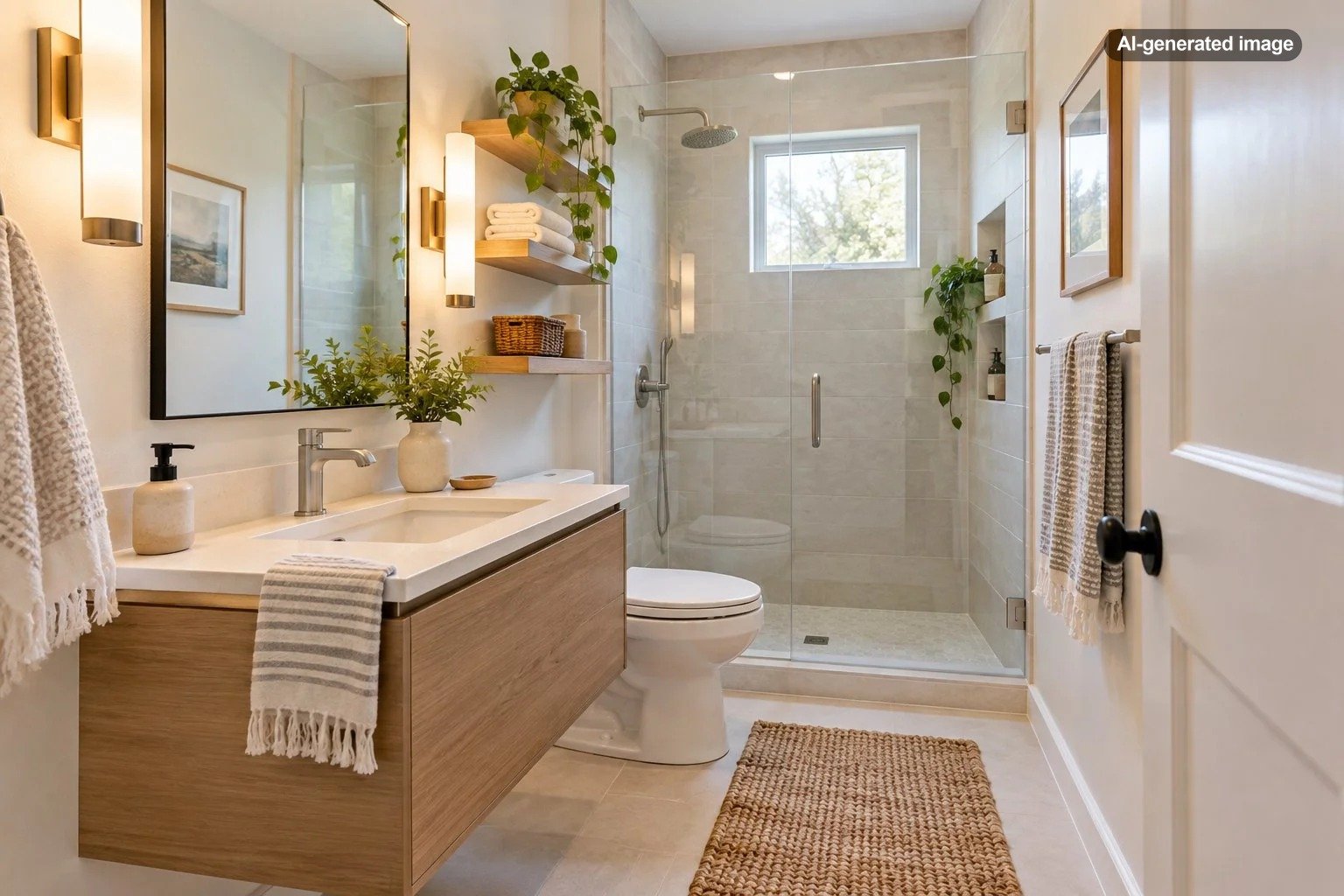
A generous mirror is one of the most useful tools in a compact bathroom because it reflects both the room and its available light. In many small guest bathrooms, a wider mirror above the vanity is more effective than surrounding a small mirror with multiple framed pictures or decorative objects.
The mirror does not have to cover the entire wall. It simply needs to feel substantial relative to the vanity and available wall space. A thin frame, frameless edge, or visually quiet design generally creates less interruption than an ornate, heavy frame in an already crowded room.
If the bathroom has a window, consider what the mirror reflects. Positioning or sizing it so that it captures daylight can make the room feel brighter. In a windowless bathroom, the mirror can still help distribute artificial light and reduce the sense of a solid wall closing in around the vanity.
Improve the Lighting Before Assuming You Need White Paint
Small bathrooms are often blamed on color when lighting is the bigger problem. A single ceiling fixture can create strong shadows around the vanity and corners, making the boundaries of the room more obvious.
When practical, combine general illumination with useful light near the mirror. The room should feel evenly lit rather than dramatically bright in one spot and murky everywhere else. Better lighting can make pale colors feel cleaner, mid-tone colors feel richer, and even deeper colors feel deliberate rather than gloomy.
Reduce Contrast When You Want the Walls to Recede
Every strong visual boundary gives the eye another place to stop. In a compact bathroom, many abrupt changes between wall color, trim, tile, flooring, cabinetry, towels, and shower materials can make the room feel divided into smaller pieces.
You do not need everything to match. Instead, aim for a controlled palette. A soft wall color with similarly quiet tile, a vanity that does not sharply dominate the room, and towels that belong to the same overall color story can produce a calmer view.
This is particularly helpful in a guest bathroom because you can keep the room visually disciplined without having to accommodate a household’s entire collection of daily toiletries.
Choose Furniture and Fixtures That Respect the Walking Space
If you are renovating, scale deserves more attention than style labels. A handsome vanity that is too deep for the room can make every visit feel like squeezing past furniture. A shallower vanity, pedestal sink, compact cabinet, or wall-mounted vanity may preserve more usable space, depending on the bathroom and its storage needs.
A floating vanity can also expose more flooring, which helps the room appear less visually blocked. The tradeoff is that reducing the vanity’s size can reduce enclosed storage, so it works best when the remaining storage is planned carefully.
Before replacing anything, measure how far the existing vanity projects from the wall and how much clear walking space remains. A few inches can make a noticeable difference in a genuinely narrow room, but there is little value in shrinking a fixture if doing so creates awkward daily use.
In a small bathroom, the best-looking object is often the one that leaves enough empty space around it to be appreciated.
Keep Storage Useful but Visually Quiet
Open shelves can look charming in photographs, but they also place every spare roll, bottle, folded towel, and container on display. In a very small guest bathroom, concealed storage often creates a calmer result.
A mirrored medicine cabinet can combine reflection and storage without consuming countertop space. A shallow wall cabinet may work where a deeper floor cabinet would obstruct circulation. Inside drawers and cabinets, simple organizers can keep guest essentials accessible without turning them into decoration.
Use vertical storage selectively. One tall element can be efficient; covering every open section of wall with shelves can make the room feel more crowded. Leave some blank wall visible so the eye has somewhere to rest.
Be Selective About What Lives on the Countertop
For a guest bathroom, the countertop can usually be simpler than the one in a primary bath. Hand soap, perhaps a small tray or container, and one decorative item may be plenty. Spare toiletries, cleaning products, extra paper goods, and backup linens can usually stay behind a door or inside a drawer.
The same principle applies to towels. A coordinated set can make the room feel orderly, but displaying every available towel at once adds unnecessary bulk. Keep what guests are likely to use within easy reach and store the rest elsewhere when possible.
Let the Floor Stay Visible
Visible flooring helps establish the room’s full footprint. Too many items touching the floor can break that footprint into fragments. Consider whether the bathroom really needs a freestanding storage tower, large basket, scale, bulky hamper, decorative stool, and oversized trash can simultaneously.
A bath mat can still be practical, but it should suit the proportions of the room rather than cover most of the visible floor. Similarly, wall-mounted accessories may be preferable to freestanding ones when floor space is especially scarce.
Handle the Shower or Tub as Part of the Whole Room
In a full guest bathroom, the shower or tub enclosure can either extend the visual space or form a large visual barrier. A light shower curtain that can be opened when the bathroom is not in use often feels less imposing than a dark, heavy curtain left closed.
During a renovation, clear glass can preserve sightlines and allow the eye to perceive more of the bathroom at once. That does not automatically make it the right choice for every household: glass requires regular cleaning, offers less visual concealment, and may cost more than a curtain arrangement.
If you already have a perfectly functional shower, do not assume it needs to be rebuilt. Simply coordinating the curtain, bath mat, towels, and nearby wall colors may substantially reduce visual fragmentation.
Before you decide
- Remove countertop and floor items before buying new decor.
- Use a mirror that feels generous rather than undersized.
- Improve uneven lighting and dark corners.
- Limit unnecessary contrast between large surfaces.
- Check whether the vanity is disproportionately deep or bulky.
- Favor concealed storage for visually messy necessities.
- Keep enough open wall and floor area to create breathing room.
Do Not Make Everything Tiny
One of the easiest mistakes in a small room is filling it with numerous miniature objects. A tiny mirror, tiny shelf, tiny artwork, tiny containers, and tiny accessories can create more visual activity than one or two confidently scaled pieces.
Instead, choose fewer elements with enough presence to look intentional. One substantial mirror may work better than a mirror surrounded by several small frames. One well-placed towel bar may look calmer than multiple hooks and racks competing on the same wall.
This is also why a small bathroom can support a bold material or pattern when it is used thoughtfully. A distinctive wallpaper, tile, or paint color can give the room character as long as the rest of the composition is sufficiently controlled.
What Makes the Biggest Difference Without Remodeling?
If you want the largest visual improvement without changing plumbing or fixtures, prioritize decluttering, a larger or better-positioned mirror, improved lighting, coordinated textiles, and fewer freestanding objects. Those changes address the way the room is perceived rather than merely adding decoration.
After that, look at scale. If one permanent feature clearly dominates the room, such as an unusually bulky vanity or storage unit, replacing that single element may accomplish more than a long list of smaller cosmetic updates.
Frequently Asked Questions
Should a small guest bathroom always be painted white?
No. White and other light colors can reflect light effectively, but they are not the only workable choices. A soft color or even a deeper shade can succeed when the lighting, finishes, and contrast are handled thoughtfully.
Does a large mirror make a small bathroom look bigger?
A larger mirror can make a compact bathroom feel more open by reflecting light and extending the visual field. It is especially useful when it replaces several smaller decorative items that would otherwise make the wall feel busier.
Are open shelves good in a small bathroom?
They can be, especially when floor storage is limited, but they need restraint. A small number of neatly arranged items can look attractive; several shelves filled with toiletries and supplies can increase visual clutter.
What should you remove first from a cramped guest bathroom?
Start with unnecessary floor items and countertop clutter. These are usually the easiest things to change and can reveal whether the bathroom truly needs additional storage or simply has too many objects competing for limited visible space.