Should All Living Room Furniture Sit on the Area Rug?
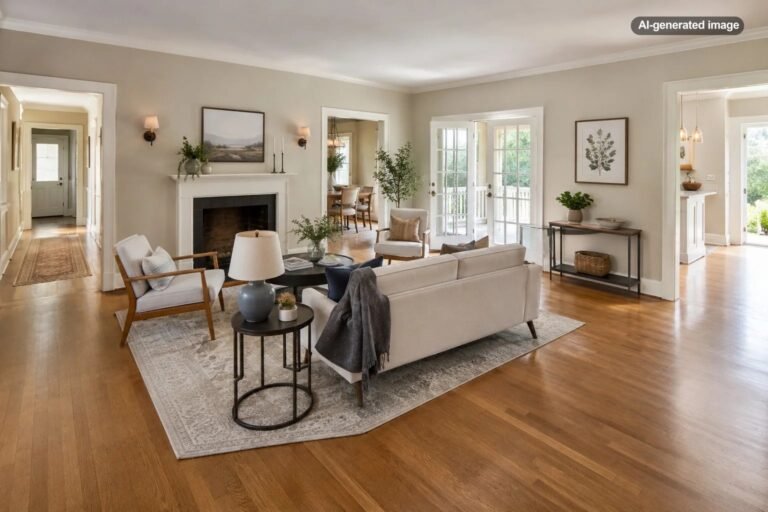
No, all living room furniture does not have to sit completely on the area rug. The right arrangement depends on the rug size, furniture layout, room proportions, and the effect you want to create. What matters most is that the rug visibly connects the main seating pieces instead of floating alone beneath the coffee table.
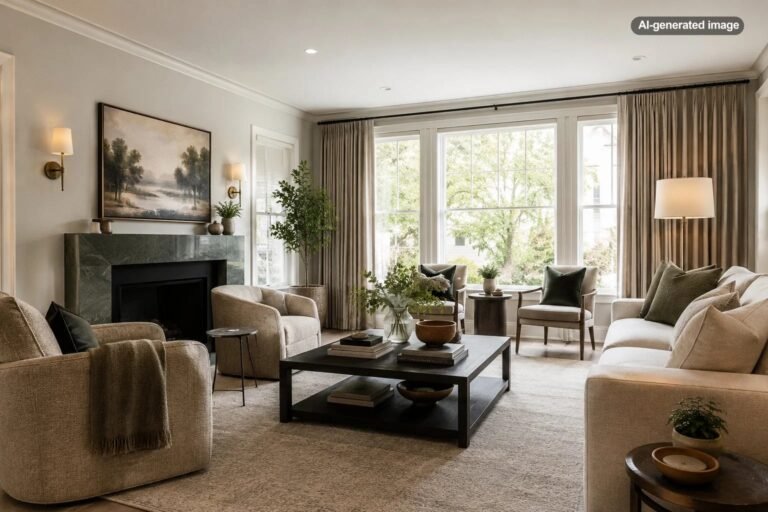
In many living rooms, placing the front legs of the sofa and chairs on the rug is the most practical and polished solution. A larger room may look better with every seating piece fully grounded on the rug, while a compact room can feel balanced with a smaller rug that reaches beneath only the front legs.
The real purpose of an area rug in a living room
An area rug is not merely a soft surface or decorative patch. It establishes the visual boundary of the conversation area. When its edges relate clearly to the sofa, chairs, and tables, those separate pieces read as one intentional arrangement.
This is why a rug that is generously sized often makes a room feel more composed. It creates a broad foundation beneath the furniture rather than a small island in the center. The result can make the seating arrangement appear more substantial and the room itself feel wider.
The rug does not need to touch every item in the room. A console, media cabinet, floor lamp, bookcase, or occasional table can remain outside its perimeter. Concentrate on connecting the primary seating pieces that form the room’s social center.
Three furniture placement options that work
| Placement | Best suited to | What it does |
|---|---|---|
| All legs on | Large rooms and generous rugs | Creates a unified, expansive seating zone |
| Front legs on | Most standard living rooms | Connects the furniture without requiring an oversized rug |
| All legs off | Small rooms or intentionally compact layouts | Defines the center while leaving furniture around the rug |
All furniture legs on the rug
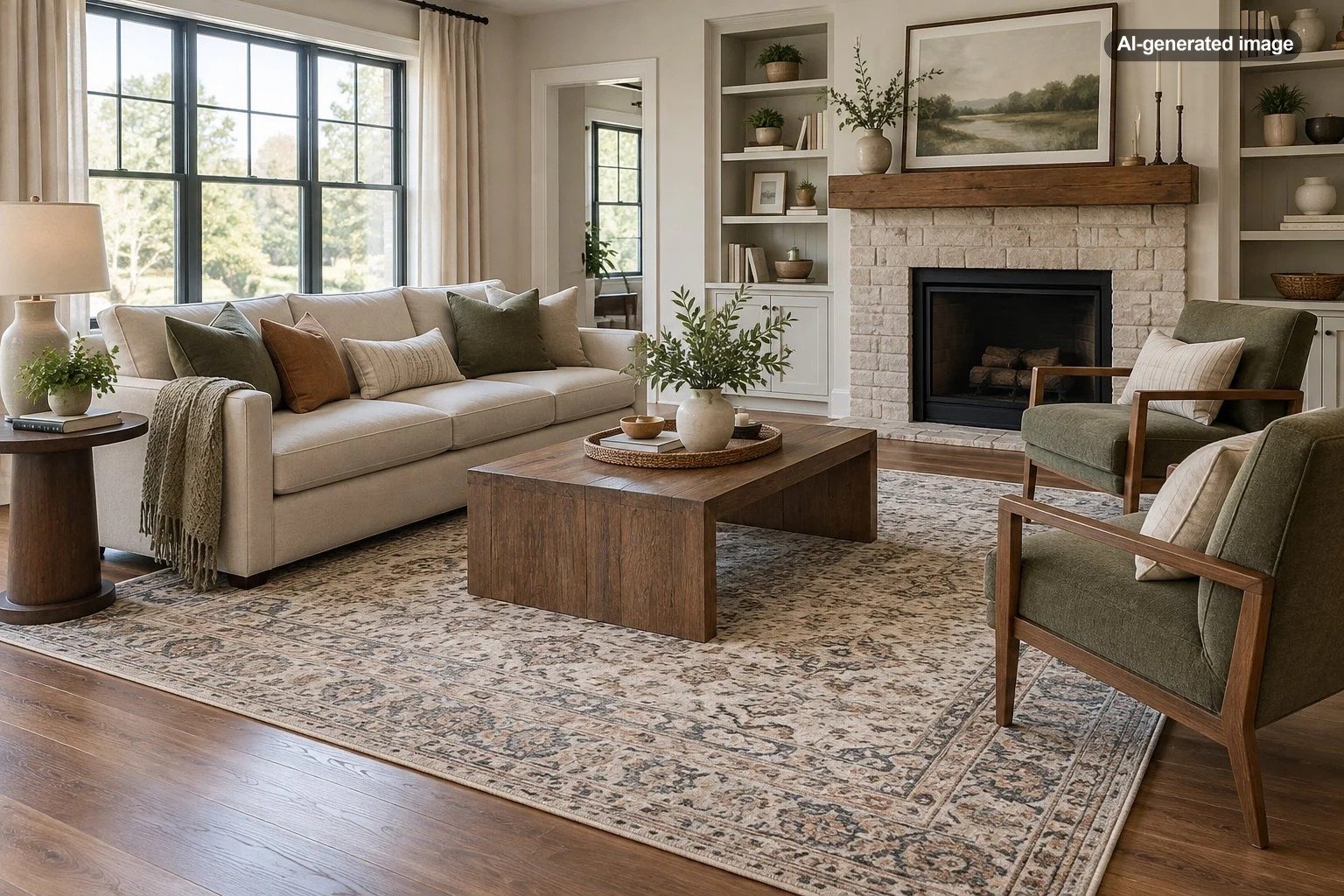
This arrangement generally looks the most formal and complete. The rug should extend beyond the sofa and chairs rather than ending directly at their outer legs. That visible border helps the furniture feel comfortably contained instead of crowded onto the textile.
It works especially well in open floor plans because the rug establishes a distinct living zone without walls. It is also useful when furniture floats away from the walls. The tradeoff is straightforward: the arrangement requires a large rug, enough floor space around it, and careful measuring before purchase.
Front legs on the rug
This is the most adaptable option. The front legs of the sofa and primary chairs rest on the rug while the rear legs remain on the surrounding floor. The overlap physically links the pieces, and the exposed floor around the perimeter prevents the rug from overwhelming the room.
Aim for enough overlap that the furniture looks firmly anchored. A rug tucked only an inch or two beneath a sofa can appear accidental and may shift more easily. In many layouts, roughly 6 to 12 inches beneath the front of a seating piece creates a clearer visual connection, although furniture depth and rug construction may call for an adjustment.
All furniture legs off the rug
An all-legs-off layout can work when the rug is deliberately used to frame a coffee table in a small room. It is less forgiving because the rug can quickly look undersized. The spacing between the rug and each seating piece should appear even and intentional.
This approach is usually less successful in a large living room, where a small central rug may make the furniture seem disconnected. If the room feels as though every chair is orbiting a lonely rectangle, increasing the rug size is likely to improve the composition.
A good rug does not have to hold every leg, but it should hold the room together.
How far should the rug extend?
For an all-legs-on arrangement, look for a visible margin of rug beyond the outer furniture legs. Approximately 8 to 18 inches often creates breathing room, but the ideal amount depends on the scale of the furniture and the room. A slim chair may need less surrounding rug than a deep sectional.
Also consider the exposed floor between the rug and the walls. Leaving a consistent border helps the area rug look deliberate and preserves the character of wood, stone, or tile flooring. In a compact room, that border may be fairly narrow. In a larger room, more exposed flooring can keep the rug from resembling wall-to-wall carpet that came up short.
Do not choose a rug by room dimensions alone. Measure the actual seating arrangement, including the furniture in its normal position. A spacious room with a compact seating group may need a different rug than a smaller room filled by a sectional and two substantial chairs.
What to do before choosing a size
- Arrange the sofa, chairs, and tables where they will actually be used.
- Choose an all-legs-on, front-legs-on, or all-legs-off layout.
- Mark the proposed rug edges with removable painter’s tape.
- Check walking paths, door clearance, floor vents, and nearby furniture.
- View the outline from the room entrance and adjoining spaces before ordering.
How the sofa and chairs should relate to the rug
The sofa usually establishes the primary axis. In a conventional layout, center the rug in relation to the sofa or the complete seating group, not automatically within the room. This distinction matters when a fireplace, doorway, bay window, or open walkway makes the furniture arrangement asymmetrical.
Chairs should follow the same visual logic as the sofa whenever possible. If the sofa has its front legs on the rug, the principal lounge chairs generally should as well. A small accent chair positioned beyond the main conversation zone can be an exception, but multiple unexplained exceptions make the layout feel improvised.
Sectionals often benefit from a larger rug because of their visual weight. At minimum, the rug should extend beneath the front legs of the sectional and reach meaningfully into the open seating area. Avoid placing a tiny rug solely beneath the coffee table when it is surrounded by a large sectional.
What about coffee tables and side tables?
A coffee table normally sits fully on the rug. It should feel centered within the seating arrangement and leave comfortable clearance from the surrounding seats. The exact gap can vary, but the table should be close enough to reach without restricting movement.
Side tables are more flexible. A table placed beside a sofa may sit fully on the floor, partly on the rug, or fully on it depending on the rug boundary. Stability matters more than symmetry here. If one pair of legs sits on a thick rug and the other pair rests on hard flooring, the table may wobble or tilt.
The same concern applies to floor lamps with broad bases. Keep each base on one level surface rather than straddling a raised rug edge. This is a functional detail, but resolving it usually makes the room look tidier as well.
When a larger rug is worth considering
A larger rug may solve more than one decorating problem at once. It can connect seating that currently feels scattered, give a small coffee table better scale, soften a broad expanse of hard flooring, and distinguish a living area within an open plan.
Affiliate disclosure: CraneManor.com may earn a commission when you purchase through links on this page. This does not affect the price you pay. Learn more.
Material, pile, color, care requirements, and the room’s traffic level still matter. Before choosing a woven area rug, confirm its dimensions and construction against your taped floor plan and household needs.
A larger rug is not automatically the better choice. In a small room, covering nearly all visible flooring can make the space feel heavy, particularly when the rug has a strong pattern or dark color. The goal is sufficient connection, not maximum coverage.
Common area rug placement mistakes
- Choosing for the coffee table alone: This often produces a rug that is too small for the full seating group.
- Mixing placement rules without a reason: One chair fully on, another barely touching, and the sofa completely off can make the arrangement look unsettled.
- Ignoring doors and vents: A well-proportioned rug is still inconvenient if it prevents a door from opening or obstructs an important floor register.
- Creating an unstable furniture edge: Tables, lamps, and lightweight chairs can wobble when their feet straddle a thick rug boundary.
- Forgetting the rug pad: An appropriately sized pad can reduce shifting, add cushioning, and keep the pad from showing around the edges.
The simplest rule for making the final decision
Choose the smallest rug that still connects every major piece in the conversation area with clear, consistent overlap. For many homes, that means placing the front legs of the sofa and chairs on the rug. For a spacious or open room, placing all seating legs on a larger rug can create a stronger sense of structure.
If replacing the rug is not practical, refine the furniture positions instead. Reduce uneven gaps, align the rug with the seating group, and make the relationship between each piece look intentional. A successful layout is not defined by one universal rule; it is defined by proportion, consistency, and a room that functions comfortably.