Why Is There Slime or Discoloration Inside a Toilet Tank?
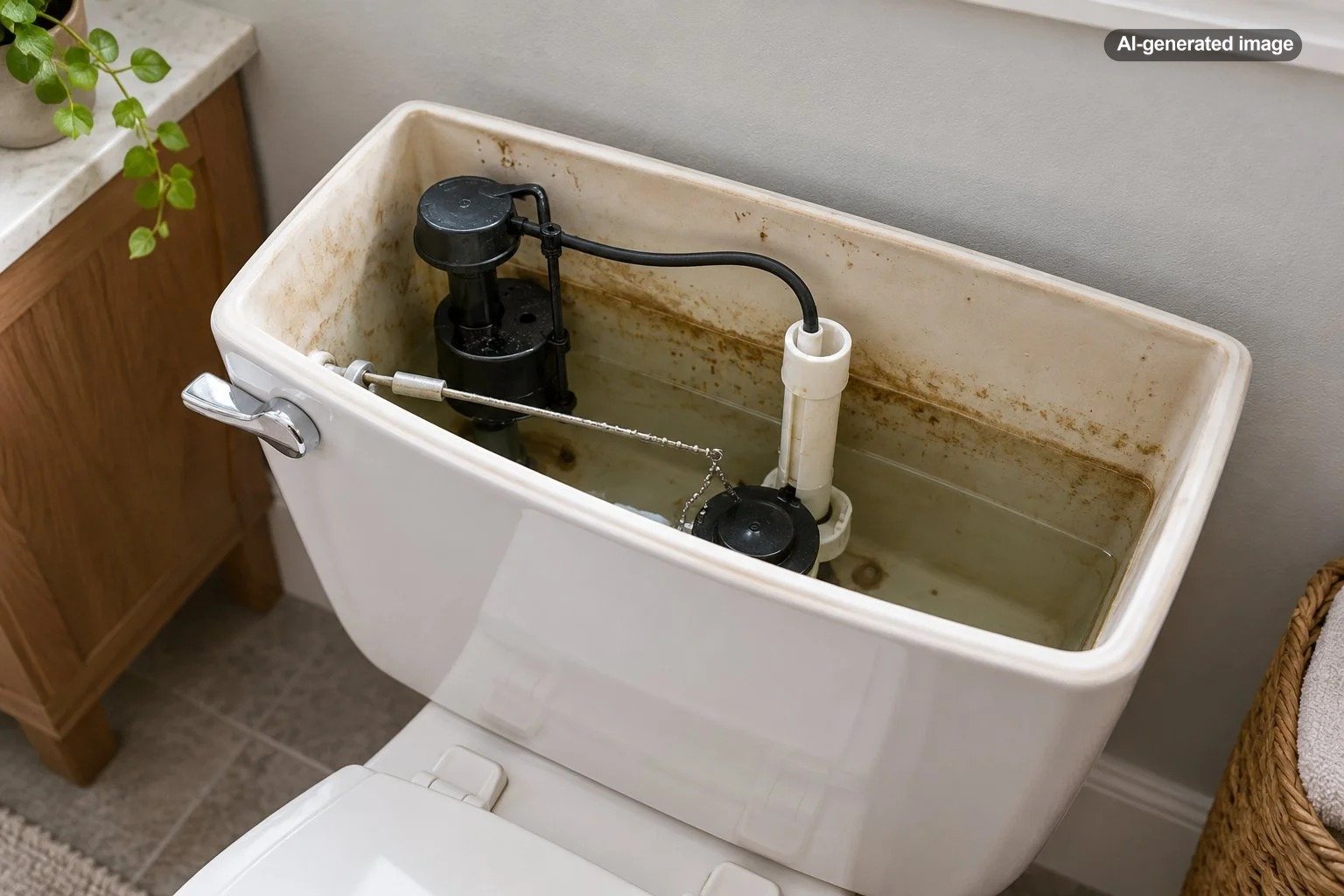
Discovering slime, dark patches, or rusty discoloration inside a toilet tank can be surprising, especially when the toilet bowl looks perfectly clean. The good news is that these deposits often have an ordinary explanation: minerals in the water, naturally occurring microorganisms, accumulated sediment, or residue that develops on surfaces that remain submerged. The important question is not simply what color the deposit is, but whether it is slippery, gritty, attached to the surface, or appearing elsewhere in the home’s plumbing.
Most minor toilet tank deposits can be addressed with careful cleaning and observation. However, recurring slime, unusual water color, or changes at other fixtures may justify investigating the water supply rather than repeatedly scrubbing the tank.
What Causes Slime or Discoloration Inside a Toilet Tank?
A toilet tank is essentially a small reservoir that repeatedly fills with household water. Its surfaces remain wet for long periods, and dissolved minerals, fine particles, and microorganisms can accumulate over time.
Several conditions make deposits more noticeable. Water with elevated iron or manganese can leave colored residue. Mineral-rich water may produce crusty buildup. Sediment may settle where the water moves slowly, while microorganisms can attach to submerged surfaces and form a film.
Unlike the toilet bowl, the tank is also easy to overlook during routine bathroom cleaning. A deposit can gradually accumulate without causing obvious changes in everyday toilet operation.
What Different Colors and Textures May Mean
The most useful first step is to examine the deposit without disturbing the toilet’s internal components. Pay attention to whether it is soft or hard, where it appears, and whether the surrounding water is clear.
| Appearance | Possible explanation | Useful next check |
|---|---|---|
| Orange or rusty brown slime | Iron deposits or iron-related bacterial growth | Look for similar deposits in other fixtures |
| Brown grit or loose particles | Sediment, rust, or mineral particles | See whether particles settle after refilling |
| Black or dark brown staining | Manganese, dark mineral residue, or microbial film | Determine whether the residue is gritty or slippery |
| Pink or reddish slippery film | Possible pigmented microbial growth | Check other persistently damp bathroom surfaces |
| White or pale crust | Mineral scale from hard water | Look for scale around faucets and shower fixtures |
| Greenish or mixed-color film | Possible biological growth or other accumulated residue | Check recurrence and other water-quality changes |
These descriptions are starting points, not definitive diagnoses. Different substances can look alike, and a tank may contain more than one type of deposit.
Why Orange or Brown Slime Deserves a Closer Look
One possible explanation for rust-colored slime is iron bacteria. These microorganisms use iron in their environment and can produce gelatinous deposits on surfaces exposed to water.
Iron bacteria are especially relevant when brown or orange material feels slippery rather than powdery. The U.S. Environmental Protection Agency has documented slimy, rust-colored deposits inside flush tanks as a characteristic sign of iron bacterial activity.
Iron bacteria are generally discussed as a nuisance affecting water appearance, odor, and plumbing performance, rather than as proof of an immediate health hazard. Their presence, however, does not establish that a water supply is otherwise free of harmful contaminants.
How Iron Bacteria Differ From Ordinary Rust
Ordinary rust or iron sediment may appear as loose orange-brown particles or staining. Iron-related biofilm can have a soft, sticky, gelatinous texture that clings to surfaces.
A tank may contain both. For example, dissolved iron can contribute to staining while microorganisms form a film that captures additional particles. Visual inspection cannot reliably separate every cause.
If rusty or slimy deposits occur throughout the house, especially with a private well, the issue may originate in the water supply or plumbing system rather than inside the toilet itself.
What Causes Black Residue Inside a Toilet Tank?
Black or very dark residue has several possible explanations. Manganese in water can contribute to dark staining. Biological films can also appear dark, and deposits from deteriorating rubber or plastic components may resemble dirt or sludge.
Texture and location are particularly useful clues. Dark material that feels gritty and adheres to the porcelain may suggest mineral deposits. Black particles collecting around an aging rubber seal or gasket could indicate component deterioration.
Inspect the flapper and other accessible rubber components without pulling, stretching, or dismantling them. If a part is cracked, sticky, distorted, or shedding material, it may need replacement according to the toilet manufacturer’s instructions.
Do not assume black residue is mold simply because of its appearance. Color is not a reliable method of identifying mold, bacterial growth, or manganese deposits.
Can Mold or Bacteria Grow Inside a Toilet Tank?
Microorganisms can form films on damp and submerged surfaces, including those inside a toilet tank. The term biofilm describes a community of microorganisms attached to a surface within a protective matrix.
Not every biofilm is mold, and not every colored deposit is biological. Some organisms create visible slime, while others produce little obvious discoloration.
Pinkish residue, for example, can be associated with pigmented bacteria in damp household environments. Yet identifying the organism responsible requires more than observing the color.
A toilet tank also provides different conditions from a shower wall or damp ceiling. Its predominantly submerged surfaces, water chemistry, and flushing patterns influence what accumulates there. Consequently, a cleaning approach suitable for bathroom tile may not be appropriate for the tank’s rubber seals and flush mechanism.
How to Determine Whether the Problem Is the Tank or the Water Supply
Before cleaning, take a few minutes to identify how widespread the problem might be. This helps distinguish a localized maintenance issue from something that deserves broader investigation.
What to check first
- Examine another toilet. If multiple tanks contain similar deposits, the incoming water becomes a more likely contributor.
- Inspect faucet aerators and shower fixtures. Rust-colored staining, black particles, or mineral scale elsewhere can provide useful context.
- Observe the tank water. Is the water itself discolored, or are the deposits limited to submerged surfaces?
- Check for odors. An unusual earthy, metallic, or sulfur-like smell may warrant water-system investigation, although odor alone cannot identify the cause.
- Consider recent changes. Plumbing repairs, water-main work, well servicing, or a change in treatment equipment may coincide with new sediment.
- Note the rate of recurrence. A film that rapidly returns after proper cleaning deserves more attention than a thin deposit that accumulates over a long period.
For households using a private well, persistent changes in water color, odor, or deposits are reasons to discuss appropriate testing with a qualified water-testing laboratory or local health department. Public-water customers can contact their water utility if discoloration appears at several fixtures or continues after the utility’s recommended checks.
How to Clean Slime or Discoloration From a Toilet Tank Safely
For light deposits, gentle mechanical cleaning is usually the most sensible starting point. Strong chemical treatments are not automatically better, particularly around seals, valves, and plastic components.
1. Check the Toilet Manufacturer’s Cleaning Instructions
Before adding anything to the tank, consult the instructions for the specific toilet model. Some manufacturers warn that chemical cleaners placed directly in a tank can damage flush valves, rubber seals, or other working parts.
For example, Kohler advises against in-tank cleaning products on its conventional toilets because they can harm internal components. That warning should not be treated as a universal specification for every toilet, but it illustrates why model-specific guidance matters.
2. Shut Off the Water and Lower the Tank Level
Locate the toilet’s shutoff valve and close it gently. Flush to lower the water level, then remove the tank lid and place it on a stable, padded surface.
Do not force a stuck shutoff valve or attempt to disassemble unfamiliar components. Some toilet designs contain specialized flushing mechanisms or concealed connections that require different procedures.
3. Remove Loose Deposits With Gentle Cleaning
If the manufacturer’s instructions permit, use a soft cloth or nonabrasive sponge dampened with water to loosen residue on accessible tank walls. A small amount of mild detergent may be appropriate for compatible surfaces, followed by thorough rinsing.
Avoid soaking seals, scrubbing rubber parts aggressively, or forcing a brush into narrow mechanical spaces. Keep cleaning supplies away from moving components and valve openings.
For stubborn mineral scale, use only a product specifically approved for the relevant tank materials and follow its instructions. Acidic household remedies are not automatically compatible with every valve, gasket, finish, or previously used chemical.
4. Rinse and Restore Normal Operation
Remove loosened debris with a cloth or sponge, restore the water supply, and allow the tank to refill. Flush and inspect the toilet for normal operation.
Check that the tank stops filling properly, the flapper or other flush seal closes, and there is no leakage around the tank or supply connection. If the toilet begins running continuously or a seal no longer seats properly, stop and address the mechanical issue.
5. Monitor What Returns
After cleaning, note whether the deposit returns over the following days or weeks. A dated photograph can help track changes in coverage and color without relying on memory.
Repeated heavy accumulation may be a sign that cleaning alone is not addressing the source.
Why Bleach Tablets and Harsh Cleaners Can Be a Bad Idea
Automatic toilet-cleaning tablets may appear convenient, but products placed directly into the tank can expose internal components to chemicals for extended periods.
Some conventional toilets specifically prohibit these treatments because chemical exposure can damage rubber or plastic parts and contribute to leaks. Toilets equipped with manufacturer-approved, isolated cleaning reservoirs may have different instructions.
Never mix bleach with vinegar, ammonia, acidic toilet cleaners, or other cleaning chemicals. Dangerous fumes can result. If a tank contains remnants of an unknown cleaning product, do not add another chemical.
Cleaning and disinfecting are also different activities. Physically removing dirt and biofilm is often the first appropriate step. If disinfection is necessary, use only a product approved for that application and compatible with the toilet’s components, following its complete label directions.
What If the Slime Comes Back After Cleaning?
Recurring residue is useful information. It suggests that conditions favorable to the deposit remain present, even when the visible material has been removed.
If only one toilet is affected, investigate that fixture first. An aging gasket, internal component, accumulated sediment, or infrequent use may be relevant.
If several toilets show the same rusty or dark slime, the water supply deserves greater attention. Private-well owners may need testing for iron, manganese, bacterial indicators, and other concerns selected according to local conditions and the laboratory’s recommendations.
Do not assume an ordinary water softener, sediment filter, or household pitcher filter will resolve every type of slime. Different water problems require different treatment approaches, and some filtration systems can themselves develop deposits when poorly matched or maintained.
Where iron bacteria or substantial water-system biofilm is suspected, treatment may involve more than cleaning a toilet. A qualified well or water-treatment professional can evaluate the appropriate scope of testing and maintenance.
When Should You Call a Plumber or Water Specialist?
A small amount of staining in an otherwise functioning toilet generally does not require an emergency visit. Professional evaluation becomes more worthwhile when the issue extends beyond cosmetic buildup.
Signs that deserve further investigation
- Water suddenly becomes brown, black, or unusually cloudy at several fixtures.
- Slime or sediment returns quickly after careful cleaning.
- The toilet develops leaks, weak flushing, or continuous refilling.
- Rubber seals or other tank components appear to be deteriorating.
- Water has a persistent unusual odor or taste.
- A private well shows changes in water quality or has overdue recommended testing.
- Deposits occur throughout the home rather than in one toilet.
A plumber is a good starting point for tank mechanisms, leaking seals, and suspected pipe corrosion. A qualified water specialist or certified laboratory is better suited to investigating water chemistry and microbial contamination.
If a public water utility issues a drinking-water advisory, follow its instructions rather than relying on household cleaning or filtration assumptions.
How to Help Prevent Future Toilet Tank Buildup
Preventing residue depends on its cause. There is little benefit in repeatedly applying cleaning products when the deposit originates in the incoming water.
Inspect the tank occasionally, especially when a toilet has been used infrequently or the home has a history of sediment or mineral staining. Clean accessible surfaces gently when needed and keep internal parts in good repair.
For hard-water deposits, ask whether existing water treatment is operating as intended before considering additional equipment. For recurring iron-related slime, identify the source and extent of the problem before selecting a treatment system.
Owners of private wells should follow locally recommended testing practices and arrange additional testing when water characteristics change. In rentals or condos, report persistent unusual deposits, leaks, or widespread discoloration to the responsible property manager rather than modifying shared water-treatment equipment.
The goal is not necessarily to keep the inside of the toilet tank looking showroom-new. It is to maintain a functioning fixture, protect its components, and recognize when a cosmetic-looking symptom points to a broader issue.
Frequently Asked Questions
Is brown slime inside a toilet tank dangerous?
Not necessarily. Rust-colored slime can be associated with iron bacteria or other relatively common water-related deposits. However, its appearance cannot establish water safety. If the home uses a private well or has changes in water quality, appropriate testing is advisable.
Why is there black sludge in my toilet tank but not the bowl?
The tank provides surfaces where particles, minerals, and biological films can collect between flushes. Dark deposits might involve manganese, microbial growth, or deteriorating components. Examine their texture, location, and whether similar material appears elsewhere.
Will vinegar remove slime from a toilet tank?
Vinegar may affect certain mineral deposits, but it is not a universal solution for biological slime and may be unsuitable for some toilet components. Follow the manufacturer’s cleaning instructions, and never combine vinegar with bleach or other cleaning chemicals.
Can toilet tank slime cause a toilet to run continuously?
Accumulated debris can interfere with the seating of a flush seal or other moving components. However, continuous running can also result from worn parts or incorrect water-level settings. If gentle cleaning does not restore normal operation, the mechanism should be inspected and repaired.
How often should the inside of a toilet tank be cleaned?
There is no single cleaning interval appropriate for every tank. Water chemistry, toilet design, use, and the presence of deposits all matter. Occasional inspection and cleaning when buildup appears are more sensible than exposing tank parts to unnecessary chemicals on a rigid schedule.
The Bottom Line
Slime or discoloration inside a toilet tank usually points to accumulated minerals, sediment, biological films, or aging internal components. Its color is a useful clue, but texture, recurrence, and whether other fixtures are affected tell a more complete story.
Begin with gentle inspection and cleaning that follows the toilet manufacturer’s instructions. Avoid harsh in-tank chemicals, watch for mechanical problems, and investigate the water supply if deposits return quickly or appear throughout the home. That approach addresses the actual problem without turning an ordinary maintenance discovery into an unnecessary plumbing project.
Sources & Further Reading
- U.S. Environmental Protection Agency: Manual of Small Public Water Supply Systems – Background on iron bacteria and rust-colored slime in water systems.
- Sterling Plumbing: How to Maintain and Clean Toilets – Manufacturer guidance on toilet cleaning, mineral deposits, and avoiding in-tank cleaners.
- U.S. Environmental Protection Agency: What’s the Difference Between Products That Disinfect, Sanitize, and Clean Surfaces? – Explanation of cleaning versus disinfection and the importance of product-label instructions.
- U.S. Environmental Protection Agency: Flood Cleanup to Protect Indoor Air and Your Health – General chemical-handling precautions, including warnings against mixing cleaning products.