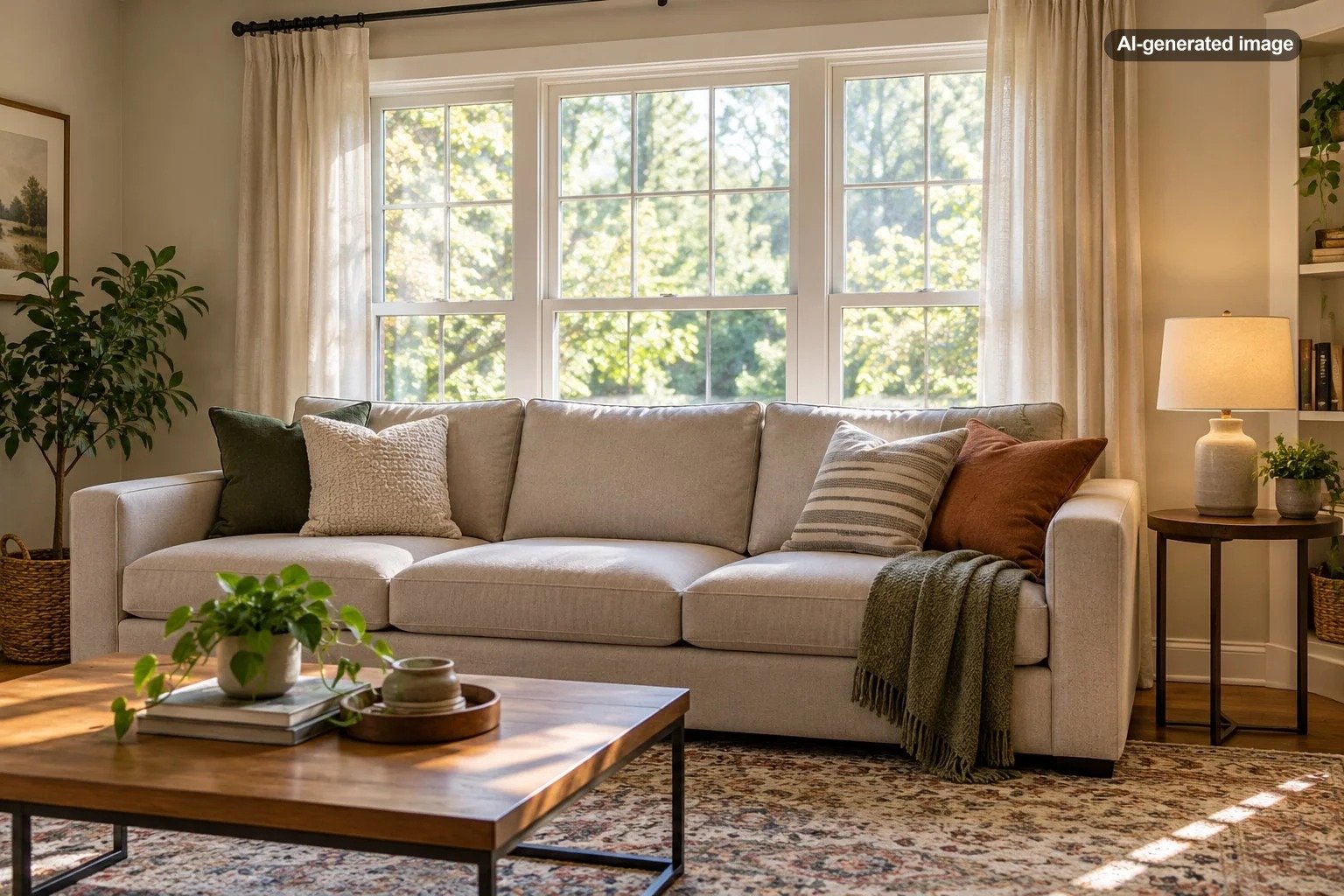
Can a Sofa Block Part of a Window?
Yes, a sofa can block part of a window, and in many living rooms that is a perfectly workable arrangement. The important question is not whether the sofa overlaps the window at all, but how much of the window it covers and whether the placement interferes with light, views, window operation, or the proportions of the room.
A low or medium-height sofa positioned beneath a large window can look intentional and balanced. Problems usually appear when a tall sofa back hides most of a small window, presses tightly against curtains, makes the window difficult to open, or blocks so much daylight that the room feels noticeably darker.
How Much of the Window Can a Sofa Cover?
There is no universal percentage that a sofa is allowed to cover from a decorating standpoint. Instead, judge the relationship between the height of the sofa back and the height of the window.
A sofa that overlaps the sill or the bottom section of a tall window often looks natural because plenty of glass remains visible above it. A tall-backed sofa placed in front of a short window can be more difficult. If only a narrow strip of glass remains visible, the window may begin to look oddly cropped rather than intentionally framed.
Look at the arrangement from the main entrance to the room as well as from the seating area. Ideally, the window should still read as an architectural feature rather than disappearing behind the furniture.
A sofa does not need to clear the window completely; it simply needs to leave enough of the window visible and usable for the room to feel deliberate.
Leave Some Space Between the Sofa and the Window
A sofa does not usually look or function best when its back is pressed directly against the window wall. Even a modest gap can make the arrangement feel less cramped and leave room for curtains, shades, cleaning, and window hardware.
The appropriate distance depends on the room. In a compact apartment, the gap may be only a few inches. In a larger living room, pulling the sofa farther forward can make the furniture arrangement feel more intentional and can improve access behind it.
Before settling on the position, check whether you can comfortably reach window locks, handles, shades, or blinds. A beautiful arrangement becomes irritating quickly if opening a window requires climbing over the sofa.
Think About Natural Light Before Finalizing the Layout
One advantage of placing a sofa beneath a window is that the furniture often occupies wall space that would otherwise be difficult to use. The tradeoff is that a large upholstered piece can intercept some incoming light.
How noticeable this is depends on the window. A wide or tall window may lose relatively little useful daylight when only its lower portion is covered. A small window in an already dim room deserves more caution.
If daylight is important, lower-profile furniture is usually easier to place beneath a window. Sofas with lower backs, slimmer arms, or visible legs tend to feel less visually heavy than oversized pieces with tall cushions and substantial backs.
Make Sure the Window Treatments Still Work
Curtains and shades can determine whether this layout succeeds. Floor-length curtains need room to hang rather than becoming trapped behind the sofa. If the sofa pushes the fabric against the wall, the curtains may bunch, wrinkle, or become difficult to open.
Roman shades, roller shades, cellular shades, and other treatments that remain largely within the window area can be convenient when furniture sits close to the wall. Full-length curtain panels can still work, but leave enough clearance for them to fall naturally.
Also consider where the curtain panels collect when they are open. If the sofa is nearly as wide as the window, the fabric may compete visually with the sofa arms unless the window treatment was planned with the furniture placement in mind.
Consider the View From Both Sides of the Sofa
If the window overlooks a garden, skyline, pool, or another feature you enjoy, decide whether losing the lower portion of that view matters. A seated person may still have an excellent view through the upper section of the glass, while someone standing elsewhere in the room may see the sofa cutting across it.
This is mostly a matter of priorities. In a small living room, gaining a functional furniture arrangement may be more valuable than preserving every inch of the view. In a room built around large scenic windows, keeping the glass more open may deserve greater weight.
Watch for Heating, Cooling, and Airflow Obstacles
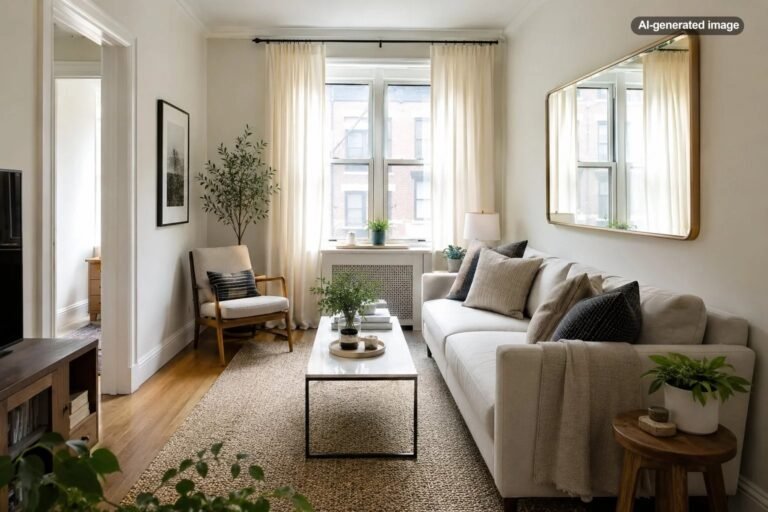
Before pushing furniture toward a window wall, look at what else is there. Older homes may have a radiator below the window, while newer rooms may have floor registers, baseboard heating, or other equipment nearby.
A large sofa should not be placed where it obstructs equipment that depends on open airflow or where heat could affect the upholstery. If there is a radiator, vent, or similar fixture beneath the window, the furniture layout needs to accommodate that system rather than treating the wall as empty space.
The same principle applies to electrical outlets, cable connections, and controls you use regularly. Leave enough access that routine household tasks do not require moving a full-size sofa.
When a Sofa in Front of the Window Looks Best
This arrangement is particularly effective when the window is substantially taller than the sofa, the sofa is visually lighter than the wall opening, and the furniture placement improves the overall circulation of the room.
It can also be useful in small spaces where every wall must work hard. Apartments, narrow living rooms, and rooms with multiple doorways often provide few uninterrupted furniture walls. Treating the lower portion of a window as usable furniture space can unlock a layout that otherwise seems impossible.
Before you decide
- Check how much glass remains visible above the sofa.
- Make sure window locks and handles are still reachable.
- Confirm curtains or shades can open and close normally.
- Look at the room in daylight to judge the effect on natural light.
- Check for radiators, registers, baseboard heating, outlets, or controls behind the sofa.
- Make sure the sofa improves rather than constricts the room’s walking paths.
When You May Want a Different Arrangement
Consider another location if the sofa hides most of a small window, makes the room significantly darker, prevents normal operation of the window, or creates an awkward collision with curtains or heating equipment.
You might also try a lower loveseat, a pair of chairs, a bench, or a more compact sofa. Changing the type of seating can preserve the useful wall position without covering as much glass.
Sometimes the better solution is simply to float the sofa away from the window rather than placing it directly against the wall. A little separation can make both the sofa and the window feel more intentional, especially in a larger living room.
FAQ
Does a sofa have to sit below the windowsill?
No. The back of the sofa can rise above the sill. What matters more is whether enough of the window remains exposed for the proportions, daylight, and function of the room.
Will a sofa in front of a window make a room look smaller?
Not necessarily. In some small rooms, using the window wall actually improves the layout because it opens other walls and creates clearer furniture groupings. An oversized or unusually tall sofa, however, can make a modest window feel crowded.
Should a sofa touch the wall beneath a window?
It generally works better to leave at least a small amount of clearance when possible. The gap gives window treatments room to operate and makes cleaning and accessing the window easier.
Is a low-back sofa better in front of a window?
Often, yes. A lower back leaves more glass exposed and usually feels lighter against the window. That does not mean a taller sofa cannot work, but its scale deserves closer attention.
Ultimately, a sofa can absolutely block part of a window. Treat the window and sofa as a single composition: preserve useful daylight, keep the window functional, respect anything installed beneath it, and choose proportions that make the overlap look intentional. If those pieces work together, there is no decorating rule requiring the entire window to remain visible.