Can a Smart Thermostat Control Indoor Humidity?
Yes, a smart thermostat can help control indoor humidity, but the important word is help. A thermostat can measure humidity, change how compatible heating and cooling equipment operates, and, in some installations, control a whole-home humidifier or dehumidifier. It cannot remove or add moisture by itself.
How much control you actually get depends on both the thermostat and the HVAC equipment connected to it. A humidity-reading thermostat paired with an ordinary air conditioner may offer only modest dehumidification help, while a compatible thermostat connected to dedicated humidity-control equipment can provide much more direct control.
What a Smart Thermostat Actually Does With Humidity
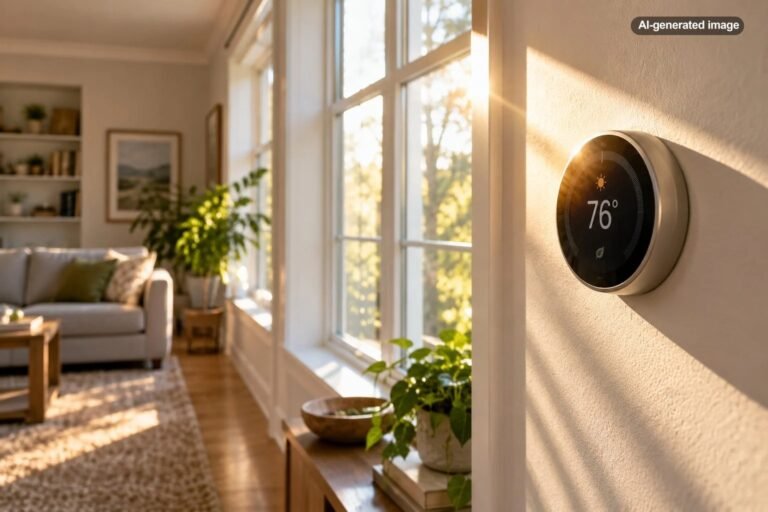
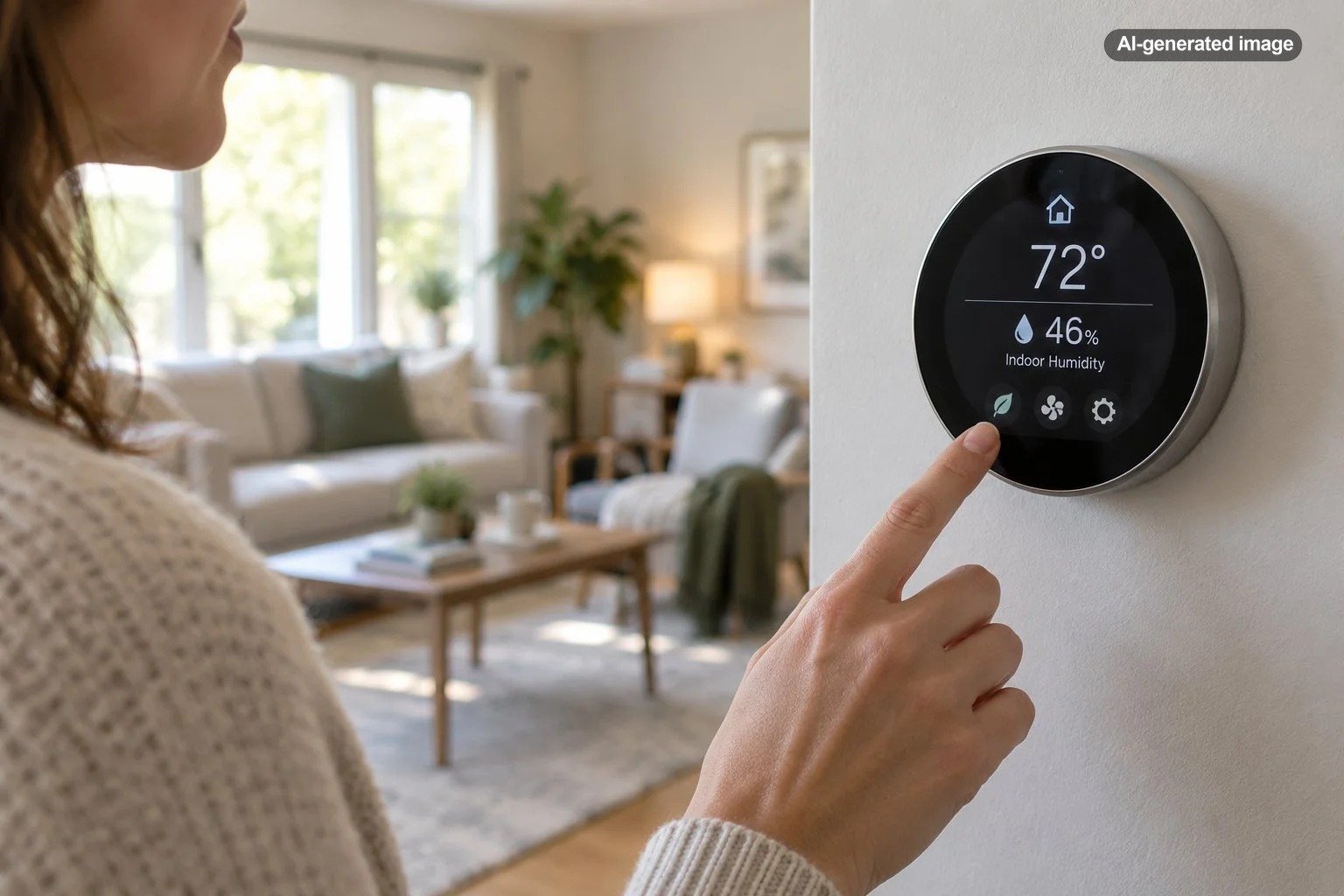
Many smart thermostats include a humidity sensor alongside their temperature sensor. That lets the thermostat report indoor relative humidity and, depending on the model and connected equipment, use that reading when deciding how the HVAC system should operate.
There are several levels of humidity control that are easy to confuse. A thermostat may simply display humidity, it may use normal cooling operation to help reduce excess moisture, or it may directly control compatible whole-home humidity equipment. Those are not the same capability.
| Capability | What it means | What the home needs |
|---|---|---|
| Humidity monitoring | The thermostat reports indoor relative humidity. | A thermostat with a humidity sensor. |
| Cooling-based dehumidification | The thermostat may run compatible cooling equipment differently to remove more moisture. | An air conditioner or heat pump and supported controls. |
| Dedicated dehumidifier control | The thermostat calls for a whole-home dehumidifier when needed. | Compatible thermostat, wiring, controls, and dehumidifier. |
| Humidifier control | The thermostat can request added moisture during dry conditions. | Compatible whole-home humidifier and controls. |
Why Air Conditioning Affects Humidity
An air conditioner does more than lower air temperature. As warm indoor air passes over a cold evaporator coil, water vapor can condense on the coil and drain away. That is one reason an air-conditioned house may feel less humid after the system has been running.
A smart thermostat can sometimes use that relationship more deliberately. Google, for example, documents a feature called Cool to Dry on supported Nest thermostats. It can use an air conditioner or heat pump to help reduce excessive humidity, and it can work differently when the cooling system itself offers a dehumidification mode.
There are limits. Cooling cannot be extended indefinitely just to remove moisture because the house can become too cold. Google notes that its Cool to Dry feature has operating limits and may not always reach a specific humidity target. That illustrates the broader point: cooling-based moisture removal is not the same as having a dedicated dehumidifier.
The thermostat can make the decision, but another piece of equipment still has to move the moisture.
When a Smart Thermostat Can Control a Whole-Home Dehumidifier
The most direct form of humidity control occurs when a compatible thermostat is wired and configured to control a whole-home dehumidifier. In that arrangement, the thermostat’s humidity sensor can serve as part of the control strategy and request dehumidification independently of an ordinary cooling call, depending on the equipment design.
This can be particularly useful in homes where moisture remains high even when indoor temperature is comfortable. Mild but humid weather is a common example: the air conditioner may not need to run for long enough to remove as much moisture as the house requires.
Compatibility matters considerably here. Thermostat terminals, HVAC control boards, accessory wiring, equipment staging, and supported operating modes vary. A thermostat that can display humidity should not automatically be assumed to control a dehumidifier.
Can It Control a Whole-Home Humidifier Too?
Some thermostats can also work with compatible whole-home humidifiers, which add moisture during dry conditions rather than removing it. This is most relevant during heating season in climates where indoor air becomes uncomfortably dry.
The same compatibility rule applies. The thermostat needs appropriate hardware support, wiring, and configuration. Some systems also use outdoor conditions when determining suitable humidification levels because adding too much moisture in cold weather can contribute to condensation on windows or other cold surfaces.
If humidification is one of your goals, check the documentation for both the thermostat and the humidifier before assuming they can communicate directly.
What Humidity Level Should You Aim For?
The U.S. Environmental Protection Agency advises keeping indoor humidity between roughly 30 and 50 percent as general indoor-air-quality guidance. EPA mold guidance also recommends keeping indoor relative humidity below 60 percent when possible, with 30 to 50 percent described as an ideal range.
Those numbers are useful reference points rather than a reason to obsess over a single reading. Indoor relative humidity changes with temperature, weather, showering, cooking, occupancy, ventilation, and HVAC operation. A brief fluctuation is different from a persistent moisture problem.
A separate humidity gauge can be useful when you want to compare the thermostat’s reading with another location in the house. A thermostat mounted in a central hallway may not represent the humidity in a bathroom, basement, bedroom, or other moisture-prone room.
When the Thermostat Is Not the Real Problem
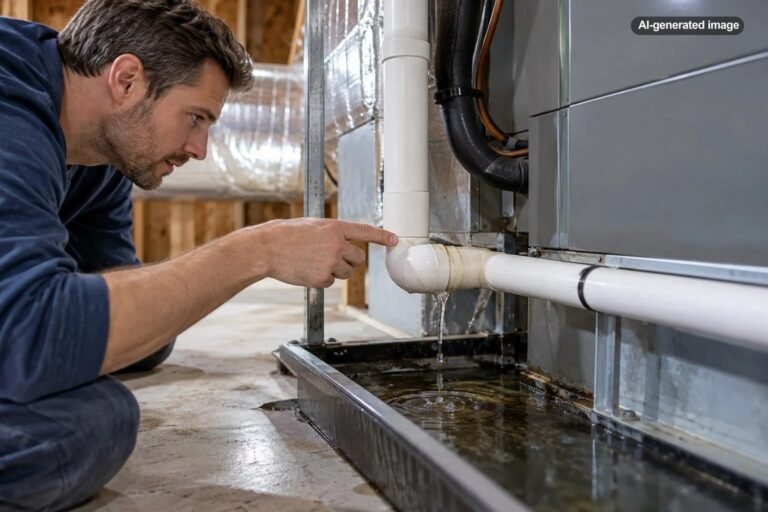
If indoor humidity remains high, replacing the thermostat may not solve the underlying issue. The problem may involve equipment operation, moisture entering the house, insufficient moisture removal, air leakage, ventilation, drainage, or another building condition.
One common mistake is expecting a smarter control to compensate for HVAC equipment that is not suited to the moisture load. Another is assuming that a low thermostat setting guarantees low humidity. A home can be cool and still feel damp.
How to Decide Whether You Need More Humidity Control
What to do
- Check the humidity reading over several days rather than reacting to one momentary number.
- Compare readings in different parts of the home with a separate humidity meter if certain rooms feel noticeably different.
- Review your thermostat documentation to see whether it merely senses humidity or can actively control compatible equipment.
- Identify what humidity-control equipment you already have, including any whole-home humidifier, dehumidifier, variable-capacity system, or cooling equipment with a dehumidification mode.
- If high humidity is persistent, condensation is recurring, or the HVAC system does not appear to manage moisture properly, have the system evaluated by a qualified HVAC professional.
Choosing a Smart Thermostat for Humidity Features
If humidity management is a priority, start with your HVAC system rather than the thermostat shopping page. Write down the model and type of heating and cooling equipment you have, along with any whole-home humidifier or dehumidifier. Then determine which thermostat functions that equipment can actually use.
Look for documentation covering humidity sensing, accessory control, dehumidification modes, humidifier support, wiring requirements, and equipment compatibility. Remote monitoring can also be useful if you want to check conditions while traveling, but an app does not expand the physical capabilities of the HVAC system.
Affiliate disclosure: CraneManor.com may earn a commission when you purchase through links on this page. This does not affect the price you pay. Learn more.
For homeowners who primarily want connected temperature control and remote access, a Wi-Fi-enabled thermostat such as the Google Nest Thermostat is one option to investigate. Google lists a humidity sensor among the thermostat’s sensors, but HVAC compatibility varies, and humidity sensing alone should not be treated as proof that a thermostat can directly control every type of humidifier or dehumidifier. Verify your system before purchasing or installing any thermostat.
Frequently Asked Questions
Does every smart thermostat measure humidity?
No. Humidity sensors are common on some smart thermostats, but features vary by model. Check the manufacturer’s current specifications rather than assuming the feature is included.
Can a thermostat lower humidity without an air conditioner or dehumidifier?
No. A thermostat does not physically remove water from the air. It needs compatible equipment capable of dehumidification.
Will lowering the temperature automatically fix high humidity?
Not necessarily. Cooling can remove moisture, but the result depends on equipment operation, runtime, weather, moisture sources, and the HVAC system’s design. Dedicated dehumidification may be more appropriate when excess moisture persists without a large cooling demand.
Can I use a smart thermostat with a whole-home humidifier or dehumidifier?
Possibly. Some thermostat and equipment combinations support accessory control, while others do not. Wiring and control requirements vary, so verify compatibility with the manufacturers’ documentation and use qualified HVAC help when the installation requires equipment-side wiring or configuration.
Sources & further reading
- U.S. Environmental Protection Agency: Care for Your Air – A Guide to Indoor Air Quality
- U.S. Environmental Protection Agency: A Brief Guide to Mold, Moisture and Your Home
- Google Nest Help: Learn about Cool to Dry
- Google Home and Nest Help: Nest thermostat settings
- Google Nest Help: Nest thermostat technical specifications