Can You Put a Fire Pit Under a Covered Patio?
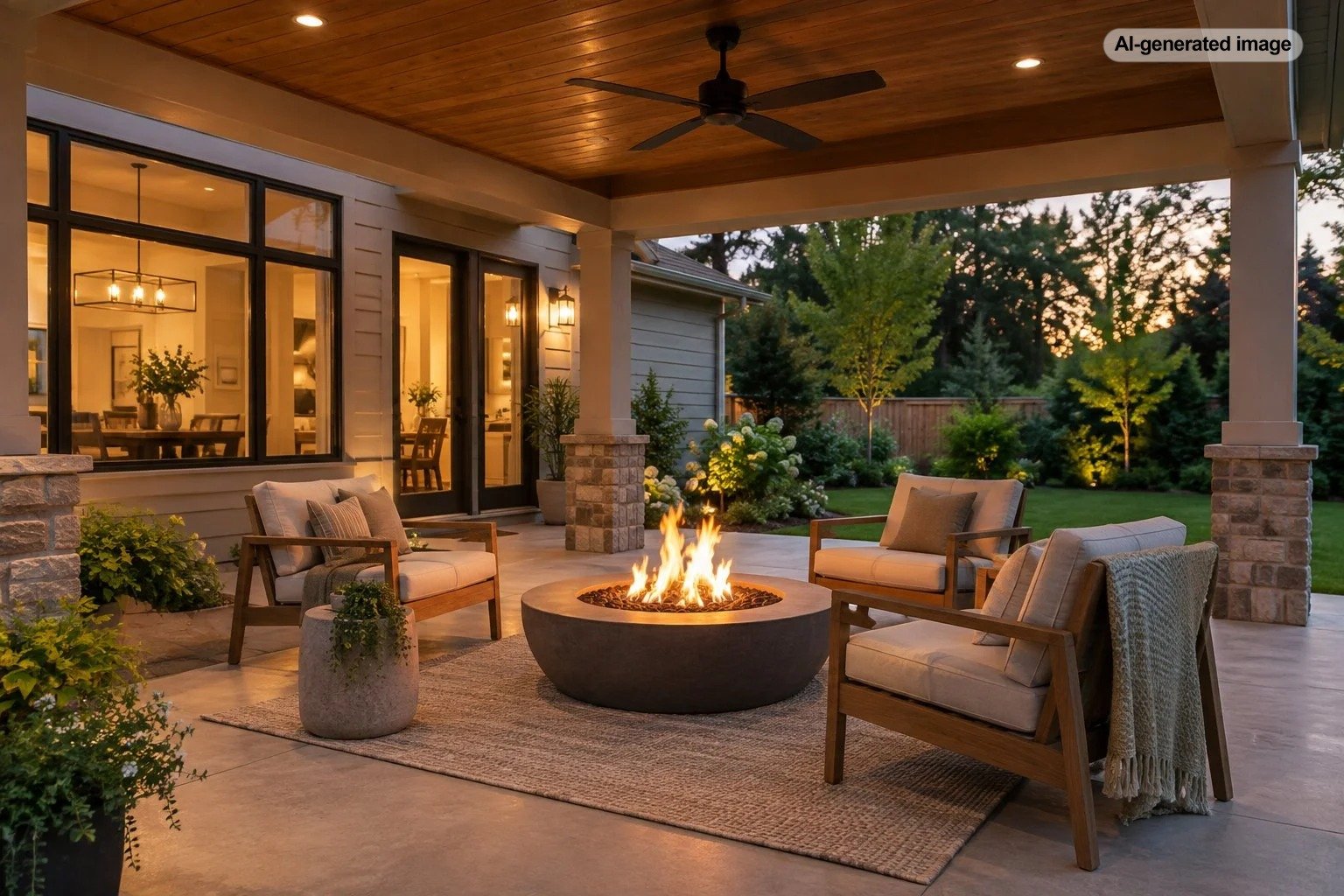
A fire pit should not automatically be considered safe under a covered patio just because the sides of the patio are open. The important questions are what kind of fire pit you have, whether the appliance is specifically listed for that setting, how much clearance the manufacturer requires, what the roof and nearby surfaces are made from, and whether the space provides enough open-air ventilation.
For many portable wood-burning fire pits, charcoal-burning products, and outdoor appliances with open flames, the safer answer is to keep them out from under combustible roofs and overhangs. A gas fire feature may have different requirements, but those requirements come from its listing, installation instructions, and applicable local rules rather than from a general assumption that a patio is outdoors.
Why a covered patio changes the safety calculation
An uncovered fire pit can release heat, smoke, combustion gases, and sparks into open air. Add a patio roof, pergola covering, awning, or deep overhang and you introduce a surface directly above the heat source. You may also reduce the amount of air moving through the space.
That matters even when the patio has no walls. Heat rises, and combustible ceiling materials, rafters, fabric awnings, accumulated leaves, decorations, curtains, and furnishings can all become part of the hazard. Wood-burning fires add another concern: floating embers and sparks.
The National Fire Protection Association advises using chimineas, personal fireplaces, and similar products outdoors and at least 10 feet from a home or anything that can burn. Its consumer guidance also emphasizes placing these products on a sturdy surface and never leaving them unattended. NFPA fire safety guidance provides additional context for outdoor flame placement.
Fuel type makes a major difference
Not every product sold as a fire pit behaves the same way. Before deciding where one can go, identify exactly what it burns and how the manufacturer classifies it.
Wood-burning fire pits
A traditional wood-burning fire pit produces open flame, smoke, intense radiant heat, and potentially airborne embers. Those characteristics make a combustible overhead structure particularly concerning. A covered patio can also collect smoke rather than allowing it to disperse freely.
Unless the installation is a purpose-designed fireplace or other system approved for the structure and installed according to applicable requirements, an ordinary portable wood fire pit is generally better placed in a genuinely open area with generous separation from the house, roof, furniture, vegetation, and other combustible materials.
Charcoal-burning products
Charcoal deserves similar caution. The U.S. Consumer Product Safety Commission warns that charcoal produces carbon monoxide and should never be used in enclosed areas. CPSC charcoal safety guidance specifically directs consumers to use charcoal grills outdoors.
A roofed patio is not necessarily an enclosed room, but partial enclosure can still affect how combustion gases disperse. Screens, curtains, walls, glass panels, closely spaced neighboring structures, and low ceilings can make an area behave very differently from a fully open yard.
Propane and natural gas fire pits
Gas fire pits often produce less smoke and fewer flying embers than wood fires, but they still create flame, heat, and combustion gases. That does not make every propane or natural gas fire pit suitable beneath a patio roof.
International Fire Code provisions illustrate why appliance listing and location matter. The code includes restrictions for portable outdoor gas-fired heating appliances and addresses clearances to buildings and combustible overhangs, while allowing certain uses when an appliance is used in accordance with its listing. Local jurisdictions can adopt and modify model codes differently, so these provisions should not be treated as a universal rule for every residence. International Code Council fire-code material shows the type of restrictions that may apply.
Tabletop and liquid-fuel fire features
Small size does not automatically mean low risk. In July 2026, CPSC warned consumers to stop using certain alcohol-fueled tabletop fire pits because of flame-jetting and pool-fire hazards. The agency noted that common liquid fuels used by these products can produce extremely hot flames. CPSC’s 2026 tabletop fire pit warning is a useful reminder to check the exact product and current safety information rather than judging a flame feature by its footprint.
The owner’s manual matters more than a generic clearance number
It is tempting to look for one universal rule such as a certain number of feet between the flame and the ceiling. That shortcut can be misleading. Different listed appliances have different burner designs, heat outputs, venting needs, side clearances, overhead clearances, fuel-storage requirements, and installation limitations.
The manufacturer’s current manual should tell you where the unit may be operated and how far it must remain from combustible materials. Pay attention to separate measurements for above the appliance, around its sides, near walls, and near doors, windows, soffits, or air intakes.
Before you decide
- Find the exact model number and current owner’s or installation manual.
- Confirm whether the unit is permitted beneath any roof, overhang, canopy, or similar structure.
- Check required overhead and horizontal clearances.
- Identify whether the patio ceiling, beams, curtains, screens, furnishings, or decorations are combustible.
- Check ventilation requirements and restrictions involving walls or partial enclosures.
- Verify fuel-cylinder or gas-line installation requirements.
- Check applicable local fire, building, HOA, or condominium rules when relevant.
If the manual is missing, do not substitute a clearance found for another model that looks similar. Burner configuration and listing conditions can differ even among products of comparable size.
Ventilation is about more than whether you can feel a breeze
Any fuel-burning appliance can produce combustion gases. Carbon monoxide is particularly dangerous because people cannot reliably detect it by sight or smell. CPSC advises operating appliances according to manufacturer instructions and local codes and warns against using outdoor fuel-burning equipment in enclosed areas. CPSC’s carbon monoxide fact sheet also recommends properly installed carbon monoxide alarms as an additional layer of household protection, not as a substitute for correct appliance use.
A patio with one open side and three enclosed sides is a very different environment from a freestanding roof supported by posts with open air in every direction. Adding roll-down screens, weather curtains, glass walls, or temporary panels can change ventilation further.
An outdoor label does not mean a fuel-burning appliance is suitable for every space that happens to be outside the home’s walls.
Look above, beside, and around the fire pit
Overhead clearance gets most of the attention, but a safe placement decision needs a wider view. Nearby siding, posts, furniture, cushions, rugs, planters, dried vegetation, privacy screens, curtains, and stored items can all matter.
Also consider what happens when people actually use the patio. A fire pit that technically fits in the center of an empty seating area may become crowded once chairs are pulled closer. Guests may drape blankets over chair backs, children or pets may move through the area, and serving tables can narrow walking paths.
When a built-in fireplace may make more sense
If the goal is dependable flame and warmth in a roofed outdoor room, a purpose-designed built-in fireplace or other listed system may be a better project than trying to adapt a portable fire pit to the space. These installations can be planned around the structure rather than positioned after the patio is already complete.
That does not make a built-in installation automatically simple. Gas supply, venting, clearances, framing, chimney or termination details, and local code requirements can require qualified design and installation. The advantage is that the fire feature and the architecture can be evaluated together.
For an existing covered patio, a qualified fireplace professional, licensed gas professional when applicable, or local code official can help interpret a manufacturer’s installation requirements when the site conditions are unclear.
What not to do
- Do not guess from photos online. Two patios that look alike may use completely different ceiling materials and fire appliances.
- Do not assume propane means indoor-safe. Many propane fire products are intended only for outdoor use and still require substantial clearances.
- Do not reduce required clearance because the flame is usually low. Follow the listed requirements for the appliance.
- Do not add curtains or enclosure panels without reconsidering ventilation. A patio’s airflow can change substantially after accessories are added.
- Do not place a portable fire pit beneath an awning simply because the awning is retractable. Verify the required separation from combustible materials in every operating condition.
- Do not rely on a smoke or carbon monoxide alarm to make an unsuitable location acceptable. Alarms are a backup layer of protection, not permission to ignore installation restrictions.
A practical way to choose a safer location
What to do
- Identify the exact fuel type and model.
- Read the manufacturer’s location, clearance, and ventilation requirements before positioning the unit.
- Measure the actual patio, including the distance to the ceiling, beams, posts, walls, doors, windows, and furnishings.
- Identify combustible materials around and above the proposed location.
- Check whether your patio is sufficiently open for the appliance’s requirements.
- Confirm any applicable local restrictions rather than assuming model-code language applies unchanged in your community.
- If the required conditions cannot be met, move the fire pit to an open location or consider a fire feature designed specifically for the covered space.
Frequently asked questions
Can you use a propane fire pit under a gazebo?
Only if the exact appliance is approved for that installation and all required clearances, ventilation conditions, and local requirements are satisfied. Many gazebos contain combustible roofs, curtains, screens, or framing that make ordinary portable fire pits inappropriate.
Is a high patio ceiling enough to make a fire pit safe?
No. Ceiling height is only one factor. Manufacturer instructions can also specify horizontal clearances, ventilation, surface requirements, and restrictions involving overhangs or combustible construction.
Can you use a wood fire pit under a pergola?
An open-slat pergola is still an overhead structure and may contain combustible wood, vines, fabric shades, lighting, or decorations. Ordinary wood-burning fire pits are better treated as open-area appliances unless a specific installation has been designed and approved for the structure.
What if the covered patio has three open sides?
That may provide more ventilation than a screened or walled enclosure, but it does not override the appliance’s installation instructions or required clearances. The exact product and patio configuration still need to be evaluated together.
Should I install a carbon monoxide alarm near a covered patio fire pit?
Follow the alarm manufacturer’s placement instructions and applicable household safety guidance. CPSC recommends carbon monoxide alarms on every level of the home and outside sleeping areas, but an alarm does not make an otherwise prohibited or inadequately ventilated fire-pit location safe.
Sources & further reading
- National Fire Protection Association: Educational Messages Desk Reference
- U.S. Consumer Product Safety Commission: Carbon Monoxide Fact Sheet
- U.S. Consumer Product Safety Commission: Charcoal Safety
- International Code Council: International Fire Code material
- U.S. Consumer Product Safety Commission: 2026 Tabletop Fire Pit Warning