

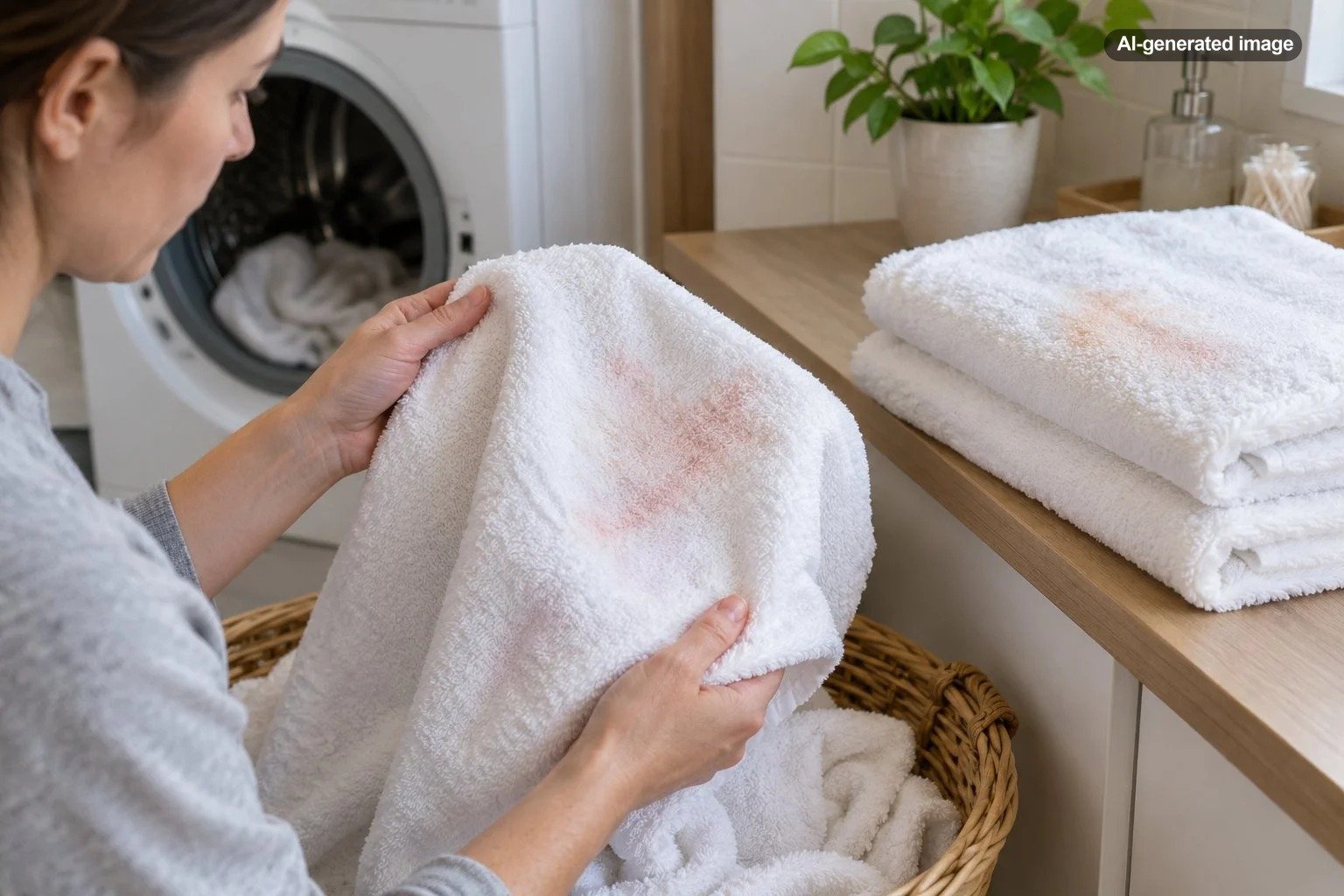
Why Do White Towels Develop Pink or Orange Stains?
Pink or orange marks on white towels usually have a fairly ordinary explanation: something is depositing color on the fabric, reacting with the wash water, or transferring from another item. Common culprits include iron or rust in the water, dye transfer, cosmetics and hair products, and residues picked up in a damp bathroom.
The pattern matters. If several white items develop rusty orange marks after washing, investigate the water and washer. If one towel turns uniformly pale pink, suspect dye transfer. If stains appear mainly on hand towels or face towels, look closely at the products being used before the towel ever reaches the laundry basket.
Orange stains often point to iron or rust
Iron is one of the most useful clues when white towels develop true rust-orange, reddish-brown, or yellow-orange marks. Iron can occur naturally in some water supplies or enter water from corroding plumbing. When dissolved iron is exposed to oxygen, it can produce the familiar orange-brown staining seen on plumbing fixtures and laundry.
This is especially worth investigating if orange discoloration affects several towels, sheets, or white garments rather than a single towel. Check sinks, tubs, toilet bowls, and other white fixtures for similar staining. A metallic-looking residue elsewhere in the house strengthens the case for a water-related cause.
Private-well households may notice the problem more readily because iron can occur naturally in groundwater. Penn State Extension notes that iron in water can produce orange or brown staining in laundry as well as on household fixtures.
Pink towels may simply be experiencing dye transfer
A white towel that becomes pink after laundering with a red, burgundy, coral, purple, or similarly saturated item may be dealing with ordinary dye transfer. Sometimes the change is obvious across much of the towel. Other times it appears as irregular pale patches where wet fabrics remained in contact.
New garments can be particularly troublesome because loose dye may be released during early washes. A stray colored washcloth, bath mat, pajama top, or sock can be enough to affect a load of whites.
If the discoloration happened immediately after a mixed-color wash and no orange staining is visible elsewhere in the home, dye transfer should be high on the list. Rewash the affected whites separately rather than repeatedly washing them with the item that may have caused the problem.
Personal-care products can leave surprisingly colorful marks
Face towels and hand towels live in a difficult neighborhood. They come into contact with makeup, hair color, self-tanning products, skin-care formulas, sunscreen, facial cleansers, and other products that may contain pigments, oils, or reactive ingredients.
Look at location as well as color. Small marks concentrated where someone dries the face, wipes makeup from the skin, or wraps freshly treated hair suggest a product-related stain more strongly than a plumbing problem. A towel used after applying self-tanner or hair color, for example, may show localized peach, pink, orange, or brown areas while every other towel remains normal.
The easiest test is behavioral rather than chemical: temporarily dedicate an older towel to the product you suspect. If the fresh white towels stop developing marks, you have probably found the source without subjecting the entire linen closet to experimental stain treatments.
How to narrow down the cause
- Separate the affected towel from the rest of the laundry and note whether the stain appeared before or after washing.
- Inspect other white fabrics from the same load. Multiple orange-stained items make a water or washer issue more plausible.
- Check sinks, tubs, toilets, and the washer area for orange, reddish-brown, or pink residue.
- Review what touched the towel before washing, including cosmetics, hair products, self-tanner, cleaning products, and colored fabrics.
- Wash white towels separately for several loads and see whether the problem stops.
- If widespread orange staining continues, investigate the water supply or plumbing rather than treating each towel as an isolated stain.
What about pink or orange residue in the bathroom?
Pink bathroom residue is a separate clue. Municipal water departments commonly identify reddish-pink films on continuously damp bathroom surfaces with the bacterium Serratia marcescens. It favors moist environments and can appear around drains, shower surfaces, toilet bowls, and other areas where water and residue linger.
That does not mean every pink towel stain is bacterial. A towel that turns pink in the washing machine is much more likely to have experienced dye transfer or contact with a colored product. But if damp towels are routinely left against an area that also develops pink or pink-orange film, clean the bathroom surface and change the drying routine rather than focusing only on the washing machine.
Allow towels to dry thoroughly between uses. Avoid leaving wet towels crumpled on the floor, trapped in a hamper, or pressed against consistently damp shower surfaces. Better drying also helps with the far more common problem of musty towel odor.
How should you treat a stained white towel?
Start conservatively. Check the care label, rinse or pretreat a fresh product stain promptly, and avoid drying the towel with high heat until you know whether the stain is gone. Heat can make some stains more difficult to address later.
For ordinary organic or cosmetic stains, use a laundry stain treatment that is appropriate for the fabric and follow its directions. For suspected dye transfer, keep the affected whites away from colored laundry while you work on the discoloration. For suspected rust, use a treatment specifically intended for iron or rust stains rather than assuming chlorine bleach is appropriate.
Do not mix stain removers or household chemicals. More chemistry is not automatically more cleaning power, and combining incompatible products can create dangerous fumes or damage fabric.
When the towel is telling you about a larger household problem
One stained face towel is usually a laundry mystery. An entire succession of orange-stained white laundry deserves a broader investigation.
If white fabrics repeatedly develop orange or reddish-brown marks and similar staining appears on fixtures, consider having the water evaluated, particularly in a home with a private well. If the problem began suddenly in a house that previously had clear water, plumbing changes, corrosion, or work on the water system may also deserve attention.
Likewise, persistent discoloration that appears only after machine washing may justify inspecting the washer for rusted components or accumulated residues. Follow the appliance manufacturer’s cleaning and service guidance rather than dismantling parts without appropriate instructions.
The fastest way to solve a mystery towel stain is to trace where the color appears before trying to overpower it in the wash.
How to keep white towels white
- Wash whites separately from strongly colored fabrics when dye transfer is a concern.
- Do not leave damp towels sitting against colored textiles.
- Give makeup, hair treatments, self-tanner, and other strongly pigmented products their own designated towel when practical.
- Hang towels so they can dry fully between uses.
- Investigate recurring orange staining on fixtures as well as laundry instead of repeatedly treating individual towels.
- Follow towel care labels and stain-remover directions rather than assuming every white fabric should receive the same bleach treatment.
FAQ
Why did my white towel turn pink in the washing machine?
Dye transfer is one of the first possibilities to check, especially if a red, pink, purple, or other saturated fabric was washed with it. Separate whites and colored laundry for the next few loads and see whether the problem stops.
Why are my towels getting orange spots after washing?
Orange or rust-colored spots across multiple items can indicate iron or rust associated with the water supply, plumbing, or occasionally the washer. Check other white laundry and household fixtures for similar discoloration.
Should I bleach orange stains on white towels?
Not until you know what caused them. If the orange mark is rust, chlorine bleach is a poor choice because it can make iron-related staining harder to remove. Use a treatment intended for the identified stain and compatible with the towel.
Does pink residue in my shower mean my water is contaminated?
Not necessarily. Municipal water guidance commonly attributes pink films on damp bathroom surfaces to environmental bacteria growing in the moist environment rather than to a problem originating in the drinking-water supply. Persistent water-quality concerns should still be evaluated through the appropriate local water provider or water-testing resource.