
Should You Turn Off Your Air Conditioner During a Hurricane?
A hurricane does not automatically mean your air conditioner must be switched off the moment the first rain band arrives. But when damaging winds, flooding, evacuation, or unstable electrical service become a realistic concern, shutting the system down can be the sensible choice. The key is understanding that the risk is not simply rain falling on an outdoor condenser designed to live outside. The bigger concerns are electrical interruptions, floodwater, wind-borne debris, and damage that may not be obvious when power returns.
For many homeowners, the practical approach is to cool the house normally while conditions are still safe and utility power is stable, then turn the system off if local officials advise shutting off electricity, if flooding threatens the equipment, if you evacuate, or if electrical service begins behaving abnormally. After the storm, do not automatically restart a system that has been flooded, struck by debris, or visibly damaged.
Why hurricanes create problems for air-conditioning systems
Central air-conditioning equipment is built for outdoor exposure, but hurricane conditions introduce stresses that ordinary summer weather does not. Strong winds can send branches, loose objects, roofing material, and other debris into an outdoor condenser. Floodwater can reach electrical components, controls, motors, and other parts that were never intended to operate while submerged.
FEMA notes that HVAC components are generally not flood resistant and may be damaged or destroyed by floodwater. Its hurricane and flood mitigation guidance also identifies wind and wind-borne debris as threats to exposed HVAC equipment. That distinction matters: an outdoor unit getting wet from rain is not the same situation as an outdoor unit sitting in storm-surge or floodwater.
Electrical service is another issue. Hurricanes frequently cause outages as trees, utility equipment, and power lines are damaged. FEMA’s power-outage guidance recommends unplugging appliances, equipment, and electronics where practical to reduce the risk of damage from electrical surges. A permanently wired central HVAC system cannot simply be unplugged like a television, which is one reason homeowners should understand how their thermostat, disconnect, and electrical panel relate to the system before storm season rather than experimenting during severe weather.
Should you turn the AC off before the hurricane arrives?
There is no universal rule that every residential air conditioner must be switched off whenever a hurricane warning is issued. Conditions vary dramatically between a tropical storm that passes offshore and a major hurricane making landfall near the home.
If your area still has stable utility power, there is no flooding threat at the property, and local emergency guidance does not call for shutting off electricity, you may choose to use the air conditioner while preparing. Cooling the house before a likely outage can also make the indoor environment more comfortable for a period after power is lost.
As conditions deteriorate, however, comfort becomes secondary to electrical and storm safety. If your utility or emergency-management authority gives specific instructions about shutting off electricity, follow those instructions. The National Weather Service advises people evacuating ahead of a hurricane to unplug electrical equipment and to shut off utilities when instructed by authorities.
What if the power starts flickering?
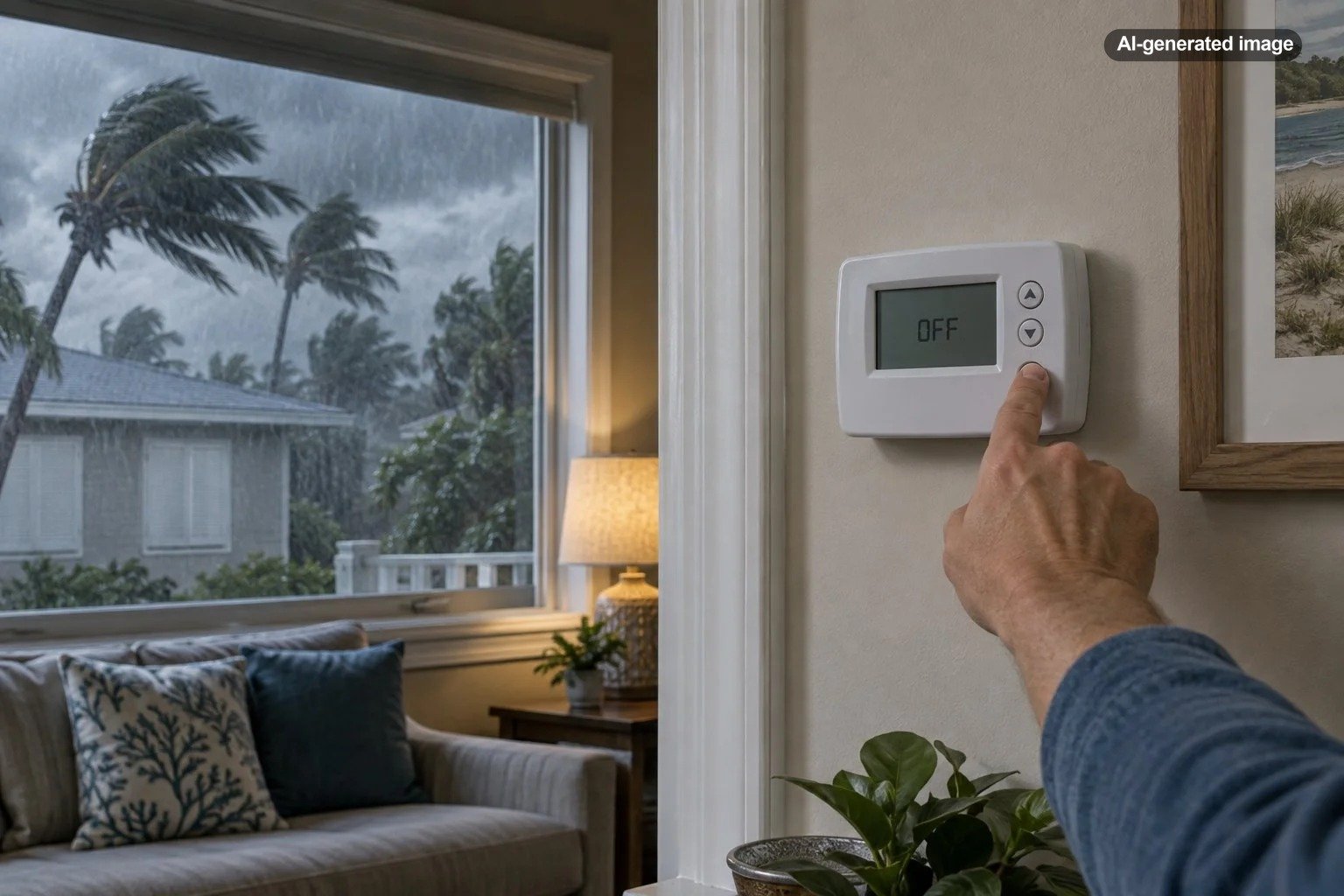
Repeated outages and restorations are a good reason to stop treating the air conditioner as business as usual. If lights are repeatedly dimming, power is cycling, or your utility is reporting widespread electrical problems, turning the HVAC system off at the thermostat can prevent it from repeatedly attempting to operate as service changes.
Do not walk outside during dangerous conditions to reach an HVAC disconnect, and do not open or operate electrical equipment in a wet or flooded area. FEMA specifically warns against touching electrical equipment when it is wet or when you are standing in water. If floodwater is threatening a home, electrical shutdown decisions should follow official safety guidance and should only be performed when it is safe to do so.
During a hurricane, protecting people comes before protecting the air conditioner.
What should you do if you evacuate?
Follow evacuation orders first. Do not delay leaving in order to perform last-minute HVAC work outside or to complete a complicated shutdown procedure.
If authorities instruct residents to shut off electricity before leaving and you can do so safely, follow that direction. National Weather Service hurricane preparedness guidance specifically notes that people may be instructed to shut off water, gas, and electricity before evacuating. Local instructions should take precedence because flood risk, utility conditions, and emergency procedures vary by location.
If no such instruction has been issued, avoid assuming that everyone should turn off a home’s main breaker. A main electrical shutdown affects refrigerators, sump pumps, alarms, communications equipment, and other systems as well as air conditioning. The right choice depends on the actual emergency conditions and guidance for your area.
Flooding changes the answer completely
If floodwater reaches an outdoor condenser, indoor air handler, electrical disconnect, duct components, controls, or other HVAC equipment, leave the system off. Do not test it simply because the power has returned.
Floodwater can affect electrical and mechanical components in ways that may not be visible from outside. FEMA’s HVAC mitigation guidance emphasizes that HVAC components are generally vulnerable to flood damage. A qualified HVAC professional should evaluate affected equipment before it is returned to service, and electrical equipment that has been submerged may require separate professional assessment.
How to restart your AC after the storm
If your home remained dry, the HVAC equipment appears undamaged, and utility power has been restored normally, restarting the system is usually less complicated. Even so, take a few minutes to inspect what you can safely see before asking the compressor to run.
What to do
- Wait until local officials say conditions are safe enough to inspect the property.
- Look around the outdoor unit from a safe distance for branches, displaced panels, obvious impact damage, leaning, or standing water.
- Check indoor areas for signs that the air handler, electrical equipment, or surrounding floor was flooded.
- If the system was switched off only at the thermostat and nothing appears damaged, follow the manufacturer’s normal operating instructions for your specific HVAC equipment.
- If anything looks damaged, flooded, loose, scorched, or abnormal, leave the system off and arrange professional evaluation.
Do not reach into the condenser to remove lodged debris, and do not attempt electrical repairs as part of post-storm cleanup. The period after a hurricane can contain hazards that were not present beforehand, including downed electrical lines, hidden flood damage, unstable structures, and damaged utility equipment.
Can a generator run your central air conditioner?
Possibly, but never assume that a portable generator can safely power a central air-conditioning system. HVAC equipment can have substantial starting and operating electrical demands, and generator capacity, wiring, transfer equipment, grounding, and the HVAC manufacturer’s requirements all matter.
Do not improvise a connection between a generator and household wiring. Generator installation or connection should follow the generator manufacturer’s instructions and applicable electrical requirements. The National Weather Service and FEMA also emphasize that portable generators must be operated outdoors because of carbon monoxide danger. Never run one inside a house, garage, or other enclosed living area.
Preparing the air conditioner before hurricane season
The best time to think about hurricane HVAC protection is well before a storm is approaching. Homeowners in hurricane-prone areas can include the air conditioner in the same seasonal inspection used for shutters, roof drainage, outdoor furniture, generators, and emergency supplies.
Before you decide
- Know which thermostat controls the system and where the relevant electrical panel and HVAC disconnect are located.
- Keep the area around the outdoor condenser free of loose objects that could become debris.
- Do not cover the condenser with an improvised tarp or enclosure while it is operating.
- Know whether the equipment sits in a location vulnerable to flooding or storm surge.
- Keep your HVAC contractor’s contact information available for post-storm inspection if damage occurs.
- Review local emergency-management and utility instructions before each storm rather than relying on generic social-media advice.
The bottom line
You do not have to turn off your air conditioner solely because a hurricane has been named or because rain has started. The decision should follow the actual hazards at your property. Stable power and ordinary rain are very different from flickering electrical service, mandatory evacuation, rising floodwater, destructive winds, or visible damage.
When those more serious conditions appear, shutting the system down may be appropriate, provided it can be done safely and consistently with local emergency instructions. Afterward, do not rush to restore cooling if the system has been flooded or damaged. A hot house is uncomfortable; energizing compromised electrical or HVAC equipment can create a much more serious problem.
Frequently asked questions
Should I turn the thermostat off if the power goes out?
If the utility power has failed, switching the HVAC system off at the thermostat can keep it from immediately calling for cooling when electricity returns. Follow any additional instructions issued by your utility, equipment manufacturer, or local authorities.
Does rain damage an outdoor AC condenser?
Outdoor condensers are intended to operate outdoors and are routinely exposed to rain. Hurricane flooding, storm surge, wind-driven debris, displacement, and electrical damage are different hazards and deserve more caution.
Can I restart an AC unit that was underwater?
Do not simply restart HVAC equipment that has been submerged or exposed to significant floodwater. Leave it off and have affected equipment evaluated by qualified professionals.
Should I cover my outdoor AC unit during a hurricane?
Avoid improvising a cover while the equipment is operating because the condenser requires airflow. If a manufacturer provides specific storm or storage instructions for your model, follow those instructions. Never go outside during dangerous winds to install or remove a cover.
What if my AC breaker trips after the hurricane?
A breaker that trips after a storm can indicate an electrical or equipment problem. Do not repeatedly reset it. Leave the system off and arrange an inspection, particularly if the unit experienced flooding, impact damage, or visible electrical damage.