

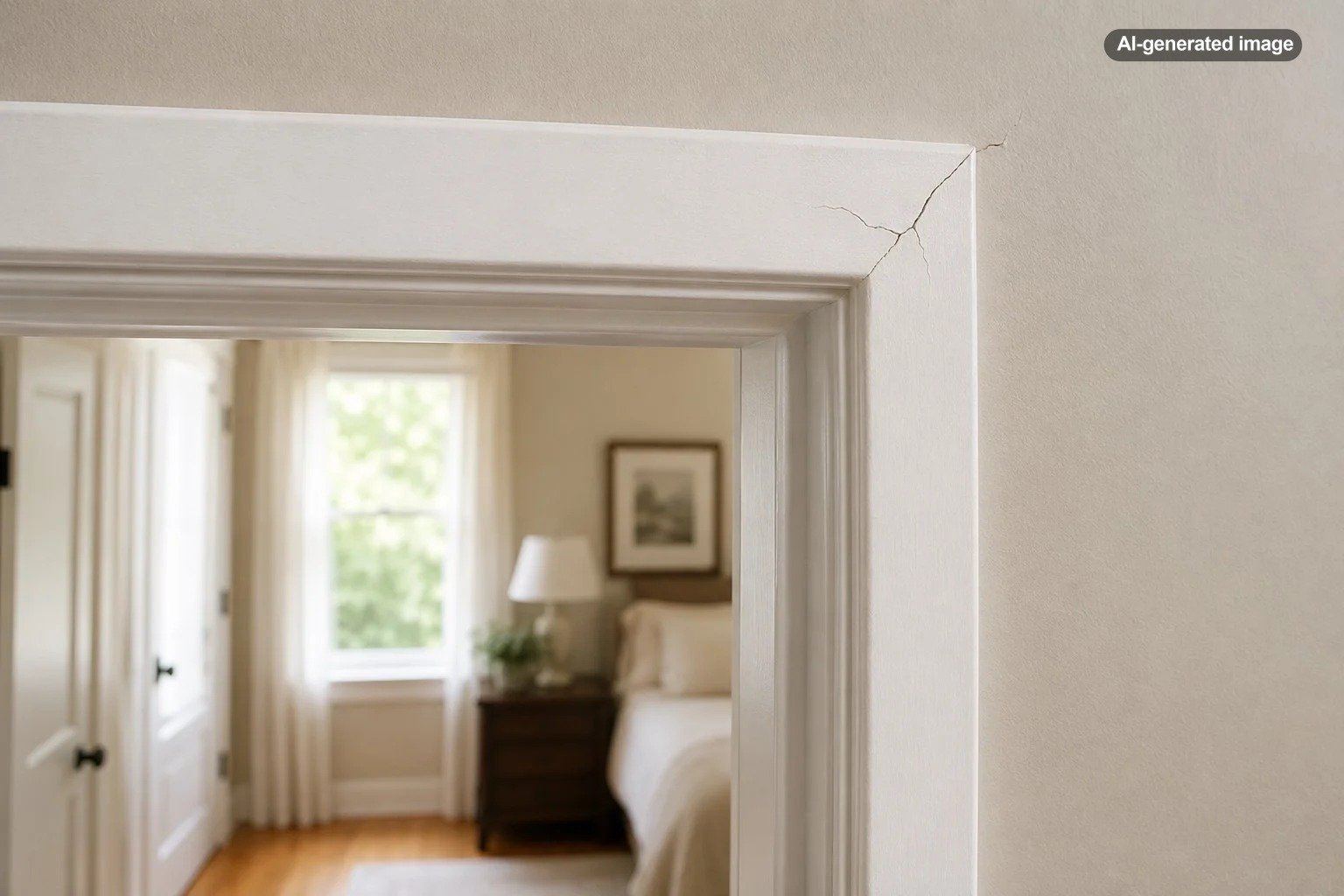
Why Does My Door Frame Crack Near the Corners?
A crack that starts at the corner of a door frame is often caused by movement rather than a problem with the door itself. Drywall, joint compound, wood framing, and the rest of the house do not all expand, shrink, and flex at exactly the same rate. Door openings also interrupt an otherwise continuous wall, which can concentrate stress at their corners.
Many small, stable cracks are cosmetic. A crack deserves more attention, however, when it is widening, repeatedly returns after repair, appears alongside sticking doors or uneven floors, or is part of a broader pattern of movement elsewhere in the house.
Why door corners are common places for cracks
A doorway creates a large opening in a framed wall. Instead of having uninterrupted drywall and framing from floor to ceiling, the wall has to transfer loads and accommodate movement around the opening. The upper corners become natural stress-concentration points.
The Gypsum Association notes that movement in a building structure is a common explanation for cracking in gypsum board systems and specifically describes cracking that can extend from the top corner of a door frame. USG likewise identifies thermal, moisture-related, and structural movement as causes of gypsum-board joint cracking.
That does not mean every crack indicates structural trouble. Houses move slightly for ordinary reasons, including changes in wood moisture content, temperature changes, seasonal humidity, and normal deflection of framing. Drywall finishes are relatively rigid, so small movements can become visible there even when the framing remains serviceable.
Start by looking at the shape of the crack
The appearance of the crack cannot diagnose the house by itself, but it can help you decide what to investigate next.
A thin diagonal crack from one upper corner
This is a familiar drywall-crack pattern around door openings. It may follow a joint or develop where stress is concentrated near the opening. If it stays narrow and unchanged and the door still operates normally, it is often reasonable to document and monitor it before making a cosmetic repair.
A crack that follows a drywall seam
If you can trace the crack along what appears to be a taped joint, the finish itself may be involved. Joint cracking can occur when building components move, and environmental conditions can also affect gypsum-board finishing materials.
Cracks at several doors or windows
A single small crack is different from a pattern appearing across the house. Multiple cracks accompanied by doors or windows that have gone out of square deserve closer investigation because the visible drywall may simply be revealing movement occurring elsewhere.
Check whether the door has changed too
Open and close the door slowly. Notice whether it rubs the jamb, drags on the floor, swings by itself when it previously stayed put, or requires noticeably more force to latch. Look at the narrow gaps between the door slab and jamb. A visibly different gap from top to bottom can indicate that the opening is no longer as square as it once was, although hinge wear, loose screws, paint buildup, or an altered door can produce similar symptoms.
Also inspect the trim. Small separations at mitered casing joints may reflect seasonal wood movement rather than drywall failure. If both the wall and trim are changing in the same area, however, take photographs and monitor the entire opening instead of treating each cosmetic symptom independently.
Consider what has recently changed
Timing can narrow the possibilities. A crack appearing soon after drywall work may relate to finishing or movement as construction materials dry and acclimate. A recurring seasonal crack may correspond with temperature or humidity changes. A new crack after significant construction, water intrusion, an impact, or noticeable foundation movement calls for a different level of scrutiny.
Wood framing is particularly responsive to moisture. Building Science Corporation has discussed the basic mismatch between moving wood framing and comparatively rigid drywall, including details intended to reduce cracking by allowing some movement between the two.
How to monitor a crack before repairing it
If there are no obvious warning signs, monitoring is often more useful than immediately hiding the crack. A fresh coat of compound and paint can erase the evidence you need to determine whether the movement has stopped.
What to do
- Photograph the crack straight on and include a ruler or other fixed scale beside it.
- Write down the date and note whether the door sticks, rubs, or latches differently.
- Check nearby doors, windows, ceilings, floors, and wall-to-ceiling joints for changes.
- Repeat the photograph from approximately the same position periodically or whenever you notice a change.
- If the crack grows or additional symptoms develop, stop treating it as an isolated finish defect and arrange an appropriate professional evaluation.
A pencil mark placed at the end of a crack can also make extension easier to notice, provided you are comfortable marking the wall. The goal is not to diagnose structural movement yourself. It is to establish whether the condition is stable or changing.
When a door-corner crack deserves professional evaluation
Cracking becomes more concerning when it is one element of a larger pattern. FEMA materials addressing building damage identify conditions such as drywall cracks, doors that are out of plumb, sticking or out-of-square windows, uneven floors, gaps between walls and ceilings, and foundation settlement or cracking as observations that can justify closer investigation.
Who you call depends on what you observe. A drywall contractor can address a stable finish defect. A carpenter can evaluate problems localized to the door, jamb, trim, or framing around an opening. When symptoms suggest broader structural or foundation movement, an appropriately qualified structural professional is a better starting point than repeatedly repairing the visible crack.
When it makes sense to repair the drywall
Once you have reasonable confidence that the crack is cosmetic and stable, the repair should address more than the paint surface. Simply painting over a crack rarely lasts because paint has little ability to bridge continued movement.
A typical drywall repair may involve removing loose material, addressing failed joint tape when present, applying compatible tape and joint compound as appropriate, feathering the repair beyond the damaged area, sanding after it has fully dried, priming the repaired surface, and repainting. The exact method depends on whether the crack is in a drywall joint, at the edge of a panel, in plaster, or in another wall system.
If the crack has already been repaired several times in precisely the same place, repeating the identical cosmetic repair is not much of a strategy. Recurrence is useful evidence that movement may still be occurring or that the previous repair did not accommodate the way the wall is behaving.
Do not confuse the door frame with the wall finish
Homeowners often describe any crack near a doorway as a cracked door frame, but several materials meet in that small area. The visible line may be in painted drywall, plaster, caulk, casing, a miter joint, the jamb, or the surrounding wall. Identifying which material actually cracked is an important first step.
A tiny opening at a painted trim joint may need a very different repair from a diagonal crack running several inches into gypsum board. Likewise, a split in the wood jamb itself is not the same symptom as cracking in the wall above it.
The useful question is not simply whether a crack exists, but whether the doorway and the rest of the house are changing with it.
Can you prevent cracks from coming back?
You cannot eliminate every bit of normal building movement, but recurring cracks should not automatically be accepted as a painting chore. Maintaining reasonably stable indoor conditions can reduce extreme changes in some finish materials, while proper drywall detailing can help accommodate movement in appropriate locations.
During a renovation, tell the contractor about any crack that has repeatedly returned rather than presenting the wall as a blank slate. Its history can influence how the opening, framing, drywall joints, and repair details are evaluated.
FAQ
Does a crack above a door mean my foundation is failing?
No. A crack above a door can result from ordinary drywall or framing movement and does not, by itself, establish a foundation problem. Foundation or structural evaluation becomes more appropriate when the crack is changing or appears alongside additional movement-related symptoms.
Why is the crack diagonal instead of straight?
The corner of an opening is a place where stresses can concentrate, so cracks can propagate diagonally away from that point. The shape is useful as an observation but is not enough to determine the underlying cause.
Should I patch the crack immediately?
If it is new and you do not know whether it is changing, photograph and monitor it first unless there is an urgent reason to investigate. Once the condition appears stable and no broader warning signs are present, a cosmetic repair becomes more sensible.
Why does the same crack keep returning after painting?
Paint alone does not correct movement or repair a failed drywall joint. Recurring cracks may mean the wall is still moving or that the underlying joint and finish need a more appropriate repair.