What Direction Should a Ceiling Fan Turn in Summer?
In summer, a ceiling fan should generally turn counterclockwise when viewed from below. That rotation pushes air downward, creating the breeze you want to feel across your skin on a warm day. The fan is not actually lowering the temperature of the room; it is helping the people in the room feel cooler through increased air movement.
That distinction matters because simply switching on a fan in an empty room does not provide the same benefit as running it while someone is there. The useful summer setting is the one that produces a noticeable downward breeze where people sit, sleep, work, or relax.
Why counterclockwise is the usual summer setting
Ceiling fan blades are angled rather than perfectly flat. When the motor turns them in the summer direction, that blade pitch drives air downward into the occupied part of the room. The moving air passes over your skin and makes warm conditions feel more comfortable.
ENERGY STAR recommends counterclockwise operation during summer specifically because it creates this downward airflow and wind-chill effect. It also emphasizes an important point: ceiling fans cool people rather than rooms, so there is little reason to leave one running after everyone has left.
The right summer direction is less about memorizing clockwise versus counterclockwise and more about confirming that the fan is sending a comfortable breeze downward.
How to check your ceiling fan direction
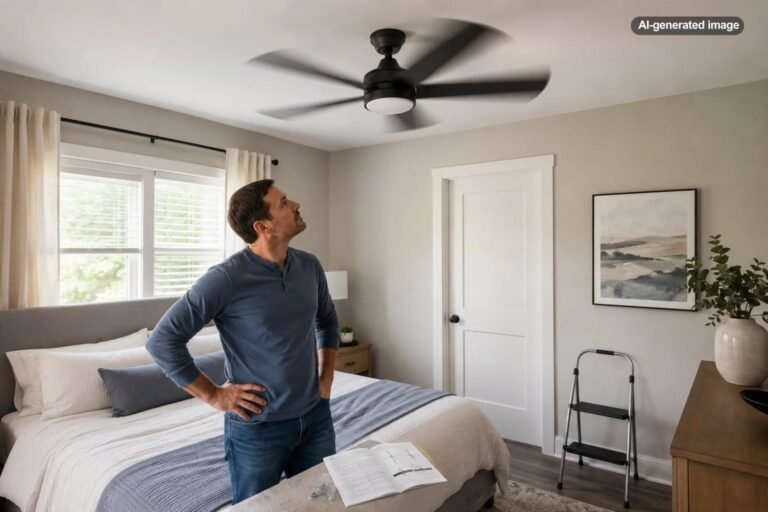
You do not need a ladder just to determine whether the fan is moving air the right way. Start by standing beneath it and paying attention to what you feel.
What to do
- Turn the fan on and select a moderate or higher speed.
- Stand several feet beneath the center of the fan.
- Look upward and note the direction in which the blades appear to rotate.
- More importantly, check whether you feel a distinct breeze being pushed downward.
- If there is little direct airflow and your fan is reversible, stop the fan completely and change its direction according to the manufacturer’s instructions.
On the usual summer setting, the blades appear to move counterclockwise from your viewpoint below the fan. If you are unsure because the blade design makes the motion difficult to judge, use the airflow test instead. A strong downward breeze is the practical result you are looking for.
Where is the reverse switch?
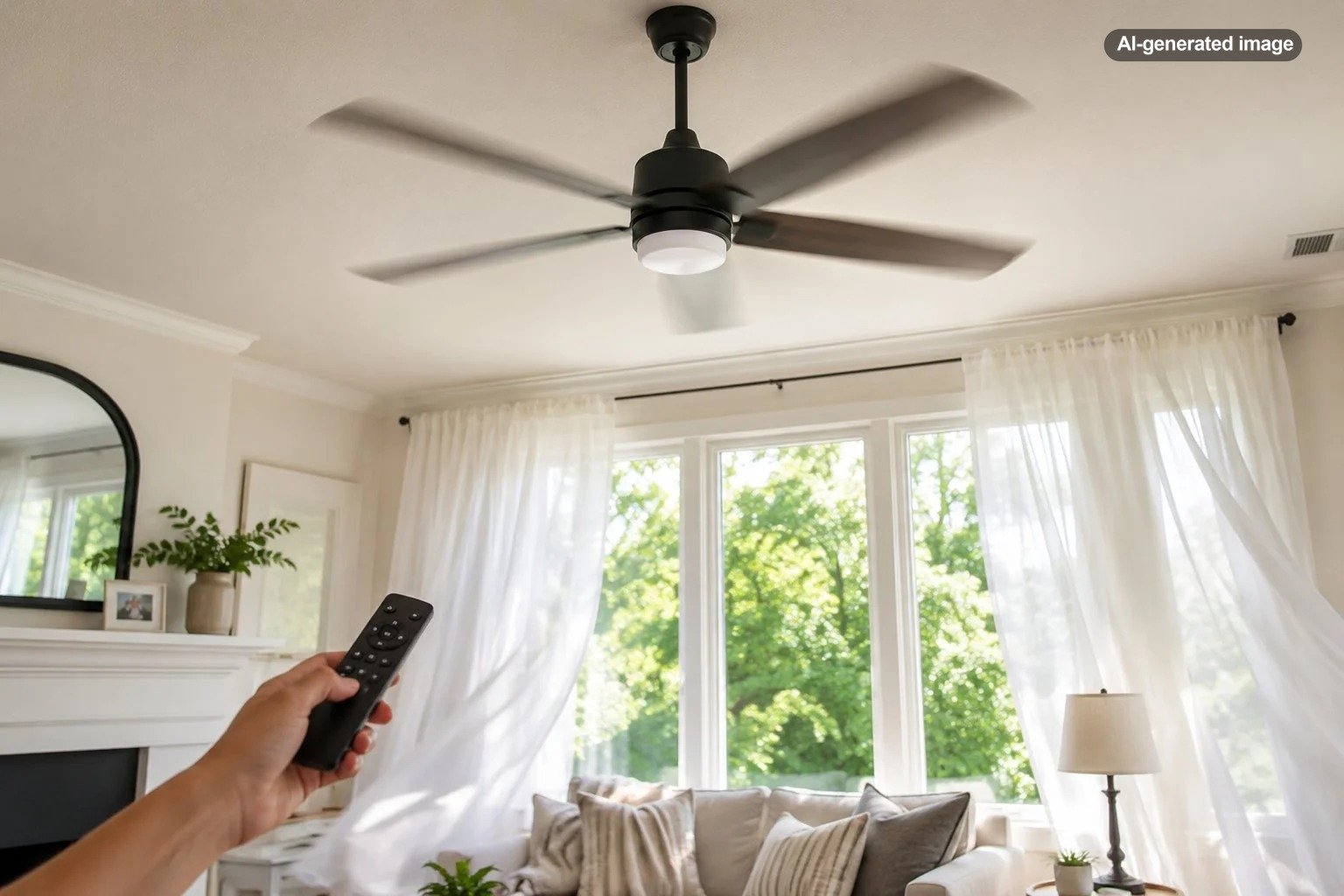
The direction control varies by fan. Traditional models often have a small slide switch on the motor housing, while other fans use a wall control, remote control, pull-chain arrangement, or app-based control. ENERGY STAR recognizes several types of airflow-direction controls, so there is no single location that applies to every fan.
If you cannot find a physical reverse switch, check the original remote or the manufacturer’s instructions for your exact model. Do not assume that a button with an unfamiliar symbol changes direction, particularly on a fan with separate lighting and speed functions.
What if your fan is already counterclockwise but the room still feels warm?
Direction is only one part of ceiling fan performance. If the fan is rotating the right way but you barely feel air beneath it, look at speed, placement, blade clearance, and the fan’s suitability for the room.
A fan set to a very low speed may create only subtle airflow. A fan mounted close to the ceiling can also behave differently from one suspended farther below it because the blades need access to surrounding air. ENERGY STAR notes that mounting configuration and clearance affect airflow, and low-profile or hugger fans may move less air than comparable fans with more space above the blades.
Room layout matters too. A fan can make a seating area feel pleasantly breezy while leaving a distant corner relatively still. In a large or unusually shaped room, one centrally located fan may not provide even comfort everywhere.
Should you leave the ceiling fan on all day?
Usually, there is no comfort advantage to running a ceiling fan in an unoccupied room. Unlike an air-conditioning system, a ceiling fan does not remove heat from the indoor air. Its main summer benefit comes from air moving across people.
That is why ENERGY STAR recommends switching ceiling fans off when a room is empty. When you return, the fan can provide its cooling sensation almost immediately after you turn it back on.
If you use a fan alongside air conditioning, think of the two systems as doing different jobs. The air conditioner changes indoor temperature and humidity, while the ceiling fan helps occupants feel more comfortable through air movement. A fan can therefore make a conditioned room feel better without being a substitute for the cooling system itself.
Why does the direction change in winter?
The familiar seasonal rule is counterclockwise in summer and clockwise at low speed in winter. During cooler months, clockwise operation is generally used to create a gentle upward airflow. This helps circulate warm air that collects near the ceiling without producing the stronger downward breeze desired in summer.
The U.S. Department of Energy likewise describes clockwise, low-speed operation as the winter approach for circulating warmer air. That is why many reversible ceiling fans include two directions even though the hardware itself does not change with the season.
Do all fans follow the same clockwise and counterclockwise rule?
The counterclockwise-for-summer rule applies to the typical reversible residential ceiling fan, but the best test is still airflow. Blade orientation, motor design, and unusual fan configurations can make visual assumptions less useful than simply checking whether air is being pushed downward.
For that reason, if a fan’s behavior seems inconsistent with the usual rule, consult its manual rather than forcing the control into a particular position. The manufacturer’s instructions are the right source for model-specific operation.
Frequently asked questions
Should a ceiling fan push air down in summer?
Yes. The usual summer setup creates downward airflow so that people beneath the fan feel a breeze.
Is counterclockwise always the summer direction?
For most conventional reversible residential ceiling fans, yes. When viewed from underneath, counterclockwise rotation generally produces the desired downward summer airflow. Confirm it by feeling for a breeze.
Does a ceiling fan actually make the room colder?
No. A ceiling fan mainly makes occupants feel cooler by moving air across the skin. It does not cool an empty room in the way an air conditioner lowers indoor air temperature.
Should I use high or low speed in summer?
Use the speed that gives you comfortable airflow. Warmer conditions or larger occupied areas may call for a higher speed, while a low setting may be enough for sleeping or mild weather.
What should I do if the fan will not reverse?
Check the fan’s remote, wall control, motor housing, or manual for a direction control. If the fan is supposed to be reversible but the control does not work, follow the manufacturer’s troubleshooting instructions or have the fan evaluated rather than opening electrical components without appropriate knowledge.
The simplest summer rule
If you remember only one thing, remember the breeze: in summer, your ceiling fan should move air downward toward the people in the room. On most household fans, that means counterclockwise rotation when you look up at the blades.
Once the direction is correct, choose a comfortable speed and switch the fan off when the room is empty. It is a small seasonal adjustment, but it can make a bedroom, living room, office, or covered indoor space feel noticeably more comfortable during warm weather.