Can You Roast Food Over a Gas Fire Pit?
You can roast food over some gas fire pits, but only if the manufacturer specifically permits cooking or food roasting on that model. A clean-burning propane or natural-gas flame does not automatically make every decorative fire pit a cooking appliance. Burner design, fire media, clearances, grease exposure, and the manufacturer’s instructions all matter.
That distinction is especially important with fire pit tables and decorative bowls. A marshmallow held briefly over a permitted flame is very different from putting burgers, bacon, or a dripping skewer above a burner that was designed only to provide warmth and ambiance.
Why a Gas Fire Pit Is Not Automatically a Grill
A gas fire pit and a gas grill may both burn propane or natural gas, but they are designed for different jobs. A grill is built around controlled cooking: it provides a cooking grate, manages dripping fat and food residue, and positions burners in a configuration intended to heat food.
A decorative gas fire pit is generally designed to create visible flame and radiant warmth. Its burner may sit beneath lava rock, ceramic logs, glass media, or another decorative material. Allowing melted sugar, grease, marinades, or food fragments to fall into that assembly can create residue, odors, flare-ups, blocked burner openings, or cleaning problems.
The fuel may be familiar, but the appliance’s intended use is what determines whether cooking belongs over the flame.
What About Marshmallows?
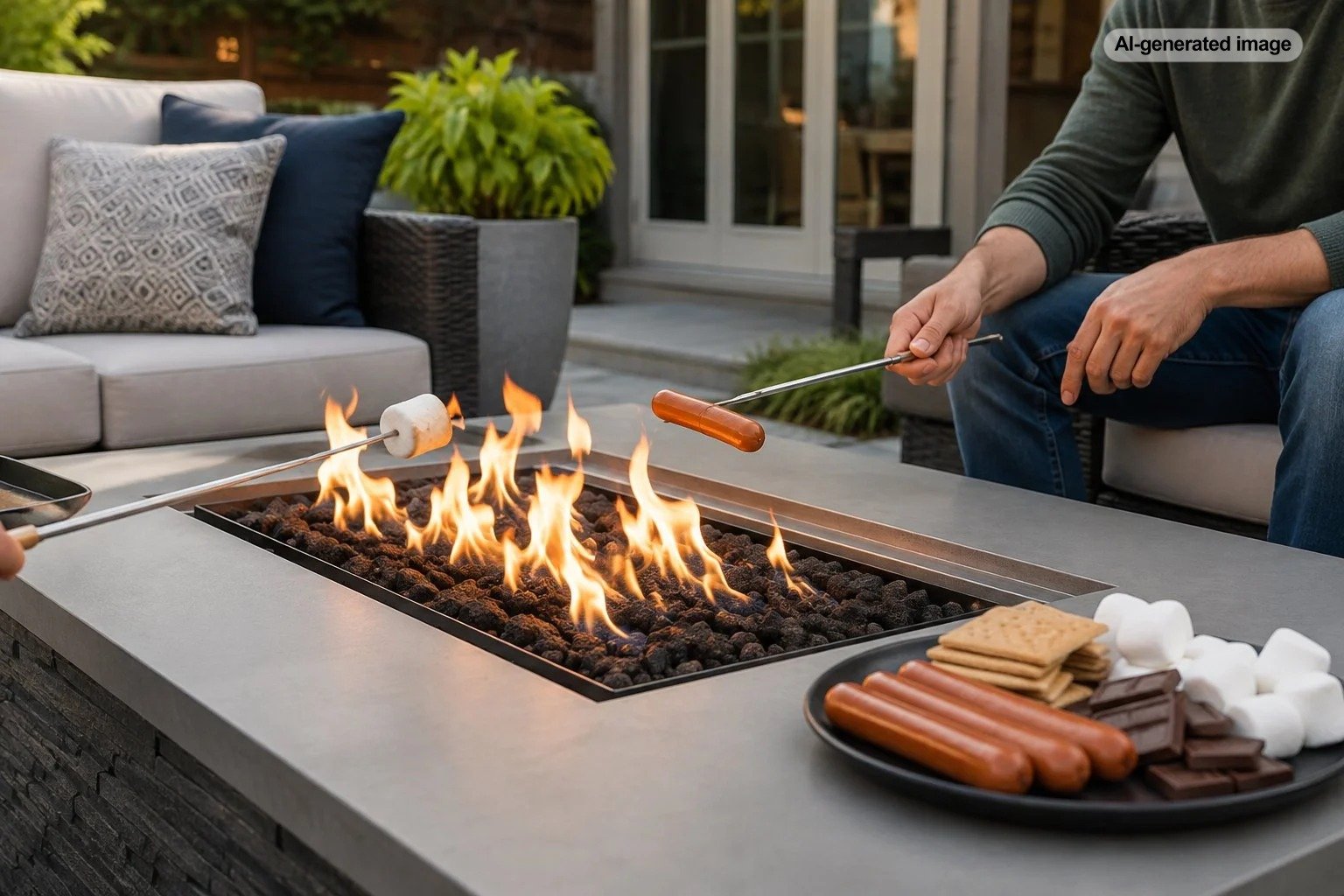
Marshmallows are the food most people have in mind when they ask this question. They do not drip fat like meat, and they are normally held on a long roasting stick rather than placed on a grate. Even so, the same rule applies: confirm that your fire pit’s manufacturer permits it.
If roasting is allowed, keep the marshmallow above the flame rather than pressing it into decorative media. A marshmallow that slips off a skewer can melt into burner ports, fire glass, or lava rock and become surprisingly difficult to remove. Let the unit cool completely before attempting any cleanup, and follow the manufacturer’s cleaning directions.
It is also worth keeping children from leaning over the fire pit to get a better angle. A long roasting utensil allows the person using it to remain farther from the burner and hot surrounding surfaces.
Foods That Create More Problems
Even when a fire pit permits simple roasting, that does not necessarily mean it should be used like an open grill. Fatty and heavily sauced foods introduce a different set of problems.
| Food or method | Main concern | Better approach |
|---|---|---|
| Marshmallows | Melted sugar falling into the burner or media | Use only if the manufacturer permits roasting and keep food securely on a long skewer |
| Hot dogs | Fat and juices can drip onto burner components | Use a purpose-built grill unless the fire pit is specifically approved for this use |
| Meat kebabs | Grease, marinades, and raw-food handling complicate the setup | Cook on a grill designed for food |
| Pans or cookware | Weight, heat concentration, and unstable placement | Do not place cookware on a decorative fire pit unless the manufacturer specifies an approved cooking accessory |
A good practical dividing line is whether food can drip substantially. The more grease, sauce, or food debris involved, the stronger the case for moving the cooking to an actual grill.
Do Propane Flames Make Food Taste Like Gas?
Propane is routinely used as a cooking fuel in appliances designed for that purpose. The issue with a fire pit is therefore not simply that it burns propane. The more important question is whether the complete appliance, including its burner, media, ventilation, clearances, and accessories, is intended to be used around food.
If you notice an unusual gas odor, abnormal flame behavior, soot, or difficulty keeping the burner lit, stop using the appliance and follow the manufacturer’s troubleshooting instructions. Do not continue roasting food while trying to determine whether the burner or fuel supply is operating correctly.
Keep Fire Media Out of the Cooking Equation
Decorative fire media is another reason not to assume that a gas fire pit can double as a grill. Fire glass, lava rock, and ceramic components are there to complement the burner system, not serve as a cooking surface.
Do not rest food, skewers, pans, foil packets, or cooking grates directly on decorative media unless your fire pit’s instructions explicitly describe that setup. An improvised grate can be unstable, and adding objects over a burner can change heat exposure in ways the appliance was not designed to handle.
A Safer Way to Decide
What to do
- Find the exact model number of your gas fire pit.
- Read the owner’s manual and look specifically for cooking, roasting, food, grilling, and accessory instructions.
- If cooking is prohibited, do not use the fire pit for food.
- If the manual does not address food use, contact the manufacturer rather than assuming it is permitted.
- If roasting is allowed, use only the accessories and operating practices the manufacturer recommends.
- Keep combustible objects away from the fire and maintain the required clearances around the unit.
- Have an appropriate means of extinguishing a fire readily available and supervise the fire pit whenever it is operating.
The Consumer Product Safety Commission recommends keeping a hose or fire extinguisher nearby when using backyard fire pits and avoiding use when wildfire risk is high. Those general precautions remain important even with a controlled gas flame.
Do Not Modify a Decorative Fire Pit Into a Grill
Adding a generic grate to the top of a fire pit can look like an easy solution, but it may introduce problems that are not obvious from above. A grate can concentrate heat, interfere with the intended flame pattern, place food drippings directly over the burner, or encourage users to put heavy cookware on surfaces that were not designed to support it.
If you want one outdoor feature that provides both fire and food preparation, look for a product specifically designed and documented for both functions. Otherwise, keeping a small grill near the fire pit is usually the cleaner and more predictable arrangement.
What About Indoor or Covered Spaces?
Do not move an outdoor gas fire pit indoors in order to roast food. Outdoor gas appliances must be used only in locations permitted by their manufacturer, with the specified ventilation and clearances. A screened porch, covered patio, pergola, balcony, or similar space can also have restrictions that depend on the particular appliance and setting.
Follow the fire pit’s installation and operating instructions rather than relying on a general rule about how much open air seems sufficient. Local fire rules, property rules, lease terms, and condominium or homeowners association restrictions can also differ.
Frequently Asked Questions
Can you roast marshmallows over a propane fire pit?
Sometimes. It is reasonable only when the fire pit manufacturer permits food roasting on the specific model. Keep melted marshmallow and other debris out of the burner and decorative media.
Can you cook hot dogs over a gas fire pit?
Only if the appliance is specifically designed or approved for that use. Hot dogs can release fat and juices, so a conventional grill is usually a more suitable cooking appliance.
Can you put a grill grate on a gas fire pit?
Not unless the manufacturer identifies a grate or cooking accessory as compatible with the fire pit. A generic grate can alter heat exposure and allow grease to fall into components that were not designed for cooking.
Can you use a pan over a gas fire pit?
Do not place a pan on a decorative fire pit unless the manufacturer’s instructions specifically support cookware and explain how it should be positioned. Improvised pan supports can be unstable and may expose the appliance to concentrated heat.
What is the simplest alternative?
Use the fire pit for warmth and atmosphere and cook on a nearby outdoor grill or another appliance designed for food preparation. You still get the pleasure of eating beside the fire without asking one appliance to perform a job it may not have been designed to do.