
Are Steam Mops Safe for Luxury Vinyl Plank Flooring?
Steam mops are not automatically safe for luxury vinyl plank flooring. Some flooring manufacturers prohibit them outright, while others may allow limited use on certain products under specific conditions. The safest answer is to follow the care instructions for your exact flooring brand and collection rather than relying on a steam mop label that simply says it is suitable for sealed floors.
Luxury vinyl plank, commonly called LVP, is water resistant and often waterproof at the surface. That does not mean it is designed to withstand concentrated heat, pressurized moisture, or repeated exposure to steam around seams and edges.
Why steam can be risky for luxury vinyl plank
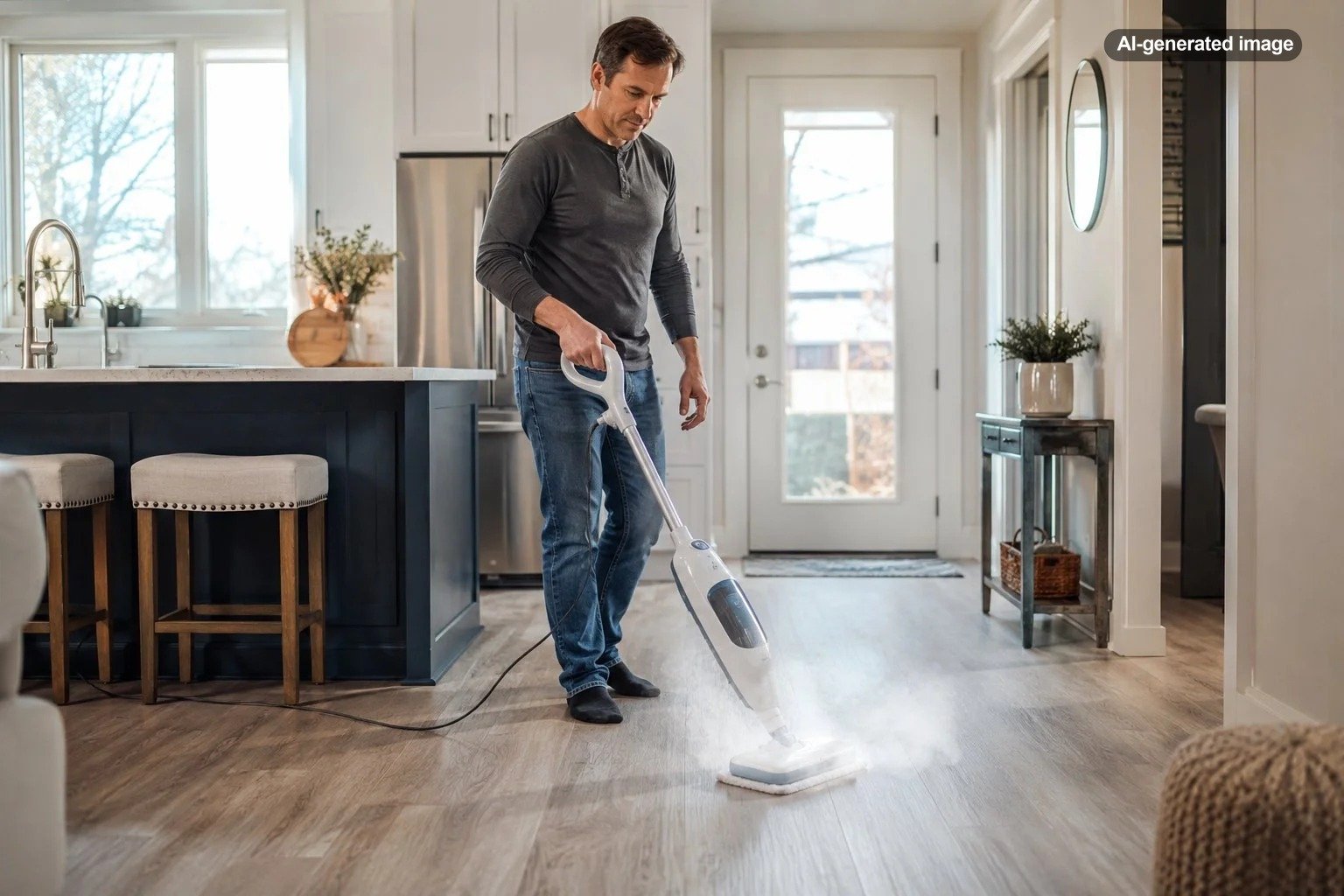
A steam mop cleans by heating water and forcing hot vapor through a pad onto the floor. That combination can loosen grime quickly, but it creates several concerns for layered vinyl flooring.
Heat can affect the plank and its finish
LVP is made from multiple layers that may include a wear layer, printed design layer, vinyl core, attached backing, and locking or adhesive components. Excess heat can potentially soften, distort, discolor, or dull materials that were not designed for steam exposure. Damage may not appear immediately after one use. Repeated heating can be the larger concern.
Moisture can reach joints and edges
The top surface of many vinyl planks resists spills well, but steam behaves differently from a small puddle wiped up promptly. Vapor can move toward plank seams, perimeter gaps, damaged edges, and transitions. Once moisture reaches beneath the visible surface, it may become trapped between the flooring and subfloor.
Adhesive installations have another vulnerability
Glue-down LVP depends on the continued performance of its adhesive. Heat and moisture may weaken some adhesive systems or contribute to lifted corners and loose areas. Floating click-lock floors do not rely on full-spread adhesive, but their joints and underlayment can still be affected by moisture intrusion or excessive heat.
Check both the flooring guide and the steam mop manual
Before using any powered cleaning appliance, identify the exact flooring product. A purchase receipt, leftover carton, installer paperwork, online order history, or label on a spare plank may provide the manufacturer and collection name.
Then review the current cleaning and maintenance guide. Look specifically for language involving steam cleaners, steam mops, heat, wet mopping, approved cleaning solutions, and warranty exclusions. A general statement that the floor is waterproof is not enough.
You should also check the steam mop manual. Some appliance instructions allow use on certain sealed hard floors but tell owners to consult the flooring manufacturer first. That places the final compatibility decision with the flooring maker, not the mop company.
Before you decide
- Confirm whether the floor is LVP, sheet vinyl, laminate, or another material.
- Find the manufacturer, collection, and installation type.
- Read the current floor-care instructions rather than a retailer summary.
- Check whether steam use affects warranty coverage.
- Inspect for open seams, loose planks, chips, lifting edges, or damaged transitions.
- Choose the more conservative method when documentation is unclear.
What about low steam settings?
A low setting may produce less heat and moisture than a maximum setting, but it does not make steam universally safe. The mop head can pause over a stubborn spot, the pad can become saturated, or vapor can collect along edges. Those variables make real-world use less controlled than a simple setting label suggests.
Recommendations such as keep the mop moving or use the lowest setting only matter when the flooring manufacturer already allows steam. They should not be used to work around a clear prohibition.
A gentle setting cannot override the care instructions written for the floor beneath it.
A safer routine for cleaning LVP
Most routine soil does not require steam. Luxury vinyl usually responds well to frequent dry cleaning and occasional damp mopping with minimal liquid.
What to do
- Remove loose grit. Vacuum with a hard-floor setting or use a soft broom or dry microfiber pad. Grit left under a wet mop can act like fine sandpaper.
- Blot fresh spills. Absorb liquid promptly instead of spreading it across several planks.
- Use a lightly damp microfiber mop. The pad should be damp enough to clean but not leave puddles or a wet trail.
- Apply an approved cleaner sparingly. Follow the flooring manufacturer’s dilution and application directions.
- Work in small sections. Rinse or replace dirty pads so soil is lifted rather than redistributed.
- Allow the floor to dry. Wipe up water that gathers near walls, cabinets, transitions, or seams.
A spray mop can be convenient because it limits the amount of liquid placed on the floor. A traditional microfiber mop also works when it is wrung thoroughly. The important distinction is moisture control, not whether the handle contains a tank.
Cleaning methods to approach carefully
More cleaner is not necessarily more effective. Heavy soap residue can leave LVP streaky, sticky, and quick to attract dirt. Abrasive powders, scouring pads, waxes, polishes, solvent-heavy products, and highly acidic or alkaline mixtures may affect the wear layer or create a difficult residue.
Homemade recipes also deserve caution. A mixture commonly recommended online may not be approved for your finish. When the floor manufacturer lists an approved product or cleaner type, that guidance should take priority.
| Cleaning method | Typical risk level for LVP | Best use |
|---|---|---|
| Dry microfiber mop | Low | Dust, hair, and light grit |
| Hard-floor vacuum setting | Low when the brush does not scratch | Crumbs and tracked-in debris |
| Lightly damp microfiber mop | Generally low when approved | Routine cleaning |
| Wet string mop | Higher because it can leave excess water | Usually unnecessary for LVP |
| Steam mop | Potentially high unless specifically permitted | Only when the exact flooring instructions allow it |
When a steam mop may be permitted
A limited number of flooring products may have instructions that permit steam cleaning under defined conditions. These might include using the lowest setting, attaching a particular pad, keeping the tool moving, avoiding prolonged contact, or limiting the frequency of use.
Those instructions apply only to the named product and installation conditions. They should not be generalized to every floor that looks similar. Two wood-look vinyl planks can have different cores, wear layers, edge treatments, backing materials, and warranties.
Signs that steam or excess moisture may have caused damage
Stop using the steam mop if you notice curled edges, new gaps, lifted corners, cloudy or dull patches, soft areas, changes in texture, or moisture emerging at seams. These symptoms can have more than one cause, so they do not prove that steam is responsible. They do justify a closer inspection.
Photograph the affected area, locate the flooring documentation, and contact the manufacturer, retailer, or a qualified flooring professional before attempting a repair. Avoid adding more water or heat while trying to flatten or clean the area.
Frequently asked questions
Can I steam mop waterproof vinyl plank flooring?
Not unless the flooring manufacturer explicitly says steam is allowed. Waterproof construction does not automatically mean the floor can tolerate high heat and vapor.
Will one use of a steam mop ruin LVP?
Not necessarily, but damage is possible depending on the flooring, temperature, dwell time, seam condition, and installation. If no change is visible, discontinue steam use until compatibility is confirmed.
What is the best type of mop for luxury vinyl plank?
A soft microfiber mop that uses very little water is a reliable general choice. Pair it with a cleaner approved by the flooring manufacturer.
Can I use a steam mop if I move it quickly?
Moving continuously may reduce concentrated exposure, but it does not make a prohibited method acceptable. Follow the flooring instructions first.
How often should LVP be damp mopped?
Clean based on household traffic and visible soil rather than soaking the entire floor on a rigid schedule. Regular vacuuming or dry mopping can reduce how often damp cleaning is needed.
The bottom line
Steam mops offer speed and heat, but those advantages are not worth gambling with an unknown LVP product. Unless the exact flooring documentation clearly permits steam, use a lightly damp microfiber mop and an approved cleaner. It is a quieter, less dramatic method, which is precisely why it is often the smarter one.