
What Is the Best Countertop Material for a Busy Kitchen?
For most busy kitchens, engineered quartz is the best all-around countertop material. It is nonporous, does not require routine sealing, cleans easily, and is available in enough colors and patterns to work with nearly any kitchen style. It is particularly well suited to households that want a polished appearance without turning countertop care into another weekly responsibility.
That does not make quartz the automatic winner for every home. Granite may be better for cooks who prioritize heat tolerance and natural variation. Porcelain offers impressive resistance to heat, staining, and sunlight, while solid surface is unusually repairable. Laminate remains a practical choice for tighter renovation budgets, and stainless steel makes sense in kitchens where performance matters more than a pristine, furniture-like finish.
What makes a countertop suitable for a busy kitchen?
A hardworking countertop must withstand more than an occasional dinner party. It may serve as a breakfast station, food-preparation surface, homework desk, grocery landing zone, and temporary home for small appliances, all before lunch.
The most useful comparison is therefore not simply which material is hardest. A successful surface must balance several qualities:
- Stain resistance: How forgiving is the material when coffee, tomato sauce, oil, juice, or food coloring sits longer than intended?
- Heat tolerance: How vulnerable is it to hot cookware, countertop appliances, and sudden temperature changes?
- Scratch and impact resistance: Will knives, dropped cans, heavy cookware, or rough ceramics leave visible damage?
- Maintenance: Does it require sealing, polishing, specialty cleaners, or careful stain removal?
- Repairability: Can chips, scratches, burns, or damaged seams be corrected without replacing a large section?
- Visual forgiveness: Does the color and finish disguise crumbs, fingerprints, water spots, and ordinary wear?
No countertop is immune to misuse. Even a durable surface benefits from cutting boards, trivets, prompt spill cleanup, and sensible handling of heavy cookware. The goal is not to find an indestructible material, but one whose weaknesses fit comfortably within your household’s habits.
How the leading countertop materials compare
| Material | Best quality | Main tradeoff | Best fit |
|---|---|---|---|
| Engineered quartz | Low-maintenance, nonporous surface | Hot cookware can damage the resin | Most active family kitchens |
| Granite | Natural beauty and strong heat resistance | Some slabs require periodic sealing | Frequent cooks who like natural stone |
| Porcelain | Excellent heat, stain, and UV resistance | Edges may chip and fabrication is specialized | Bright kitchens and indoor-outdoor designs |
| Solid surface | Scratches and damage can often be repaired | More vulnerable to heat and scratching | Seamless designs and repair-minded owners |
| Laminate | Affordable and easy to clean | Heat, cuts, and moisture at seams can cause damage | Budget-conscious renovations |
| Stainless steel | Nonporous and highly heat resistant | Shows scratches, dents, and fingerprints | Serious cooking and commercial-inspired kitchens |
Engineered quartz: the strongest all-around choice
Engineered quartz combines mineral content with pigments and binding resins to create a dense, consistent slab. Its greatest advantage in a busy kitchen is its nonporous surface. Unlike many natural stones, it does not need routine sealing, and everyday spills can usually be handled with mild soap, water, and a soft cloth.
Quartz also provides considerable design control. A homeowner can choose a quiet, nearly solid color, a dramatic marble-inspired pattern, or a subtle aggregate appearance without having to accept the unpredictable markings found in natural stone. That consistency can make seams, pattern placement, and coordination with cabinetry easier to plan.
Heat is the important limitation. Quartz may be described as heat resistant, but the resin component can be discolored or damaged by very hot cookware. Manufacturer care guidance generally calls for trivets or hot pads. Cutting directly on the surface is also unwise, both to protect the finish and to avoid dulling knives.
Advantages
- No routine sealing
- Strong resistance to everyday stains
- Wide selection of predictable patterns
- Simple daily cleaning
Tradeoffs
- Requires protection from high heat
- Chipped edges can be difficult to disguise
- Manufactured patterns may not satisfy natural-stone purists
Granite: best for natural character and heat-conscious cooks
Granite remains a strong kitchen material because it combines hardness, heat resistance, and one-of-a-kind appearance. Each slab has its own mineral pattern, so the countertop becomes a genuine natural feature rather than a repeated printed design.
For cooks who regularly handle hot roasting pans, cast-iron skillets, and heavy cookware, granite may feel more forgiving than resin-bound quartz. The Natural Stone Institute nevertheless discourages placing concentrated heat directly on stone because a sudden temperature difference can contribute to cracking. A trivet is still a sensible habit.
Maintenance varies from slab to slab. Some dense granites resist absorption well, while others benefit from an impregnating sealer. Before buying, ask the fabricator about the specific stone rather than assuming all granite needs the same schedule. Highly patterned slabs can hide crumbs and minor marks beautifully, although they may also make small spills harder to see.
Porcelain: a high-performance option with a refined look
Large-format porcelain slabs have become a serious countertop option rather than merely a tile alternative. Porcelain is fired at high temperatures and performs well against heat, staining, and sunlight. That UV resistance can be useful in kitchens with intense natural light or in designs that visually connect indoor and outdoor cooking areas.
Porcelain can reproduce marble, concrete, metal, and stone effects with impressive clarity. The printed design, however, is generally concentrated at the surface rather than continuing through the full slab. A chipped edge may therefore be more noticeable, especially on a dark or strongly patterned selection.
Fabrication quality is crucial. Thin slabs, detailed edge treatments, sink cutouts, and transportation require installers who regularly work with the material. Porcelain is a compelling choice for an active kitchen, but it should be purchased as a complete fabrication-and-installation decision rather than judged only by the sample’s appearance.
Solid surface: best when repairability and seamlessness matter
Solid-surface material offers a softer, quieter visual character than many stone products. It can be joined with inconspicuous seams and formed into integrated sinks or backsplashes, reducing the crevices where grime tends to collect.
Its standout advantage is renewability. Because the material is consistent through its thickness, many fine scratches, blotches, and other forms of damage can be sanded, refinished, or professionally repaired. That can be reassuring in a kitchen expected to remain in service for many years.
The compromise is that solid surface scratches more readily than quartz or granite and needs protection from hot cookware. Dark, glossy colors tend to reveal marks more quickly than pale or softly patterned finishes. For an active household, a lighter matte selection is usually more visually forgiving.
Laminate: the practical budget choice
Modern laminate offers a broader and more convincing range of stone, wood, and solid-color designs than many homeowners expect. It is nonporous at the surface, easy to wipe clean, and significantly less expensive than most slab materials. That makes it useful for starter homes, rentals, secondary kitchens, and renovations in which cabinetry or appliances deserve a larger share of the budget.
Its vulnerabilities are concentrated around heat, sharp objects, impact, and water penetration at seams or sink cutouts. A damaged laminate surface generally cannot be polished back to its original condition. Hot pads and cutting boards are therefore not optional niceties; they are part of normal ownership.
Installation details matter. Well-sealed sink openings, carefully bonded edges, and thoughtfully placed seams can make a meaningful difference in longevity. A textured or softly patterned finish will usually disguise routine wear better than a dark, high-gloss surface.
Stainless steel: the performance-first choice
Stainless steel is familiar in restaurant kitchens for good reasons. It is nonporous, easy to sanitize, tolerant of heat, and unaffected by many spills that would worry owners of pale stone. Sinks and countertops can also be integrated for a smooth, efficient work zone.
The material will scratch, and those scratches are not necessarily a defect. Over time, they merge into a patina that reflects regular use. Homeowners who expect every inch to remain mirror-perfect may find stainless steel frustrating, particularly under strong lighting that highlights fingerprints and smudges.
It works best when chosen deliberately for a professional or contemporary kitchen, perhaps on a baking station or hard-use island rather than throughout the entire room.
The best countertop is not the one with the fewest weaknesses; it is the one whose weaknesses are easiest for your household to manage.
Choose the material according to how your kitchen really operates
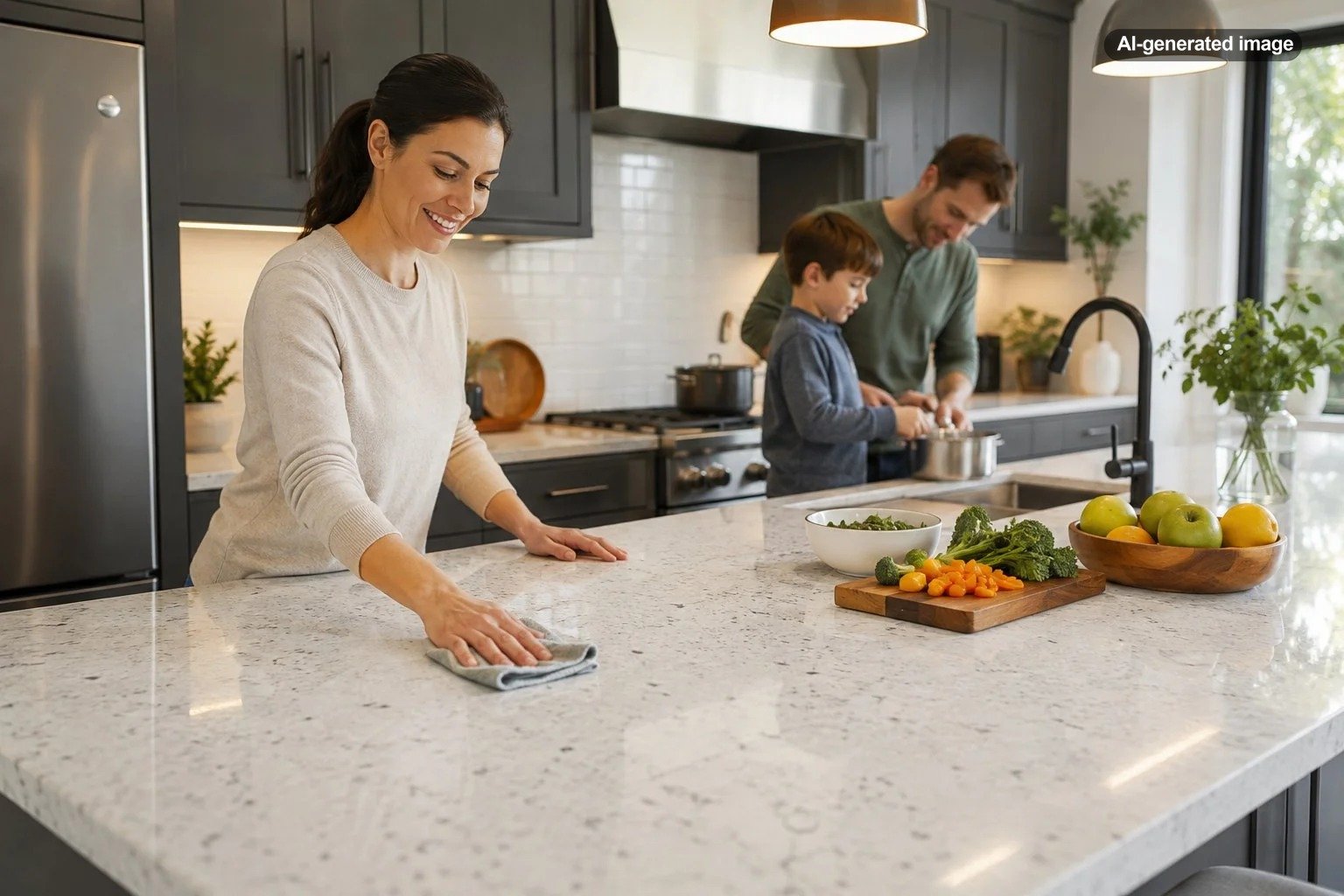
A family kitchen with children, frequent snacks, and hurried cleanup will usually benefit most from quartz. A dedicated home cook who is willing to monitor sealing may prefer granite. A bright coastal-style kitchen with strong sunlight may make porcelain particularly appealing. A household that expects scratches but values the ability to refinish them may be happier with solid surface.
Color and finish can matter almost as much as the material category. Very dark counters reveal dust, fingerprints, water marks, and fine scratches. Brilliant white counters make crumbs easy to spot but may show strongly colored spills. Midtone patterns with gentle movement tend to be the most forgiving in daily use.
Before you decide
- Bring home a sample and view it in morning, afternoon, and evening light.
- Place common cabinet, flooring, backsplash, and paint samples beside it.
- Ask whether the displayed finish requires different care from the polished version.
- Confirm how seams, corners, sink cutouts, and exposed edges will be handled.
- Review the exact manufacturer’s cleaning and heat-protection instructions.
- Choose a fabricator with experience in the specific material and edge profile.
What countertop mistakes cause the most regret?
One frequent mistake is choosing entirely by appearance. A pristine showroom slab has not yet encountered a slow cooker, lemon juice, cast-iron pan, school project, or leaking grocery bag. Understanding the care routine before installation is more useful than discovering it afterward.
Another mistake is assuming broad material labels guarantee identical performance. Natural stones vary, quartz brands use different formulations, porcelain slabs come in different thicknesses, and specialty finishes may require more maintenance than polished versions.
Finally, do not overlook fabrication. Poorly supported overhangs, awkward seams, vulnerable sink cutouts, and careless edge work can undermine an otherwise excellent material. The countertop and the workmanship should be evaluated as one purchase.
Frequently asked questions
Which countertop is easiest to maintain?
Engineered quartz is generally the easiest premium countertop to maintain because it is nonporous and does not require routine sealing. Laminate is also simple to clean, but it is less tolerant of heat, cuts, and water entering damaged seams.
Which countertop handles hot pans best?
Stainless steel, porcelain, and granite generally tolerate heat better than quartz, solid surface, and laminate. Even so, using a trivet protects against thermal shock, discoloration, adhesive damage, and other avoidable problems.
What is the best countertop for a home with children?
Quartz is often the most balanced choice because spills do not readily penetrate it and everyday cleaning is straightforward. Select a softly patterned or midtone finish that does not advertise every fingerprint and crumb.
Can one kitchen use more than one countertop material?
Yes. A stainless-steel baking zone, butcher-block chopping area, or contrasting island can serve a specific function while the main perimeter uses quartz, granite, or another low-maintenance surface. The transitions should be planned carefully so the combination feels intentional.
Is marble a good choice for a very busy kitchen?
Marble can be used successfully, but it develops etching, scratches, and patina more readily than quartz or granite. It is best for homeowners who genuinely appreciate natural aging rather than those seeking an unchanged, spotless appearance.
The final verdict
Engineered quartz is the best countertop material for most busy kitchens because it asks relatively little of the household while delivering reliable stain resistance, straightforward cleaning, and broad design flexibility. Its main rule is simple: protect it from direct high heat.
Granite, porcelain, solid surface, laminate, and stainless steel can each be the better choice when a particular priority outweighs all others. Match the material to your cooking habits, tolerance for visible wear, maintenance preferences, lighting, and renovation budget. A countertop that supports ordinary life gracefully will remain satisfying long after the sample-board excitement has faded.