Should a Ceiling Fan Be Centered Over a Dining Table?
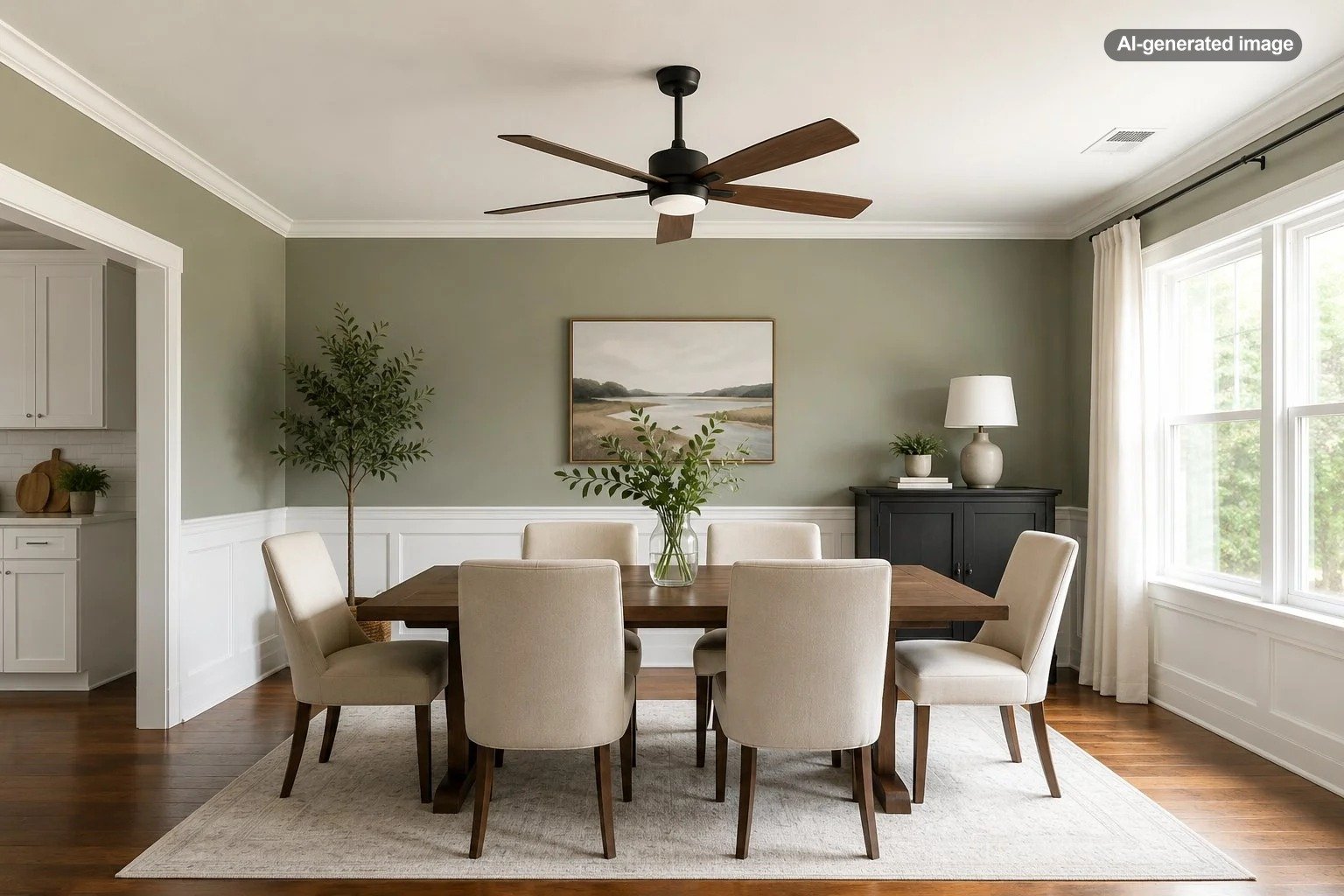
In most dining rooms, a ceiling fan looks best centered over the dining table when the table itself is centered within the room or dining zone. But that is not an absolute rule. The fan also has to work with the room’s architecture, safe blade clearances, lighting plan, furniture layout, and the possibility that the table may move later.
The useful distinction is between visual centering and functional centering. A fan can be perfectly centered over a table yet feel oddly placed in the room, while a fan centered within the architectural space may sit slightly off the table and still look completely intentional.
Start With the Dining Zone, Not Just the Table
The easiest mistake is treating the tabletop as the only reference point. Before choosing a fan location, look at the boundaries of the dining space itself.
In a traditional enclosed dining room, the architectural center of the room and the center of the table are often close to the same point. In that case, centering the fan over the table is usually straightforward and visually satisfying.
Open-concept homes are different. A dining table might occupy one end of a large kitchen-living area, sit beside an island, or be shifted to preserve a walkway. In those rooms, identify the center of the dining zone rather than automatically using the center of the entire ceiling.
Look at the rug, walls, windows, built-ins, major walkways, and adjacent furniture. Together, those elements often reveal the visual boundaries of the eating area more clearly than the room dimensions do.
The best fan location is the point where the room, the table, and the ceiling all appear to agree.
When Centering the Fan Over the Table Works Best
A table-centered fan is especially effective when the dining table is unlikely to move and acts as the dominant focal point. Round and square tables make this relationship particularly easy to read because both the table and fan radiate from a clearly defined center.
Rectangular tables can work just as well. Align the fan’s motor housing with the midpoint of the tabletop rather than trying to make the tips of the blades correspond with chair positions or table edges.
Table-centered placement also helps establish hierarchy in large or open rooms. The fan becomes an overhead marker that says, visually, that this portion of the floor plan is the dining area.
When the Fan Should Not Follow the Table
There are several situations in which following the table too literally creates a worse result.
The table is frequently extended or repositioned
If an expandable dining table changes length for holidays or entertaining, its everyday center may not represent the long-term center of the arrangement. Think about where the table sits in both configurations before committing to a permanent electrical location.
The architecture has a stronger centerline
Ceiling beams, coffers, trays, vaulted ceilings, prominent windows, fireplaces, and symmetrical openings can establish a powerful visual axis. Moving a fan several inches purely to match furniture may make the ceiling look noticeably unbalanced.
The dining area is asymmetrical
Sometimes a table is intentionally shifted to create circulation space. A fan can remain centered within the usable dining zone even if that means it is not mathematically centered above the tabletop.
Another ceiling fixture affects the composition
Recessed lighting, pendants, track lighting, speakers, skylights, and nearby fixtures may influence the most practical fan position. A well-planned ceiling should read as one composition rather than a collection of unrelated objects.
Fan Size Matters as Much as Fan Position
A correctly centered fan can still look awkward when its diameter is wrong for the space. The fan should relate primarily to the room or dining zone rather than simply matching the table width.
Hunter Fan’s current dining-room guidance, for example, groups fan blade spans by room dimensions, with smaller fans suggested for compact breakfast areas and larger spans for larger dining rooms and open-concept spaces. The manufacturer also recommends centering a dining-room fan over the table when practical.
The larger lesson is that a small table does not automatically call for a tiny fan, and a large table does not justify a fan whose blades crowd nearby walls or architectural elements. Measure the room first, then evaluate the table as part of the composition.
Before you decide
- Mark the architectural center of the dining room or dining zone.
- Mark the center of the table in its normal position.
- Check whether the table changes size or location when entertaining.
- Confirm the proposed blade span fits the surrounding space.
- Consider nearby recessed lights, pendants, beams, doors, and other obstructions.
- Check the fan manufacturer’s installation and clearance requirements before installation.
Do Not Sacrifice Safe Clearance for Perfect Symmetry
Ceiling-fan placement is not purely decorative. Blade height and clearance from walls and obstructions have to be considered before fine-tuning the visual alignment.
Hunter’s installation guidance states that its fan blades should be at least 7 feet above the floor and that blade tips should maintain 30 inches of clearance from the nearest wall or obstruction. Its guidance also calls for a ceiling-fan-approved electrical box or appropriate structural support and recommends following applicable electrical requirements and the instructions for the specific fan.
What About a Ceiling Fan With a Light?
A fan with an integrated light can simplify a dining-room ceiling, but it changes the visual effect compared with a traditional pendant or chandelier. The fan becomes both the airflow source and a prominent lighting element, making alignment with the table more noticeable.
Before relying on the fan light alone, consider how the dining surface will actually be illuminated. Recessed lights, wall sconces, lamps, or other layers may still be useful depending on the room and the type of light the fan provides.
If the room already has a decorative chandelier directly over the table, adding a fan nearby can create competing focal points. In that situation, the better solution may be a different lighting plan, a fan without an integrated light, or a fan located in an adjacent part of a larger open space. The right choice depends on the ceiling layout and how important airflow is at the table.
A Simple Way to Test the Placement Before Installation
Because a ceiling fan is harder to reposition than a chair or rug, it is worth testing the proposed location visually before electrical work begins.
What to do
- Measure the dining area and identify its architectural center.
- Measure the table and mark its midpoint on the floor.
- Use painter’s tape to mark both centerlines if they differ.
- Stand at the room’s main entrances and view the proposed fan location from several angles.
- Check how the position relates to windows, doors, cabinetry, beams, rugs, and adjacent rooms.
- Verify blade span, mounting height, obstruction clearance, structural support, and the manufacturer’s instructions before finalizing the installation point.
This exercise is especially valuable when the architectural center and table center differ by only a few inches. A small discrepancy that seems important on a tape measure may be visually irrelevant, while shifting the fan can make the ceiling noticeably less balanced.
Should You Center the Fan Over a Round, Square, or Rectangular Table?
Round tables: Centering is usually the most natural solution because both elements have obvious central points.
Square tables: Centering also tends to look crisp and intentional, particularly in square dining rooms.
Rectangular tables: Align the motor housing with the midpoint of the table. The fan does not need to imitate the table’s proportions.
Extendable tables: Consider the midpoint in both everyday and extended configurations. If those positions differ considerably, centering within the dining zone may be more practical than centering over the table’s everyday position.
The Bottom Line
Yes, a ceiling fan should often be centered over a dining table, particularly when the table is a permanent focal point in a clearly defined dining room. That alignment creates an orderly relationship between the furniture and the ceiling and can make an open dining zone feel more intentional.
But the table should not overrule the architecture or installation requirements. If the room has a strong ceiling centerline, an expandable or movable table, nearby obstacles, or an asymmetrical layout, a slightly different fan location may produce the better result.
Use the table as an important reference point, not the only one. The strongest placement is the one that looks balanced from the room’s main viewpoints, provides useful airflow, respects required clearances, and still makes sense if the furniture arrangement changes.