Should You Put Extra Toilet Paper Where Guests Can See It?
Yes, guests should generally be able to see or easily find at least one extra roll of toilet paper. It is less about displaying bathroom supplies and more about preventing the awkward moment when someone has to open unfamiliar cabinets, search drawers, or call through the door for help.
The best arrangement is simple: keep one or two backup rolls within obvious reach of the toilet while storing the rest of your supply elsewhere. Done neatly, visible toilet paper does not make a bathroom look unfinished. It makes the room feel thoughtfully prepared.
Why visible backup toilet paper is usually the better choice
A guest bathroom has a slightly different job from a private primary bathroom. People using it may not know where anything is stored, and they are unlikely to feel comfortable exploring drawers or closets. Supplies that residents can find automatically may be effectively hidden from a visitor.
That is why accessibility matters more than absolute visual minimalism. A beautifully styled powder room can still feel inconvenient if the only spare rolls are behind an unlabeled cabinet door across the room.
The goal is not to turn toilet paper into decor. The goal is to make the backup unmistakably available without letting it dominate the room.
A well-prepared guest bathroom quietly answers small questions before anyone has to ask them.
How many extra rolls should guests be able to see?
For most bathrooms, one or two visible backup rolls are enough. That provides a clear reserve without creating the impression that bulk household storage has migrated into the powder room.
A heavily used guest bath, vacation home, or bathroom serving several overnight visitors may justify three or four accessible rolls. A tiny powder room used mainly for short visits usually needs only one obvious spare.
| Bathroom situation | Practical visible reserve | Why it works |
|---|---|---|
| Small powder room | 1 spare roll | Keeps clutter low while providing an obvious backup |
| Typical guest bathroom | 1-2 spare rolls | Balances convenience and a tidy appearance |
| Bathroom for overnight guests | 2-4 accessible rolls | Reduces the need to restock during a longer stay |
| Main household bathroom | Enough for normal household use | Convenience may matter more than keeping supplies visually minimal |
Where should you put the extra rolls?
The best location is close enough to the toilet that someone can reach or identify the spare without wandering around the bathroom. That still leaves plenty of room for a setup that suits the style and size of the space.
Use a small basket
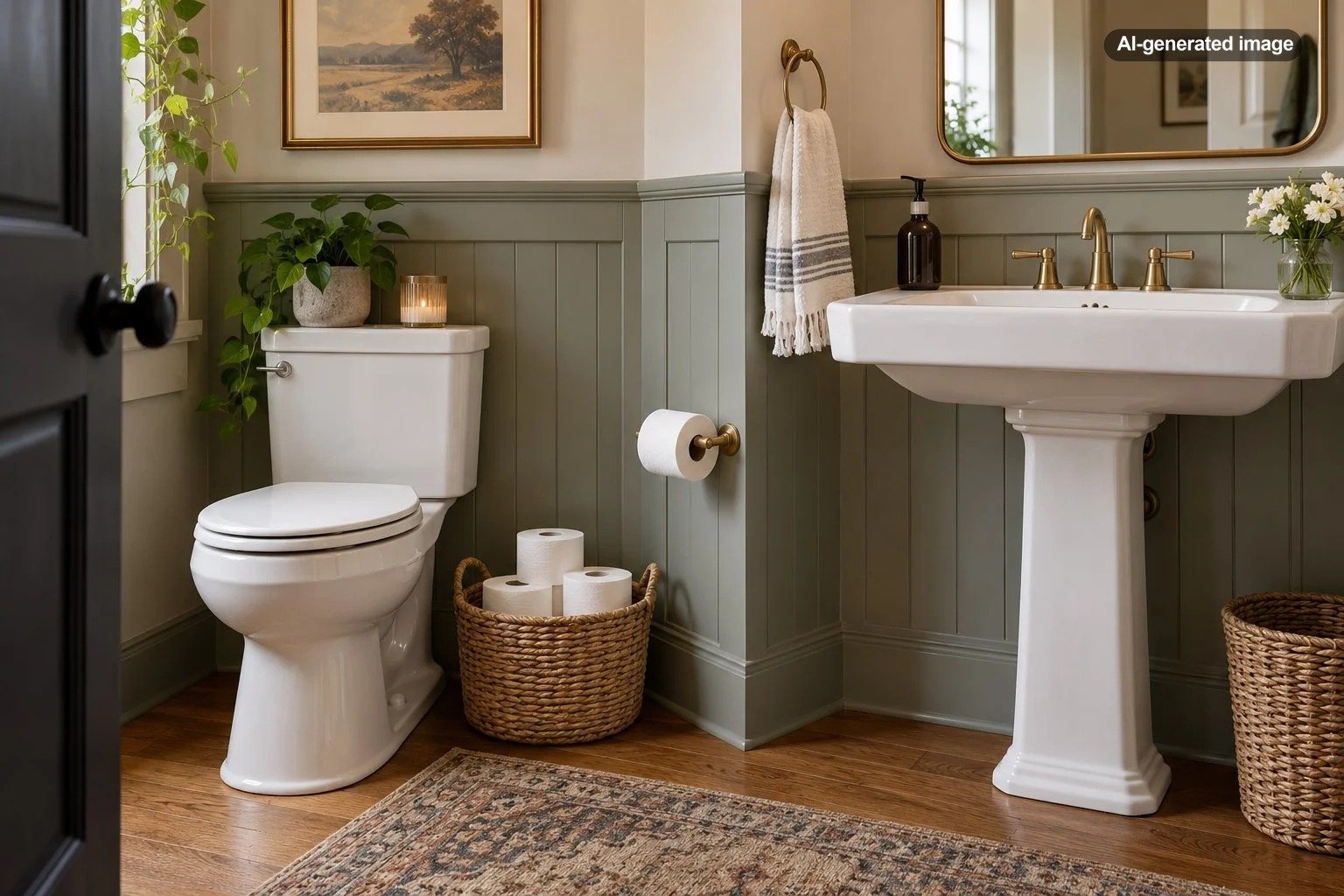
A compact basket beside the toilet is one of the easiest solutions. It contains the rolls visually, gives them a defined place, and can work with traditional, coastal, rustic, or relaxed interiors. Choose a size that fits the number of rolls you actually intend to keep there rather than an oversized basket that becomes general bathroom storage.
Use a slim freestanding holder
When floor space is tight, a narrow vertical holder can use the small gap beside the toilet without occupying much room. This approach works particularly well in apartments, powder rooms, and bathrooms without generous vanity storage.
Place rolls on an open shelf
A shelf above or near the toilet can work if it is stable, uncluttered, and easy to reach. One or two neatly arranged rolls generally look more intentional than a tall stack. If the shelf already contains decorative objects, towels, or toiletries, leave enough visual breathing room that the toilet paper does not become part of a crowded display.
Use an open vanity cubby
If the bathroom vanity includes open storage, a few rolls can be placed in a basket or neatly grouped in a lower cubby. This keeps them visible enough for a guest to understand where they are while making them less prominent than rolls sitting beside the toilet.
What if you prefer a very minimal bathroom?
You do not have to leave several bare rolls in plain view. A lidded or partially enclosed container can preserve a cleaner visual line as long as its purpose is reasonably obvious. Another option is to keep one visible roll and place additional backups inside the vanity.
What matters is avoiding storage that requires guests to solve a puzzle. If every spare roll is concealed behind identical drawers or cabinets, consider leaving one accessible backup outside the closed storage.
Should toilet paper be kept in its plastic packaging?
Usually not in a guest-facing area. Large plastic multipacks are practical for household storage, but they tend to add unnecessary visual bulk in a finished bathroom. Keep the larger supply in a closet, cabinet, laundry area, or other dry storage location and move only a few rolls into the bathroom at a time.
If you do not have storage elsewhere, a container sized to the available space can make a larger supply look more orderly. The important distinction is between deliberate storage and simply leaving an opened retail package on the floor.
Keep extra rolls clean and dry
Wherever you place them, avoid locations where toilet paper is likely to get splashed or damp. In a compact bathroom, that may mean keeping rolls away from the edge of a tub, shower opening, or sink. A basket or holder can also keep rolls from sitting directly on the floor.
Open shelving can work well, but it should not become a catchall for cleaning supplies, toiletries, and paper products all competing for space. In a small room, reducing the number of visible categories often matters more than hiding every practical item.
Before you decide
- Make sure at least one backup roll is easy for a guest to identify.
- Keep the reserve close to the toilet rather than across the room.
- Display only the number of rolls the bathroom realistically needs.
- Use a basket, holder, shelf, or cubby to make storage look intentional.
- Keep rolls away from routine splashes and damp areas.
- Store the bulk package elsewhere when possible.
What usually looks messy?
The problem is rarely the fact that toilet paper is visible. It is more often the way it is stored. Loose rolls scattered on the floor, an unstable tower balanced on the toilet tank, or a half-open bulk package tends to look accidental rather than considered.
Another common issue is overfilling a decorative basket. If rolls are wedged above the rim or spilling into the walking path, the container is too small for the amount being stored. Either reduce the visible supply or choose a more appropriate storage location.
What about toilet paper on top of the toilet tank?
It can work in a very small bathroom, but it is usually not the most orderly option. A single spare roll may be unobtrusive, while a tall stack can look precarious and consume a surface that is already visually prominent.
If the room has no other usable space, a shallow tray or small container can make the arrangement feel more deliberate. Otherwise, a slim holder beside the toilet or a nearby shelf usually provides a cleaner solution.
Should overnight guests get more bathroom supplies?
Yes, because someone staying for several days is more likely to need replenishment. Along with extra toilet paper, it can be considerate to make clean towels, hand soap, a wastebasket, and a toilet plunger easy to locate. None of these items needs an elaborate presentation; straightforward accessibility is usually more useful.
If you prefer to keep most supplies behind cabinet doors, you can still make the arrangement intuitive by placing commonly needed items together in one obvious location.
The simplest rule to follow
If a guest could run out of toilet paper and immediately see what to do next, your setup works. Whether the spare sits in a woven basket, a minimalist holder, a vanity cubby, or on a small shelf is mainly a design decision.
Keeping one or two extra rolls visible is not poor etiquette or a decorating mistake. In most guest bathrooms, it is simply thoughtful organization. The most successful arrangement makes the backup easy to find, keeps it clean and dry, and treats it as a practical part of the room rather than something that must be hidden at all costs.