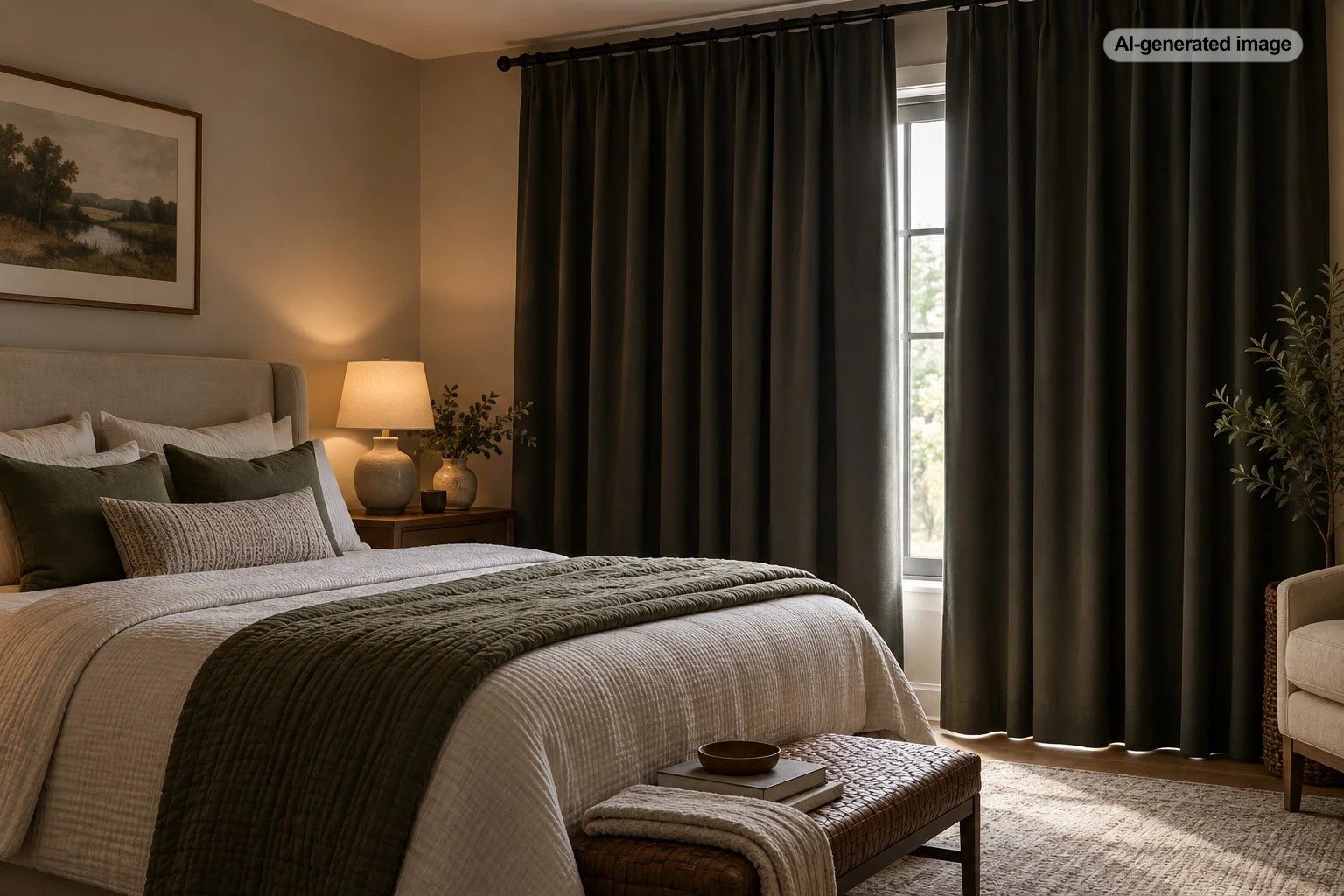
Should a Guest Room Have Blackout Curtains?
A guest room should usually have blackout curtains if the windows receive strong morning sunlight, face outdoor lighting, or make privacy difficult. They are not essential in every home, but they are one of the more practical upgrades for helping overnight visitors sleep comfortably. The best choice depends on the room’s exposure, the kinds of guests who stay there, and whether you want complete light control or a softer, more flexible window treatment.
Unlike your own bedroom, where you know exactly how much light you prefer, a guest room needs to accommodate people with different routines. Some guests welcome an early sunrise. Others need darkness to recover from travel, work an unusual schedule, or sleep past dawn. Providing a way to control the light gives visitors a useful choice without requiring them to ask for special accommodations.
Why Blackout Curtains Make Sense in a Guest Room
The strongest argument for blackout curtains is not that everyone needs a completely dark bedroom. It is that guests should have reasonable control over their sleeping environment.
Visitors cannot always predict the conditions in an unfamiliar room. A window that seems pleasantly bright during an afternoon tour might receive direct sunlight shortly after sunrise. A nearby streetlight may illuminate the pillow throughout the night. Curtains that substantially reduce incoming light can make both situations easier to manage.
They accommodate different sleep schedules
Weekend visitors, relatives attending family events, and people arriving after long travel days may keep different hours from the household. Blackout curtains let someone sleep later without expecting everyone else to modify their morning routine.
They are also useful when guests visit from another time zone. Someone who needs an afternoon rest can darken the room even while the rest of the house remains active.
They improve light control and privacy
Guest bedrooms frequently occupy secondary spaces overlooking driveways, neighboring houses, patios, or sidewalks. These locations may have less privacy than the primary bedroom.
Opaque, properly fitted curtains help prevent casual views into the room when closed. They also reduce light from porch fixtures, headlights, and nearby buildings. However, blackout fabric and privacy are not identical specifications: coverage around the curtain edges matters just as much as the opacity of the material.
They give the room a more finished appearance
Full-length curtains can soften the edges of a window, introduce texture, and make a modest guest bedroom feel more thoughtfully furnished. A substantial curtain panel can provide this visual effect without making the space formal or overly decorated.
When Blackout Curtains Are Worth Installing
Not every guest room needs the same degree of darkness. Begin by observing the room at the times your visitors are most likely to sleep.
- East-facing windows: Early sunlight can enter the room directly, making effective light blocking particularly valuable for late sleepers.
- West-facing windows: Strong afternoon and evening sunlight may create glare or make a room feel bright when a guest wants to rest.
- Street-facing bedrooms: Exterior lighting, passing vehicles, and nearby buildings can create unwanted illumination at night.
- Rooms used by children or families: Flexible light control can help accommodate naps and earlier bedtimes.
- Home offices that double as guest rooms: Blackout curtains can make a multifunctional space better suited to overnight use without a major redesign.
For a rarely occupied room overlooking a shaded, private yard, ordinary lined curtains may be perfectly adequate. There is little reason to buy maximum light blocking merely because the room has a bed.
Blackout Curtains vs. Room-Darkening Curtains
The distinction between blackout and room-darkening curtains is important because product descriptions can sound similar while offering different results.
| Feature | Blackout curtains | Room-darkening curtains |
|---|---|---|
| Light control | Designed for stronger light blocking | Reduces light but typically allows more through |
| Best setting | Bright windows or guests who prefer darkness | Moderate daylight and flexible everyday use |
| Appearance | May use dense fabric or an added liner | Often offers a softer, lighter impression |
| Privacy | Typically strong when properly fitted | Varies with fabric opacity and lighting |
| Main tradeoff | Can feel visually heavier | May not block enough light for sensitive sleepers |
Blackout does not automatically mean a room will become completely dark. Sunlight can still enter above the curtain rod, between panels, or along the sides. Product performance also varies by construction and installation.
Room-darkening curtains are often the better compromise when the goal is privacy and reduced glare rather than a near-dark sleeping environment. They may also suit a guest room that serves as a reading room or home office during the day.
How to Choose Blackout Curtains That Look Good
Practical window treatments do not have to resemble heavy theater drapes. The right proportions and materials can make blackout curtains feel entirely appropriate in a relaxed bedroom.
Choose a fabric that suits the room
Matte woven fabrics, linen-look textures, and softly structured panels tend to work well in guest bedrooms. They can create a calm appearance without introducing excessive sheen or dramatic folds.
For an airy room, consider ivory, oatmeal, warm gray, or muted sage. In a more traditional setting, deeper colors and structured pleats may complement upholstered furniture and wood finishes.
Do not assume that only dark-colored curtains can block substantial light. Some light-colored products use an opaque backing or separate blackout liner to provide stronger coverage while maintaining a pale decorative face.
Pay attention to curtain width
Panels should provide enough fabric to cover the entire window comfortably when closed. As a general decorative starting point, combined panel width of roughly 1.5 to 2 times the rod width creates attractive fullness, although the appropriate amount depends on the heading style and the actual blackout coverage required.
Panels that barely meet in the middle can leave gaps and look stretched. Check the usable width of the curtain pair rather than relying only on the dimensions of the window glass.
Hang the rod beyond the window frame
Where space allows, extending the rod several inches past each side of the window helps the panels overlap the surrounding wall instead of stopping directly at the glass. Positioning the rod above the frame can also reduce the light entering at the top.
These are adjustable design guidelines rather than universal installation measurements. Wall space, trim, ceiling height, and window hardware should determine the final placement.
For stronger coverage, consider a wraparound curtain rod or a separate shade mounted close to the window. The latter is particularly useful when ordinary decorative drapery leaves visible light gaps.
Consider floor-length panels
Curtains that end just above the floor usually create a tidy appearance and are easy to operate. A slightly longer length can work in a formal guest suite, but excessive fabric pooling on the floor complicates cleaning and may be inconvenient when visitors need to open the curtains frequently.
Should You Combine Blackout Curtains With Sheer Curtains?
Layering blackout curtains with sheers is one of the most adaptable choices for a guest room. The sheer layer offers a softer daytime appearance and some visual screening, while the blackout layer can be closed when stronger darkness and privacy are needed.
A double curtain rod allows both layers to move independently. This arrangement is particularly appealing when the guest room doubles as another functional space and needs natural light throughout the day.
There are tradeoffs, however. Two layers require more wall projection, more hardware, and additional fabric. In a very small room, the treatment can become visually bulky.
What to Look for When Buying Blackout Curtains
Rather than shopping by color alone, evaluate the construction and how the panels will work with the window.
Before you decide
- Measure the window and surrounding wall space before selecting panel dimensions.
- Check whether the stated dimensions apply to one panel or the entire pair.
- Look for a substantial blackout lining or a fabric construction intended for strong light blocking.
- Choose hardware that lets guests open and close the curtains easily.
- Check the fabric care instructions, particularly for lined or layered materials.
- Plan for gaps around the edges if the room receives strong direct sunlight.
Some products are offered with decorative front fabrics and separate blackout backing. Others use dense fabric construction without a distinct visible lining. Either arrangement can work, but the finished result depends on how the treatment fits the window.
Affiliate disclosure: CraneManor.com may earn a commission when you purchase through links on this page. This does not affect the price you pay. Learn more.
For a guest bedroom where a pale fabric is preferred, NICETOWN blackout curtains are one example of a lined two-panel option worth comparing with other window treatments. Check the available dimensions, hanging style, and current product details against your window measurements. Even curtains marketed for full light blocking may allow light through installation gaps.
What About Temperature and Noise?
Blackout curtains sometimes come with claims about insulation and noise reduction. These potential secondary benefits should not be confused with the primary purpose of controlling light.
Substantial curtains can contribute to window comfort in some conditions, particularly when they fit closely enough to limit air movement near the glass. The U.S. Department of Energy discusses window coverings as one approach to managing unwanted heat transfer and solar gain. Actual results depend on the window, curtain construction, climate, and how the covering is used.
That does not mean blackout curtains will fix a drafty window, eliminate street noise, or deliver a predictable reduction in utility bills. A curtain is not a substitute for appropriate window repairs or dedicated sound-control measures.
If exterior noise is the main concern, evaluate the window and surrounding conditions independently. Light blocking and sound blocking are different performance goals.
Common Mistakes That Make Guest Room Curtains Less Useful
Even attractive curtains can disappoint if they are difficult to use or poorly matched to the room.
Choosing panels that are too narrow
Insufficient fabric leaves a visible center gap or makes the curtains difficult to draw fully across the window. Measure both the window opening and the required coverage before ordering.
Installing the rod too close to the window
When panels stop at the edges of the glass, light can leak around them. Greater overlap onto the wall generally improves coverage, provided the curtains can still move smoothly.
Making the room too dark during the day
A guest bedroom should still feel welcoming when visitors arrive. Darkening the room permanently with fixed coverings can make it less versatile. Choose curtains that open easily, allowing guests to decide how much daylight they want.
Forgetting about ease of use
An elegant treatment loses some of its appeal if the rod sticks or the fabric is difficult to move. Guests should be able to operate the curtains without instructions or special effort.
Also consider the location of furniture. A bedside table pressed against a curtain panel can prevent it from closing properly. Leave enough clearance for normal operation.
When Blackout Curtains Might Be Unnecessary
Blackout curtains are not automatically the best option simply because a room is designated for visitors.
For a shaded bedroom with limited outdoor lighting, good privacy, and infrequent overnight use, substantial light-filtering or room-darkening curtains may be enough. They can preserve a brighter appearance without adding an opaque layer the room rarely needs.
In a rental property where drilling is restricted, a removable blackout shade or suitable tension-mounted treatment may be more practical, provided the mounting method is compatible with the window and sufficiently secure.
If the window treatment is primarily decorative, focus on proportion, fabric texture, and privacy. There is no reason to prioritize maximum darkness when the actual problem is an unfinished-looking window.
Frequently Asked Questions
Do guests generally prefer blackout curtains?
Preferences vary, but adjustable light control gives guests more flexibility. Blackout curtains are especially helpful for visitors who sleep late, take daytime naps, or are sensitive to exterior light. They are most useful when they can be opened easily during the day.
Are blackout curtains too heavy-looking for a small guest bedroom?
Not necessarily. Light-colored fabrics, restrained hardware, and neatly fitted panels can keep the room feeling open. Avoid unnecessary layers or oversized decorative hardware in a tight space.
Can white blackout curtains really darken a bedroom?
Yes, some white and light-colored curtains use opaque backing or blackout lining to block substantial amounts of light. However, performance varies by product, and edge gaps may remain even when the fabric itself is highly opaque.
Are blackout blinds better than blackout curtains?
Blinds or shades can be a good choice when a compact appearance and close window fit are priorities. Curtains provide more decorative softness and can extend beyond the frame. Combining a fitted shade with curtains may offer better flexibility than either treatment alone.
Should blackout curtains stay closed when guests are not using the room?
There is no need to keep them closed continuously. Opening the curtains allows daylight into the room and makes it easier to notice cleaning or maintenance needs. During periods of strong sunlight or unwanted heat gain, closing appropriate window coverings may be useful.
The Bottom Line
For most regularly used guest bedrooms, blackout curtains are a worthwhile option because they let visitors control their sleeping conditions. They are particularly useful for bright windows, street-facing rooms, and households that welcome guests with different schedules.
The best solution is not necessarily the darkest or most elaborate curtain. It is a window treatment that provides enough privacy and light control, fits the room beautifully, and is simple for guests to use. A thoughtfully fitted pair of blackout curtains can meet those needs without making the bedroom feel closed off from daylight.
Sources & Further Reading
- U.S. Department of Energy: Window Treatments and Energy Efficiency – Background on how window coverings can influence indoor comfort and energy performance.
- NICETOWN: Blackout Curtains – Manufacturer information about blackout curtain constructions and available window-treatment styles.