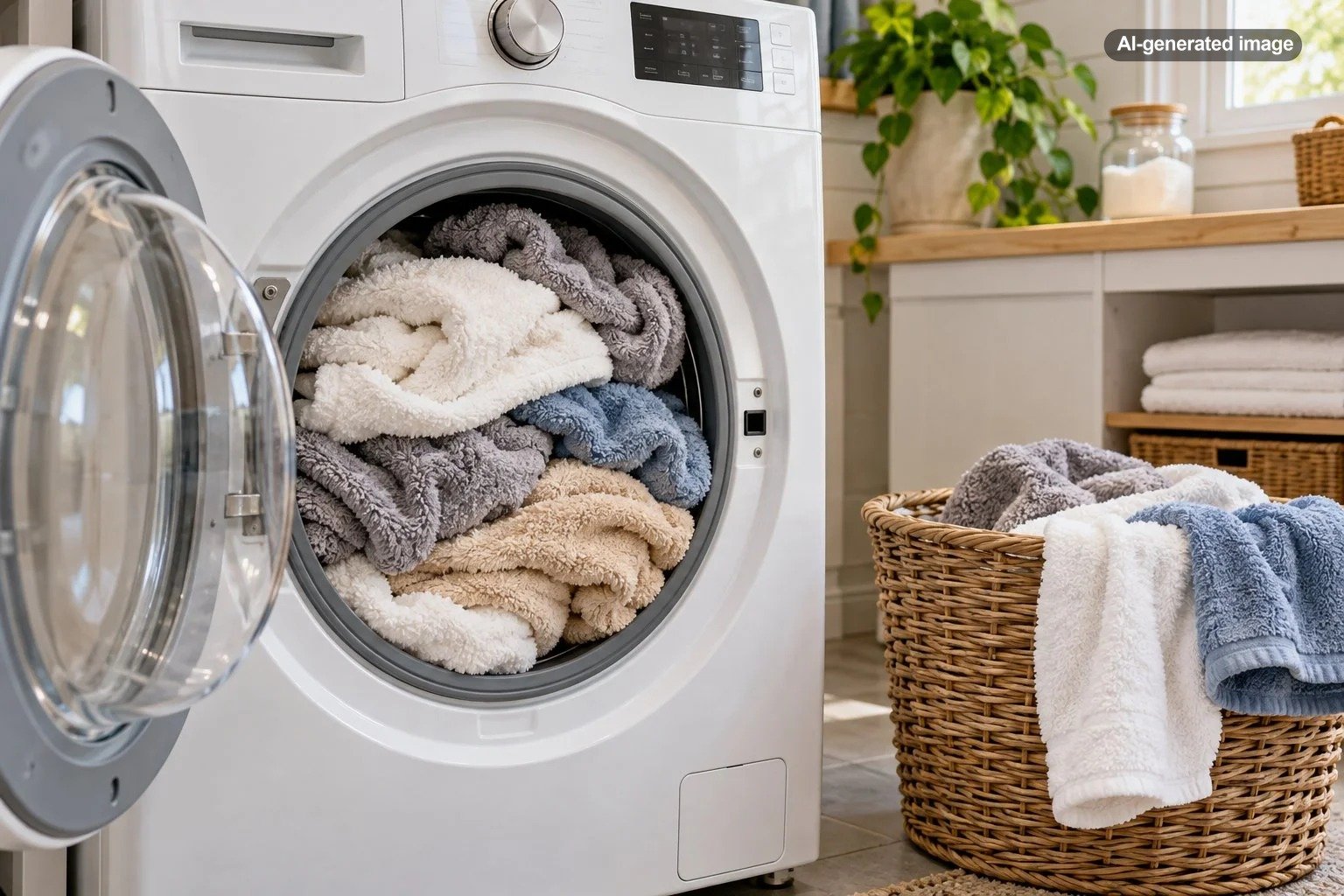
Can Overloading the Washer Make Towels Smell?
Yes, overloading the washer can make towels smell, even when they have just been through a complete wash cycle. Towels need enough room to move, absorb wash water, release dirt and body oils, and rinse thoroughly. When too many thick towels are packed into the drum, cleaning becomes less effective, and odors can remain trapped in the fabric.
The frustrating part is that overloaded towels may look perfectly clean. They can even smell pleasant while the detergent fragrance is fresh, only to develop a sour or musty odor when they get damp again. Understanding how load size affects washing performance can help solve the problem without immediately reaching for stronger detergent or replacing perfectly usable towels.
Why an Overloaded Washer Can Leave Towels Smelling Bad
Washing machines depend on a combination of water, detergent, mechanical movement, and rinsing to remove soil from fabric. Packing the drum too tightly interferes with that process.
Towels are particularly vulnerable because their absorbent loops hold substantial amounts of water. A load that seems manageable when dry becomes much heavier once saturated, and dense layers of fabric can restrict movement.
Less Room for Effective Cleaning
In a properly loaded washer, towels can shift, tumble, or circulate according to the machine’s design. This movement helps wash water and detergent reach the fabric and carry away accumulated soil.
When towels are compressed together, some areas may receive less effective washing action. Body oils, skin residue, and other odor-producing material can remain in the fibers.
Poor Rinsing Can Leave Residue Behind
Overloading also makes it harder for the machine to rinse thoroughly. Detergent and loosened soil may remain in the fabric instead of being carried away with the rinse water.
Residual detergent can contribute to stiff-feeling towels and buildup over repeated washes. Adding extra detergent to an already crowded load often makes the situation worse rather than improving cleanliness.
Heavy Loads May Spin Less Effectively
A tightly packed load can also create balance problems during the spin cycle. Depending on the washer, an uneven or excessively heavy load may result in a reduced spin speed, interrupted spinning, or towels that retain more moisture than expected.
Very wet towels take longer to dry. When moisture remains in thick fabric for an extended period, unpleasant odors can develop or return.
How to Tell Whether You Are Putting Too Many Towels in the Washer
There is no universal towel count that works for every washing machine. Washer capacity, towel size, fabric weight, and the manufacturer’s loading instructions all matter.
A large-capacity machine may accommodate a load that would overwhelm a compact washer. Similarly, oversized plush bath sheets occupy much more space than lightweight hand towels.
Signs your towel load may be too large
- You must push down firmly to fit the last towels into the drum.
- Towels are wedged tightly together rather than resting loosely.
- The washer struggles to balance or complete the spin cycle.
- Towels emerge unusually wet or tangled together.
- Some towels smell noticeably worse than others in the same load.
- Washing performance improves when you divide the same laundry into smaller batches.
For a front-loading washer, towels generally need space to lift and tumble during the cycle. For a top-loading washer, follow the manufacturer’s loading arrangement, particularly when the machine uses a washplate instead of a traditional agitator.
Do not rely on a fixed rule such as filling every washer exactly halfway or three-quarters full. Those estimates can be useful starting points, but the machine’s instructions and the actual movement of the towels matter more.
How to Fix Towels That Smell After an Overloaded Wash
If your towels already smell sour or musty, begin with a straightforward rewash. The goal is to improve cleaning and rinsing, not to cover the odor with fragrance.
What to do
- Divide the towels into smaller loads. Remove enough towels so the remaining items can move freely. Avoid packing the drum to its physical limit.
- Check the care labels. Choose a wash temperature and cycle suitable for the fabric, considering both the towel manufacturer’s instructions and the washer manual.
- Measure detergent carefully. Use the detergent type and amount recommended for the washer, load size, and soil level. High-efficiency machines require compatible detergent.
- Consider an additional rinse. If towels feel coated, unusually stiff, or excessively sudsy, an extra rinse may help remove lingering detergent.
- Remove towels promptly. Transfer them to the dryer or an appropriate drying location as soon as the cycle finishes.
- Dry completely. Check thick seams, hems, and folded areas before putting towels away.
For persistent odor, a repeat wash using an appropriate laundry product may be necessary. An oxygen-based laundry additive can be an option when its label and the towel care instructions permit it. Avoid combining cleaning chemicals or improvising mixtures of bleach, vinegar, ammonia, or other products.
Repeatedly increasing detergent, water temperature, or additive concentration is not a substitute for correcting an overloaded machine. It can also create unnecessary wear or residue.
What If the Towels Still Smell After Washing Smaller Loads?
Overloading is only one possible cause. If reducing the load size does not help, the timing and location of the smell provide useful clues.
| What you notice | Possible explanation | What to check next |
|---|---|---|
| Towels smell immediately after washing | Incomplete cleaning, detergent residue, or washer odor | Load size, detergent dose, washer interior |
| Towels smell only when damp again | Lingering fabric residue or incomplete cleaning | Rewash performance and complete drying |
| Towels smell after being stored | Residual moisture or damp storage conditions | Closet ventilation and towel dryness |
| All laundry has the same musty smell | Washer cleanliness or a machine-related issue | Drum, dispenser, gasket, and cleaning cycle |
| Towels remain unusually wet after spinning | Unbalanced loading or inadequate water extraction | Load distribution, cycle performance, and drain or spin problems |
Detergent or Fabric Softener Buildup
More detergent does not automatically mean cleaner towels. Excess detergent may rinse poorly, especially in a crowded washer or when an unsuitable detergent is used.
Conventional liquid fabric softeners can also leave a coating that affects absorbency. If towels feel slippery, waxy, or less absorbent than expected, try washing them without added fabric softener and follow the care instructions.
A Washer That Needs Cleaning
Residue and trapped moisture inside a washing machine can contribute to unpleasant odors. Front-loading door gaskets, detergent dispensers, and other areas that retain water deserve particular attention.
Run the washer’s designated cleaning cycle according to its manual. Use only an approved cleaner or cleaning method for that machine, and inspect accessible areas that the manufacturer identifies for routine care.
When the appliance is not in use, allowing appropriate ventilation can help the interior dry. Follow the manufacturer’s guidance, especially in households where an open appliance door could create a child or pet safety concern.
Towels That Are Not Drying Completely
A perfectly reasonable wash load can still produce smelly towels if the dryer is overloaded. Dense, tangled towels may dry unevenly, leaving damp sections near thick hems or inside folds.
Separate tangled items before drying, avoid overcrowding the dryer, and use a setting compatible with the towel labels. Keep the lint filter clean according to the dryer instructions and address unusually long drying times.
Why Towels Sometimes Smell Fine Until They Get Wet
A towel that smells fresh straight out of the dryer but unpleasant after a shower may still contain residual soil or other odor-producing material. Moisture can make an existing smell more noticeable.
Fragranced detergent can temporarily mask this issue. Once the scent fades and the towel gets damp, the underlying odor becomes easier to detect.
This pattern does not prove that the washer is overloaded. It simply suggests that fragrance alone is not a reliable test of whether the towel has been cleaned and dried adequately.
How to Keep Towels Fresh Without Doing Excessive Laundry
Washing smaller loads does not mean every towel needs its own cycle. A sensible routine balances effective cleaning, household convenience, and the washer’s capacity.
- Group similar fabrics and weights. Washing very heavy bath sheets separately from delicate or lightweight items can improve load balance and simplify drying.
- Spread damp towels out after use. Hang them where air can circulate rather than leaving them bunched on the floor or in a closed hamper.
- Do not store damp laundry. Make sure towels are thoroughly dry before folding and placing them in a cabinet.
- Use detergent according to the actual load. A smaller load generally does not require the same detergent quantity as a large, heavily soiled one.
- Maintain the washer. Follow the manufacturer’s instructions for cleaning cycles, dispensers, seals, and any user-serviceable filters.
- Watch for recurring patterns. If odors consistently follow particularly large loads, adjust your laundry routine before changing products.
In a small apartment or shared laundry room, dividing a large weekly towel pile into two manageable loads may be more practical than attempting to wash everything at once. In a larger household, staggering towel changes and laundry days can help prevent the hamper from turning into one enormous load.
When an Odor Problem Might Indicate a Washer Issue
Occasional musty towels do not automatically indicate a broken appliance. However, persistent odors accompanied by poor draining, standing water, repeated error codes, leaking, or interrupted spin cycles deserve attention.
Persistent odor after correct loading, suitable detergent use, complete drying, and the recommended washer-cleaning routine may also justify a professional inspection. An underlying drainage or machine problem will not be solved by adding more fragrance to the laundry.
Frequently Asked Questions
Can washing too many towels at once cause a sour smell?
Yes. Crowding can interfere with washing, rinsing, and spinning, allowing odor-producing residue or excess moisture to remain in the towels. A smaller load is a useful first troubleshooting step.
How many bath towels should go in one washing machine load?
The appropriate number depends on machine capacity, towel dimensions, thickness, and manufacturer guidance. Load towels loosely and avoid compressing them to fit. Thick bath sheets generally require more room than standard bath towels.
Will an extra rinse fix towels that smell?
An extra rinse may help when detergent residue is contributing to the problem. It will not necessarily remove persistent soil or solve odors caused by poor drying, a dirty washer, or inadequate washing action.
Should towels be washed in hot water to remove odors?
Not automatically. Choose the warmest appropriate setting allowed by the towel care label and washer instructions. Some colors, finishes, and materials require gentler treatment. Proper load size and detergent use are important regardless of temperature.
Can the dryer make freshly washed towels smell?
Yes. If towels are crowded, dry unevenly, or remain damp before being folded, odors can develop or return. Check that thick areas are completely dry before storing them.
The Bottom Line
Overloading the washer can absolutely contribute to smelly towels. When thick fabric is packed too tightly, the washer has a harder time cleaning, rinsing, and extracting water effectively.
Start with the simplest test: divide the towels into smaller loads, use the correct amount of detergent, and dry everything completely. If the towels come out fresher, you have found a practical adjustment that may solve the problem. If the odor remains, look next at detergent buildup, washer cleanliness, drying conditions, and the machine’s performance.
Fresh towels depend less on strong fragrance than on allowing the entire laundry process to work properly.
Sources & Further Reading
- Whirlpool Product Help: Not Cleaning Clothing – Front Load Washer. Manufacturer guidance on load size, detergent use, rinsing, and washing performance.
- Whirlpool Product Help: Not Cleaning Clothing – Top Load Washer. Guidance on appropriate loading arrangements, cleaning performance, and washer maintenance.
- GE Appliances: Frequently Asked Questions About GE Washers. Manufacturer information on washer odors, moisture, and operating behavior.
- Whirlpool: What Size Washer Do I Need?. Background on washer capacity and why laundry quantities vary by machine and towel size.