Can an Air Purifier Be Too Small for a Room?
Yes, an air purifier can absolutely be too small for a room. A unit may still capture particles when it is undersized, but it can take longer to process the room’s air and may struggle to keep up with particles entering or being generated in the space. The more useful question is not simply whether the purifier runs, but whether it delivers enough filtered air for the room where you actually plan to use it.
Room dimensions matter, but so do ceiling height, fan speed, doors to adjoining spaces, and the type of pollutant you are trying to reduce. That is why judging an air purifier by its physical size alone is not very helpful.
Why an undersized air purifier can fall behind
A portable air purifier works by moving room air through its filtration system and returning filtered air to the space. If the unit moves relatively little clean air compared with the volume of the room, it takes longer to cycle through that air.
That matters because rooms are not sealed laboratory boxes. Outdoor particles can enter through doors and windows. Cooking, dusting, pets, candles, fireplaces, and ordinary movement can add particles indoors. An undersized purifier may be removing particles while new ones are arriving at a comparable or faster rate.
The EPA explains that higher fan speeds and longer operating times generally increase the amount of air filtered. The reverse is useful to remember: a small unit operating quietly on a low setting in a large open room may provide considerably less filtration than its most flattering coverage number suggests.
An air purifier is sized for the air it can effectively process, not for the amount of floor space its cabinet occupies.
CADR is more useful than judging the purifier by its dimensions
Clean Air Delivery Rate is one of the most practical numbers for comparing portable air cleaners intended to remove particles. CADR describes the volume of filtered air a cleaner delivers for specific particle categories. A higher CADR generally means the unit can serve a larger area or clean the air in a smaller area more rapidly.
The EPA’s consumer guidance provides an approximate sizing table for rooms with 8-foot ceilings. Its examples pair a 100-square-foot room with a minimum CADR of 65 cubic feet per minute, 200 square feet with 130 cfm, 300 square feet with 195 cfm, and 400 square feet with 260 cfm. These figures are estimates rather than universal guarantees, but they provide a useful reality check when comparing models.
| Room situation | What it means for sizing |
|---|---|
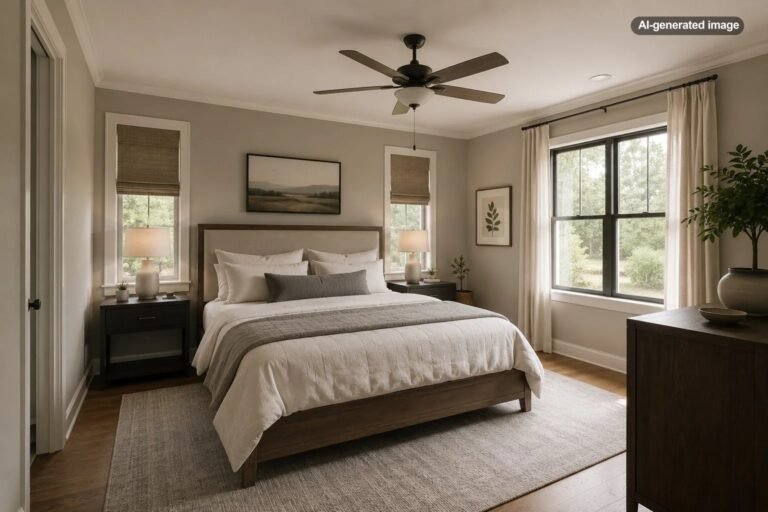
| Small enclosed bedroom | A modest purifier may be sufficient if its CADR matches the room. |
| Large living room | Look for greater clean-air delivery rather than simply a larger appliance cabinet. |
| Open-plan living area | Size for the connected space the purifier is expected to serve. |
| Ceiling higher than 8 feet | Consider a higher-capacity purifier because the room contains more air. |
| Purifier usually run on low | Allow extra capacity because published performance is commonly based on higher fan speeds. |
Do not confuse maximum coverage with equivalent performance
Room-coverage claims deserve a closer look because manufacturers may describe coverage using different numbers of air changes per hour. A purifier might be able to process the volume of a very large room once per hour while serving a substantially smaller room several times per hour.
Those are not equivalent operating conditions. If you are comparing two products, check whether their advertised square-foot figures assume the same air-change rate. CADR often makes comparisons easier because it focuses on clean-air delivery rather than a single headline room-size claim.
Ceiling height can quietly make a purifier undersized
Floor area is only part of the room. A 300-square-foot room with an 8-foot ceiling contains about 2,400 cubic feet of air. The same floor area with a 12-foot ceiling contains about 3,600 cubic feet, or 50 percent more air.
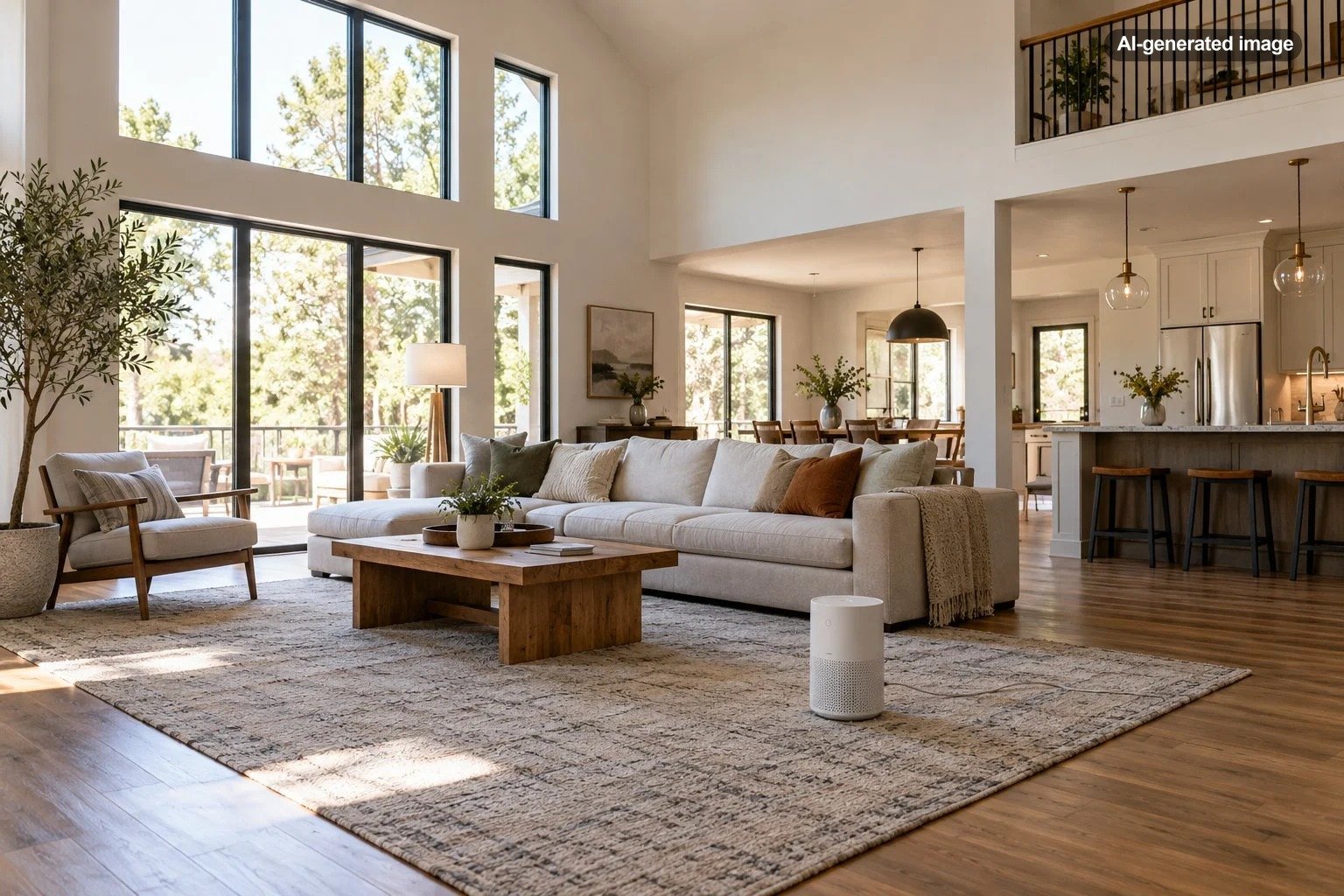
This is particularly relevant in great rooms, lofts, vaulted living rooms, and newer open-plan houses. The EPA specifically advises considering a purifier sized for a larger area when ceilings are higher than 8 feet.
Open doorways matter too. If a purifier sits in a bedroom but the door remains open to a hallway and adjacent rooms, the practical space it is interacting with may be much larger than the bedroom’s measured floor area.
Fan speed matters almost as much as the label
Air purifiers generally achieve their greatest airflow at their highest fan setting. That creates an everyday tradeoff: the setting that produces the most filtration may also create more audible fan noise.
If you know that you will rarely tolerate the highest setting, buying a unit with some capacity in reserve can be sensible. A larger-capacity purifier running at a moderate setting may fit your household better than a barely adequate model that must stay at maximum speed to approach your desired filtration rate.
Affiliate disclosure: CraneManor.com may earn a commission when you purchase through links on this page. This does not affect the price you pay. Learn more.
Automatic modes can also be useful for households that would rather not adjust fan speed manually. For example, the approved room air purifier in this article’s product library is the Coway Airmega AP-1512HH Mighty, a model that includes automatic fan control and an air-quality monitor. Coway currently lists smoke, dust, and pollen CADR values for the model and publishes different coverage figures according to air changes per hour.
Placement can make an adequately sized purifier behave like a smaller one
Even a properly sized purifier needs unobstructed airflow. Tucking it tightly behind a sofa, under a table, or against heavy curtains can interfere with the movement of air into or out of the machine.
The EPA recommends keeping portable air cleaners away from curtains and other objects that can block airflow. Follow the manufacturer’s placement instructions as well, since intake and exhaust locations differ among models.
Before you decide
- Measure the length and width of the room.
- Account for unusually high ceilings.
- Treat connected open-plan areas as one larger space when appropriate.
- Compare CADR rather than relying only on a headline coverage claim.
- Consider the fan speed you will realistically use every day.
- Leave enough clearance for unobstructed intake and exhaust airflow.
When two smaller purifiers may make more sense
One very large purifier is not the only way to serve a large space. The EPA notes that multiple air cleaners can be considered when an area is larger than a single available unit can serve.
Two units can also make practical sense in a long room, an L-shaped layout, or a home where air does not circulate freely from one end of the space to the other. The exact benefit depends on the units, their placement, and the room, so adding their advertised square-foot ratings together should not be treated as a precise engineering calculation.
Remember what an air purifier cannot do
More capacity does not turn a portable purifier into a complete indoor-air-quality solution. The EPA emphasizes that filtration is a supplement to controlling pollution sources and ventilating with clean outdoor air when appropriate. No portable air cleaner removes every indoor pollutant.
Particle filtration and gas removal are also different jobs. CADR is used for particle performance. If your concern involves gases or odors, look for filtration specifically designed for gases, such as an appropriate activated-carbon or other sorbent filter, and evaluate that capability separately.
Likewise, an air purifier should not be used as a substitute for correcting moisture problems, properly venting combustion appliances, controlling smoke at its source, or addressing other underlying household hazards.
FAQ
Will a small air purifier still work in a large room?
It can still capture particles that pass through it, but it may process the room’s air too slowly to provide the level of filtration you expected. Performance depends on its CADR, the room volume, fan speed, runtime, and how quickly new particles enter the space.
Is it better to oversize an air purifier?
Some extra capacity can be useful, particularly if you have high ceilings or prefer lower fan speeds. There is no need to buy the largest machine available simply for its own sake; the goal is enough clean-air delivery for the room and operating conditions.
Should I size an air purifier by square feet or cubic feet?
Square-foot guidance is convenient for typical rooms, but ceiling height changes the actual volume of air. If your ceiling is substantially higher than 8 feet, account for the additional volume by choosing more capacity.
Can one purifier clean an entire house?
Portable air cleaners are generally intended for a single room or area. Walls, closed doors, stairways, and separated rooms limit how freely air moves through a home. Central HVAC filtration serves a different role and works when air is moving through that system.