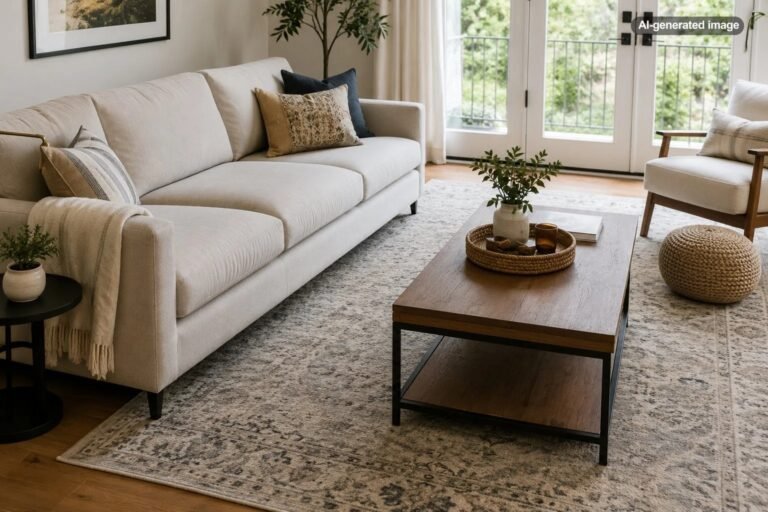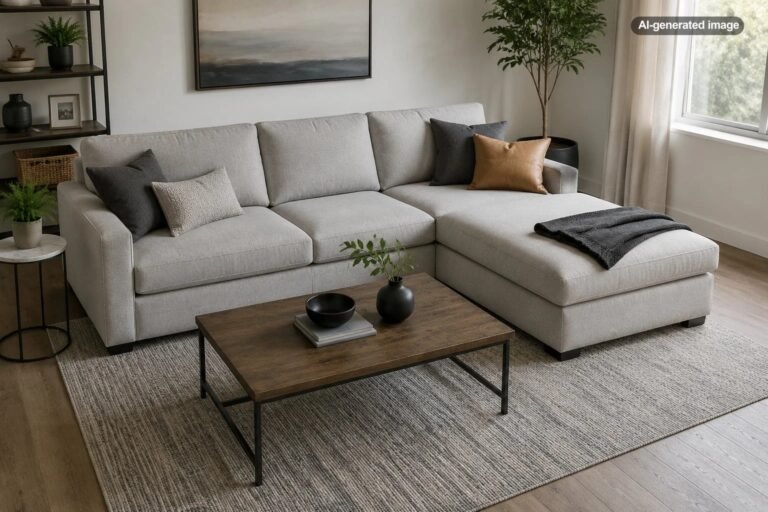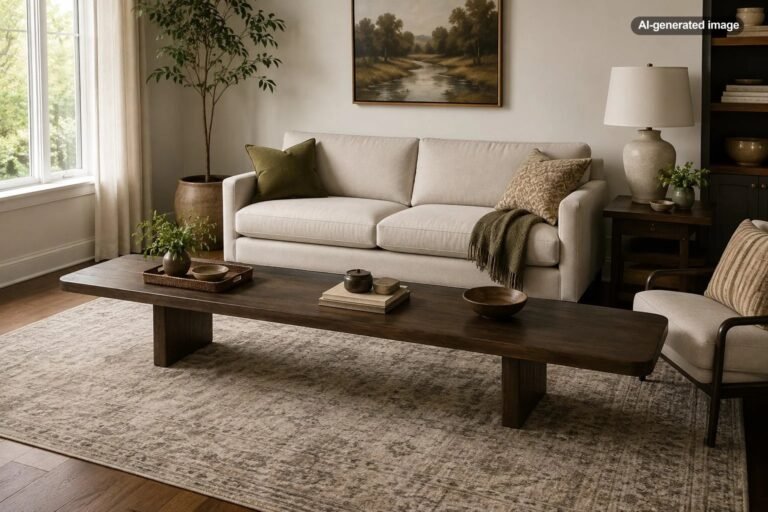

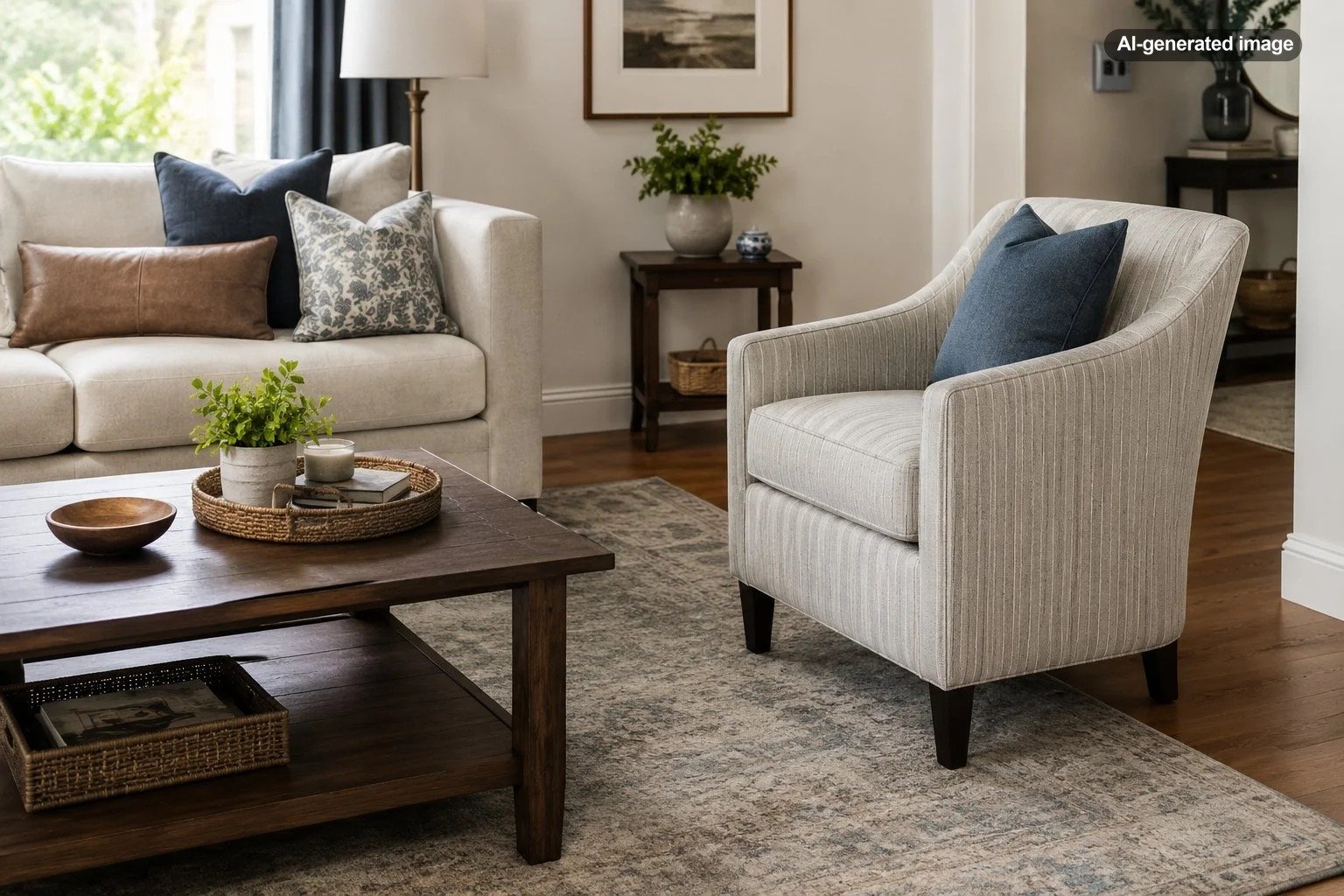
How Far Should an Accent Chair Be From a Coffee Table?
An accent chair generally works best about 12 to 18 inches from a coffee table, with roughly 16 to 18 inches being a particularly comfortable starting point in many living rooms. That range keeps the table close enough to reach without making the person sitting in the chair feel boxed in. It also leaves enough room to stand up, sit down, and move a leg around the edge of the table.
The exact distance depends on the chair’s depth, the coffee table’s shape, how people use the room, and whether the space beside the chair doubles as a walking path. Think of 12 to 18 inches as a useful measuring range rather than an inflexible decorating command.
Why 12 to 18 Inches Usually Works
Coffee tables sit in an unusual part of the living room. They need to be close enough to the seating to function, yet far enough away that knees, feet, and normal movement do not constantly collide with them. A gap of approximately 12 to 18 inches usually balances those competing needs.
At the tighter end, the table is convenient for setting down a drink, remote, book, or small plate without a significant forward lean. At the wider end, the seating arrangement feels more relaxed and gives occupants additional room when standing.
The appropriate measurement should be taken from the nearest edge of the chair to the nearest edge of the coffee table, not from the chair’s back or center point. With unusually curved or sculptural furniture, measure from the closest points that affect someone entering or leaving the seat.
Good furniture spacing is not about maximizing empty floor; it is about giving every piece enough room to work.
Use the Chair, Not Just the Room, as Your Guide
Two rooms of identical dimensions can need very different chair-to-table spacing because accent chairs vary substantially in shape. A compact upright chair occupies space differently from a deep lounge chair with a thick cushion and a reclining seating position.
Upright accent chairs can often sit closer
An upright chair encourages a more vertical posture, so a person can often comfortably use a coffee table positioned toward the closer end of the range. Around 12 to 16 inches may feel natural, especially in a conversational seating area where the table is intended to serve every seat.
Deep lounge chairs often benefit from more room
A deep chair tends to place the sitter’s feet farther forward. If the coffee table is too close, the arrangement can feel cramped even when the tape measure suggests an acceptable distance. Starting around 16 to 18 inches usually gives these chairs more breathing room.
Swivel chairs need clearance for movement
A swivel chair adds another variable because its front edge changes position as the chair rotates. Test the chair through the portion of its rotation people are likely to use. The coffee table should not become an obstacle whenever someone turns toward a conversation partner, television, fireplace, or window.
When the Coffee Table Is Shared With a Sofa
Most living rooms are not designed around a single accent chair. The coffee table may need to work for a sofa, two chairs, a sectional, or several different seating types at once. In that situation, do not automatically center the table mathematically within the room.
Instead, center it visually within the seating group and check the functional distance from each important seat. The sofa might sit 16 inches away while a chair is 18 inches away, and the arrangement can still look completely intentional.
A slight difference is preferable to forcing perfect symmetry that makes one seat inconvenient. This matters particularly when the accent chair is angled toward the sofa rather than positioned parallel to the table.
Adjust the Distance for the Coffee Table Shape
Table shape changes how much floor area feels occupied. A rectangular table creates long straight edges that can make a narrow clearance feel more obvious. A round or oval table removes the corners, which can make the same measured distance easier to navigate.
Rectangular tables
Pay special attention to the corners nearest the chair. A chair angled toward a rectangular table may technically have plenty of clearance at its center while one table corner intrudes into the natural path used to stand up.
Round and oval tables
Curved tables can be forgiving in arrangements with multiple chairs because there are no sharp corners projecting toward the seating. This is especially helpful in compact living rooms where occupants frequently walk around the table.
Square tables
Square tables can work beautifully in larger conversation groups, but their depth means they may occupy more of the center zone than expected. Check the distance from every chair rather than assuming one measurement applies equally to all four sides.
Leave More Space When the Gap Is Also a Walkway
The 12-to-18-inch range is intended primarily for the relationship between seating and a table. It is not generous circulation space. If family members regularly need to walk directly between the accent chair and coffee table, a larger gap may be necessary.
Before widening that particular gap, however, consider whether the better solution is to redirect traffic behind or beside the chair. Constant foot traffic through the middle of a conversation area can make the whole room feel less settled.
In a small apartment or condo, compromises are inevitable. You may decide that a slightly tighter 12-to-14-inch furniture gap makes more sense because it preserves a clearer path elsewhere in the room.
Check Reach as Well as Clearance
Spacing is not successful simply because no one bumps into the furniture. The coffee table also needs to be usable. Sit naturally in the accent chair and see whether you can reach the table without an exaggerated forward stretch.
If the table is difficult to reach at a comfortable spacing, the issue may be the table’s size or position rather than the chair. A smaller round table, an oval table, or an occasional side table may serve the chair more effectively than pulling a large coffee table too close.
Table height matters as well. A particularly low coffee table paired with an upright, higher-seated chair can be awkward to use even when horizontal spacing is correct. Furniture proportions should work together in three dimensions, not merely on a floor plan.
How to Test the Placement Before Committing
What to do
- Place the accent chair roughly where you want it in the seating group.
- Position the coffee table about 16 to 18 inches from the nearest edge of the chair.
- Sit down naturally and check whether the tabletop is comfortably reachable.
- Stand up and confirm that your knees and feet have enough room.
- Walk around the chair and table using the route people normally take through the room.
- If the chair swivels, rotate it through its normal range and check for interference.
- Adjust in small increments until reach, movement, and visual balance all feel comfortable.
Painter’s tape can help when you are choosing furniture before it arrives. Mark the coffee table footprint on the floor, then position the chair relative to that outline. This makes an oversized table or a tight corner much easier to recognize before purchasing or rearranging heavy pieces.
Common Accent Chair Placement Mistakes
One frequent mistake is pushing the accent chair against a wall simply because there is available space there. If the chair sits too far from the coffee table and sofa, it may look disconnected from the conversation area. Pulling it forward several inches can make the furniture feel like a cohesive group instead of unrelated objects around a perimeter.
The opposite problem is squeezing the chair tightly against the table to make a small room look as though it contains more open floor. That strategy often backfires. The visible empty area may increase, but the seating itself becomes uncomfortable to use.
Another mistake is obsessing over symmetry. Furniture should look balanced, but an accent chair does not need to mirror the sofa’s distance from the table exactly. Angled chairs, swivel chairs, and mixed furniture styles often look better with slightly different spacing.
Before you decide
- Start around 16 to 18 inches from chair to table.
- Try 12 to 14 inches when compactness and easy reach are priorities.
- Allow extra clearance for deep or swivel chairs.
- Check table corners when the chair sits at an angle.
- Do not treat a seating gap as a full traffic aisle.
- Test the arrangement while sitting, standing, reaching, and walking.
FAQ
Is 12 inches too close between a chair and coffee table?
Not necessarily. Twelve inches is near the tight end of a practical seating-to-table range, but it can work with a compact, upright chair and a table that does not interfere with the sitter’s feet. Test the actual furniture before deciding.
Is 24 inches too far from an accent chair to a coffee table?
Twenty-four inches can work when circulation requires additional clearance, but the coffee table may become inconvenient to reach from the chair. If the distance needs to be that large, a small side table can make the seat more functional.
Should an accent chair line up with the edge of the coffee table?
No. The chair can sit parallel to the table, partially overlap its visual footprint, or angle toward the center of the seating group. Comfortable movement and a cohesive conversation area matter more than matching edges precisely.
Should both accent chairs be the same distance from the coffee table?
They can be, but they do not have to be. Matching distances create a more formal and symmetrical arrangement, while slight variations often suit relaxed or asymmetrical rooms. Keep both chairs close enough for the table to be useful.
What is the best starting measurement?
Start at roughly 16 to 18 inches, then adjust according to the chair’s depth, the table shape, traffic flow, and how easily a seated person can reach the surface. The best final distance is the one that makes the furniture group comfortable to use as well as visually balanced.