How Do You Arrange Furniture Around a Corner Fireplace?
A corner fireplace is easiest to work with when you stop trying to make the entire room line up with it. Instead, treat the fireplace as one important visual anchor and arrange the seating around the way the room actually needs to function. In many living rooms, that means keeping the main sofa reasonably straight, angling one or two smaller pieces toward the fireplace, and using a rug and coffee table to pull the arrangement together.
The goal is not perfect symmetry. It is a comfortable conversation area with clear walking paths, useful sightlines, and enough breathing room around the fireplace. A corner fireplace can actually make a room feel more relaxed because the furniture does not need to march along a single axis.
Start With the Room’s Main Job
Before moving furniture, decide what the living room needs to do most often. A room used mainly for conversation can lean more strongly toward the fireplace. A television room may need seating that acknowledges both the screen and the fire. A pass-through living room needs especially careful circulation because a beautiful arrangement becomes frustrating if everyone has to weave around a sofa.
This matters because a corner fireplace creates a diagonal focal point. Trying to rotate every piece toward that diagonal can make the rest of the architecture feel crooked. Instead, let the largest furniture piece respond to the room itself and use smaller pieces to create the visual connection to the fireplace.
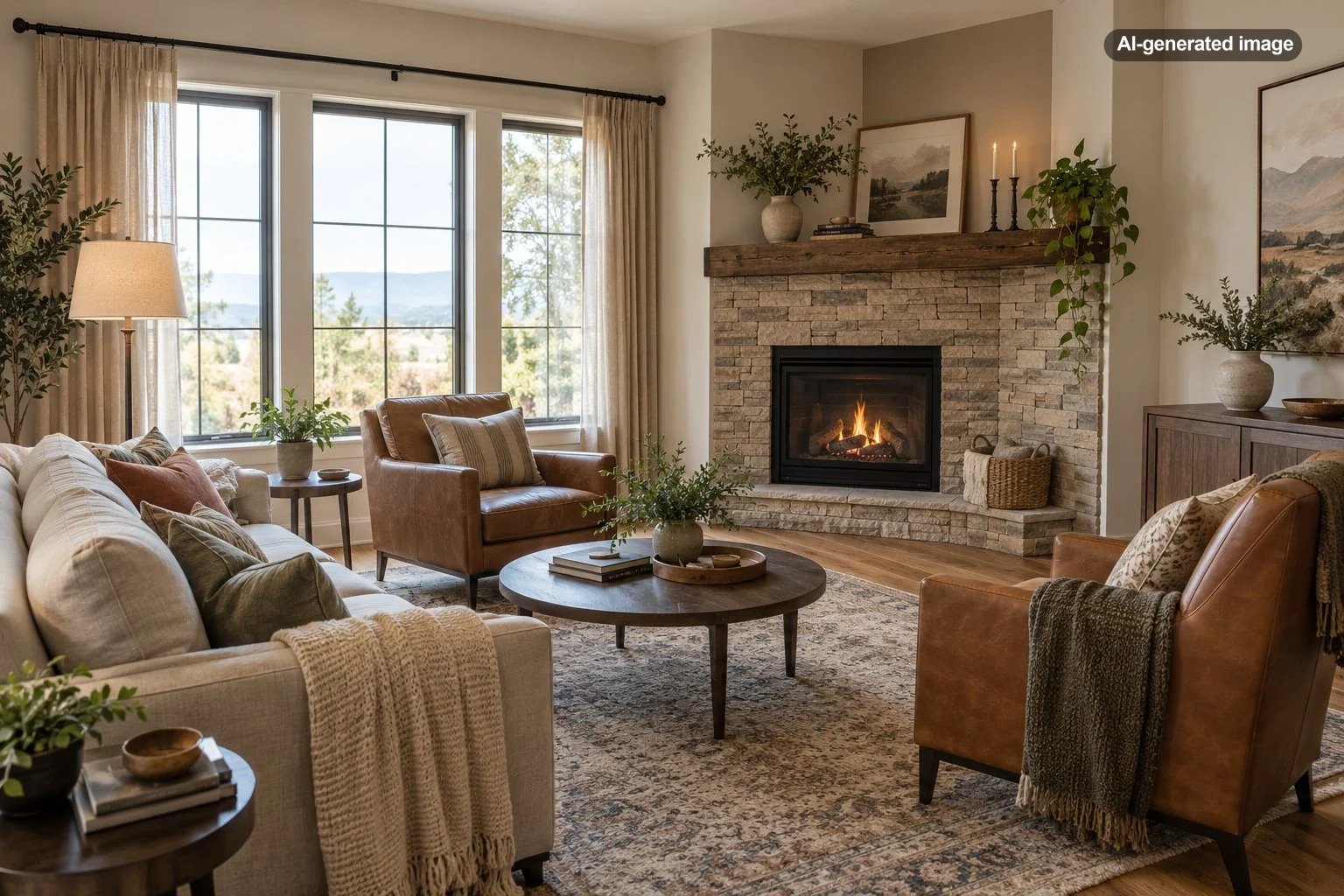
The fireplace can anchor the room without forcing every piece of furniture to face it directly.
Place the Sofa Where It Makes the Most Sense
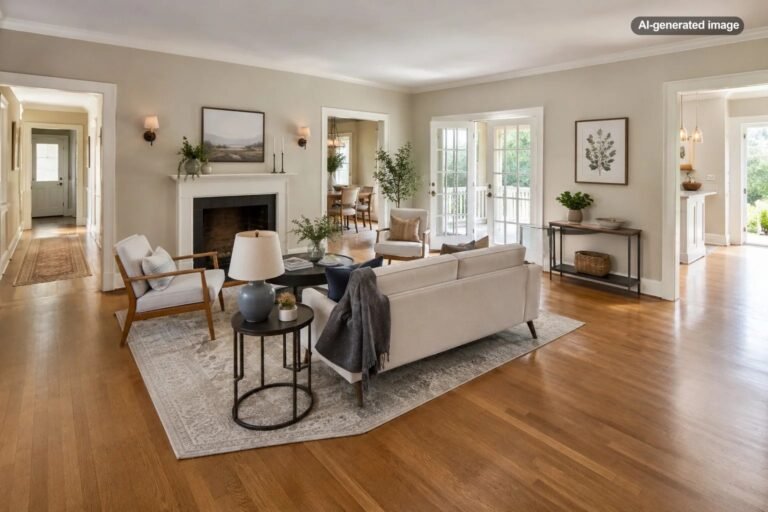
In many rooms, the sofa works best parallel to the longest usable wall or floating within the room rather than placed diagonally. A straight sofa gives the layout a stable visual foundation while the corner fireplace provides the architectural interest.
If the fireplace occupies the front-right corner, for example, the sofa might sit along the opposite wall with two chairs turned slightly toward both the sofa and fireplace. Another option is to float the sofa with its back toward an open dining area or kitchen, creating a clear boundary between zones.
Avoid assuming that pushing the sofa tightly against a wall will automatically make a small room feel larger. A modest amount of breathing space or a floating arrangement can create a more intentional seating group when the floor plan permits it.
Use Chairs to Bridge the Angle
Chairs are particularly useful in a corner-fireplace room because they can absorb the diagonal relationship without making the whole arrangement feel skewed. A pair of matching chairs can sit approximately opposite the sofa and turn slightly toward the fire. One substantial chair can also occupy the fireplace side of a smaller room while a lighter chair, stool, or ottoman balances the other side.
Swivel chairs are another practical option in rooms with competing focal points. They can face the fireplace during a quiet evening, turn toward other guests during conversation, or pivot toward a television without requiring a permanent diagonal layout.
Center the Seating Group, Not Every Object
One of the most useful tricks with an off-center fireplace is to create a strong center somewhere else. A coffee table, ottoman, or area rug can become the organizing center of the furniture group. The fireplace then acts as a secondary visual anchor rather than the geometric center of every element.
Place the coffee table according to the seats that actually use it. Likewise, orient the rug around the furniture grouping. Do not slide the rug toward the corner simply because that is where the fireplace sits. When the sofa, chairs, table, and rug clearly belong together, the room reads as intentional even if the architecture is asymmetrical.
A round or oval coffee table can be especially forgiving in an angled layout because it does not establish another strong directional line. It can also make circulation around a compact seating group feel less rigid.
Protect the Main Walking Paths
After finding a promising arrangement, walk through the room exactly as you would on an ordinary day. Test the path from the doorway to the sofa, from the living room to adjoining spaces, and between seats. If a corner of the coffee table or the back of a chair repeatedly interrupts that route, the layout needs adjustment.
Corner fireplaces sometimes tempt homeowners to scatter furniture across the diagonal center of the room. That can create a visually interesting photograph but an annoying everyday floor plan. Whenever possible, let major circulation routes pass around the seating zone rather than directly through it.
What to do
- Mark the locations of doors, windows, the fireplace, and any television.
- Position the largest sofa according to the room’s function and longest practical sightline.
- Add chairs and angle them only as much as needed to acknowledge the fireplace.
- Place the coffee table or ottoman in relation to the seating, not the corner wall.
- Use an area rug to define the complete conversation zone.
- Walk every normal route through the room and adjust anything that creates a bottleneck.
What If the TV and Fireplace Are in Different Places?
A corner fireplace and a television on another wall create two focal points, but the room does not have to choose only one. Decide which feature receives attention for longer periods. In a frequently used media room, it is reasonable for the sofa to have the clearest television view while chairs maintain a stronger relationship with the fireplace.
If television viewing is occasional, the furniture can favor conversation and the fireplace instead. Flexible seating, especially swivel chairs or lightweight occasional chairs, makes a dual-purpose layout easier to live with.
Mounting a television above a fireplace should not be treated as the automatic solution. Whether that position is suitable depends on the fireplace design, heat conditions, wall construction, viewing height, and equipment requirements. Keeping the television elsewhere can often produce a more comfortable viewing angle while allowing the fireplace to retain its own architectural identity.
Do Not Forget Scale and Visual Weight
An angled room becomes harder to balance when every piece is large and visually heavy. If you already have a deep sofa or sectional, consider lighter chairs with visible legs rather than adding another bulky upholstered piece. Conversely, a large room with a substantial stone fireplace may need furniture with enough scale to keep the fireplace from overpowering the seating area.
Balance does not require identical pieces on either side. A chair and floor lamp can visually counter a small console, for example. A tall plant, side table, or artwork can provide height where a furniture arrangement otherwise feels weighted toward the fireplace corner.
Keep Furniture Safely Away From the Fireplace
Furniture placement around an operating fireplace is also a safety decision. The U.S. Fire Administration advises keeping anything that can burn at least 3 feet from fireplaces and other heat sources. That includes furniture, rugs, pillows, baskets, and other combustible furnishings. Always follow the instructions and clearance requirements for your specific fireplace or appliance as well.
A generous open area in front of the fire also prevents the fireplace from feeling visually crowded. If moving the sofa far enough away destroys the furniture plan, rethink the seating group rather than squeezing upholstered pieces into the fire zone.
Layouts That Often Work
| Room situation | Useful starting layout | Why it works |
|---|---|---|
| Small rectangular room | Sofa straight, one or two chairs angled toward fireplace | Keeps the main footprint simple while acknowledging the corner |
| Open-plan living area | Floating sofa with chairs near the fireplace side | Defines the living zone without relying on walls |
| TV on adjacent wall | Sofa toward TV, swivel or angled chairs toward fire | Accommodates two focal points without forcing a diagonal sofa |
| Large conversation room | Sofa plus pair of chairs around a central table | Creates a strong social center while the fireplace remains visible |
| Compact room with oversized fireplace | Smaller sofa and visually lighter chairs | Reduces competition between bulky furniture and architecture |
Common Mistakes to Avoid
The first is aiming every seat directly at the fireplace. That can create a strange fan-shaped arrangement with no clear center. The second is centering the rug on the fireplace rather than on the furniture, which can make the seating appear to be slipping sideways across the room.
Another mistake is filling an awkward corner with extra furniture simply because there is empty floor space. Negative space can be useful, particularly near a fireplace or major walkway. The room does not need an object in every available gap.
Finally, do not buy a new sectional or oversized chair until you have mapped its actual footprint. Corner fireplaces remove some of the wall and floor area that conventional furniture layouts rely on, so scale matters more than it might in a simple rectangular room.
FAQ
Should the sofa face a corner fireplace?
Not necessarily. The sofa can remain straight while chairs or secondary seating turn toward the fireplace. This often creates a more natural layout than placing the sofa diagonally.
Can you put a sectional in a room with a corner fireplace?
Yes, provided the sectional fits without blocking circulation or encroaching on the fireplace area. Choose the chaise orientation carefully so it does not cut off the path to a doorway or isolate the fireplace from the seating group.
Should the rug point toward the fireplace?
Usually, the rug should relate primarily to the seating arrangement. Keeping it aligned with the main furniture can calm the room and allow the diagonal fireplace to provide architectural interest.
How do you make an off-center fireplace look intentional?
Create a clearly defined seating group using furniture, a rug, and a central table, then visually connect the fireplace with an angled chair, lighting, artwork, or another balanced element. The arrangement does not need to be symmetrical to feel cohesive.