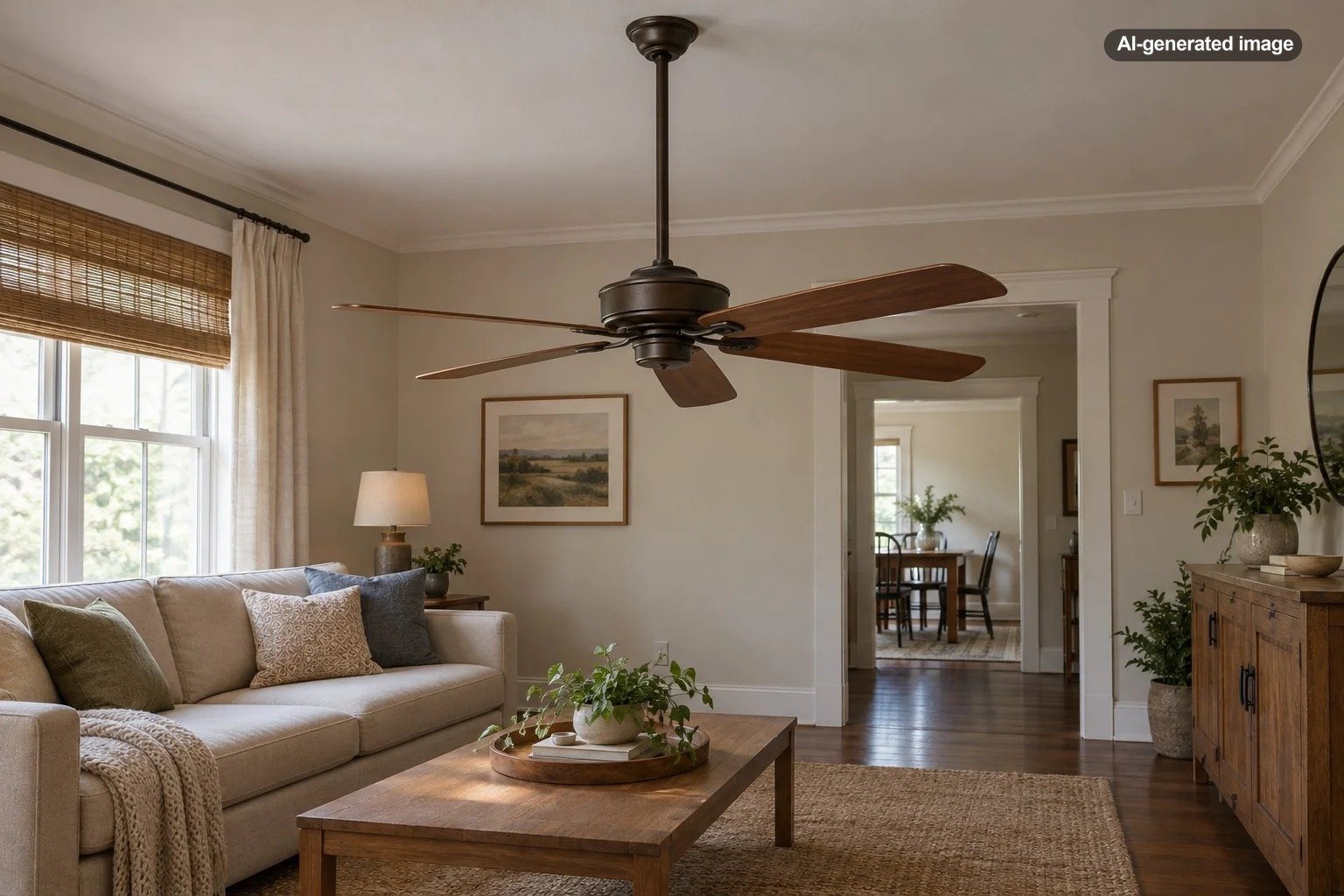
Can a Ceiling Fan Hang Too Low to Be Safe?
Yes, a ceiling fan can hang too low to be safe. Even a beautiful, properly functioning fan becomes a potential hazard when its spinning blades are within reach of people moving through the room. The concern is not simply whether someone can walk underneath it without ducking. Raised arms, ordinary household activities, and the location of nearby furniture can all affect the risk.
For typical residential ceiling fans, a widely recommended minimum is 7 feet between the floor and the lowest point of the fan blades. ENERGY STAR also recommends installing fans 8 to 9 feet above the floor when ceiling height permits, both for clearance and effective air movement. Individual manufacturers may specify additional requirements, so the instructions for the particular fan always matter.
If your fan looks unusually low, measuring its actual blade height is more useful than judging its appearance from across the room. A long downrod, an oversized light fixture, or a fan designed for taller ceilings can make an otherwise attractive installation unsuitable for a particular space.
How Low Is Too Low for a Ceiling Fan?
The important measurement is the distance from the finished floor to the lowest edge of the rotating blades. A ceiling fan that hangs below the recommended minimum clearance creates an avoidable contact hazard, even if it has operated for years without an incident.
ENERGY STAR recommends a minimum installation height of 7 feet above the floor. It also recommends at least 18 inches between the blades and surrounding walls. Some manufacturers establish more generous horizontal clearances. Hunter, for example, specifies 30 inches between blade tips and nearby walls or obstructions in its installation guidance.
These figures are not interchangeable. The 7-foot recommendation concerns vertical clearance beneath the blades, while the horizontal clearance protects against contact with nearby objects and helps ensure appropriate installation space.
Neither recommendation should be presented as a universal building-code rule. Local requirements, the fan’s listing, and manufacturer instructions can affect what is acceptable in a particular installation.
How to Measure Your Ceiling Fan’s Clearance
You do not need to dismantle a ceiling fan to determine whether it hangs too low. A careful measurement can establish whether the existing installation warrants closer attention.
What to do
- Switch the fan off. Wait until the blades have stopped completely before taking measurements.
- Identify the lowest blade edge. Measure to the lowest point along the blade’s normal rotation, accounting for any downward blade angle.
- Measure from the finished floor. Use a tape measure or suitable measuring tool to determine the vertical distance from the floor to that blade edge.
- Check nearby obstacles. Consider walls, cabinet doors, tall furniture, and other objects within the blade’s rotation area.
- Compare the results with the manual. Check the fan’s required floor and obstruction clearances, rather than relying only on a general guideline.
Measure carefully without standing on furniture or placing yourself beneath unstable equipment. If the height cannot be checked safely from the floor, have a qualified professional take the measurement.
For example, imagine a room with an 8-foot ceiling and a fan whose lowest blade edge sits 14 inches below it. The blade clearance would be 82 inches, or 6 feet 10 inches. That falls below the commonly recommended 7-foot minimum, even though the fan may not look dramatically low.
A difference of just a few inches can matter. This is why calculating the hanging height before buying a fan is much easier than discovering a clearance problem after installation.
Why Ceiling Height Changes the Right Fan
Ceiling height influences which mounting style makes sense. The fan’s overall dimensions matter just as much as the ceiling measurement because two fans with similar blade spans can have very different hanging depths.
Rooms With 8-Foot Ceilings
An 8-foot ceiling provides only 12 inches between the ceiling and the 7-foot minimum blade height. That limits how far the blades can extend downward.
A low-profile or flush-mount fan is often the practical choice. These designs position the fan closer to the ceiling and eliminate the longer downrod typically associated with standard hanging fans.
However, the words low-profile do not guarantee that every model will fit. Check the listed distance from the ceiling to the blades, not merely the total fixture height or the manufacturer’s product category.
Also remember that a decorative light kit may extend below the blades. Its lowest point deserves separate consideration, particularly above beds, raised furniture, or areas where people may lift objects overhead.
Rooms With 9-Foot Ceilings
A 9-foot ceiling generally offers more mounting flexibility. Depending on the fan’s dimensions, a standard mounting arrangement or an appropriately sized downrod may place the blades within the desirable 8- to 9-foot range.
The correct downrod cannot be chosen from ceiling height alone. The motor housing, blade position, mounting assembly, and any additional components affect the finished installation.
Rooms With Vaulted or Tall Ceilings
Tall rooms may benefit from a longer downrod that positions the blades closer to the occupied part of the room. A fan mounted extremely high can produce less noticeable airflow where people actually sit and stand.
Vaulted ceilings introduce another consideration: the mounting system must accommodate the ceiling angle while maintaining adequate blade clearance from the sloped surface and nearby obstructions.
Use a manufacturer-approved mounting system and downrod combination. Not every fan is compatible with every ceiling slope, accessory, or extension length.
What Makes a Low-Hanging Fan Dangerous?
The main concern is accidental contact with moving blades. A person may have plenty of clearance when walking normally but still reach into the fan’s rotating area while stretching, lifting laundry, carrying a long object, or raising both arms.
Children introduce additional considerations because play can involve jumping, reaching, or climbing onto furniture. A safe installation should not depend on everyone remembering to avoid an unusually low fan.
Furniture arrangements matter, too. A bed, bunk bed, elevated seating area, or other climbable furnishing can change how close someone can get to the blades.
The recommended floor clearance is not permission to install a fan directly above any furniture arrangement without further thought. The room’s actual use must be considered alongside the measurements.
Another overlooked issue is the possibility of objects striking the fan. Tall cabinets, opening doors, ladders, balloons with attached strings, and long household items may enter a blade’s path. Even when an object does not cause an injury, contact can damage blades or mounting components.
Can You Make an Existing Fan Hang Higher?
Sometimes. The appropriate correction depends on the fan’s original mounting arrangement and the accessories approved for that model.
If a fan uses a downrod, a shorter manufacturer-compatible downrod might raise it enough to restore suitable clearance. However, some fans require minimum spacing below the ceiling, and the mounting assembly may not support every downrod configuration.
Replacing a standard fan with a purpose-built low-profile model may be the better solution for an 8-foot ceiling. This can avoid compromises involving unapproved accessories or incompatible mounting components.
Do not attempt to solve the problem by bending blades, removing required mounting components, improvising a shorter connection, or altering the fan’s electrical or structural support.
Ceiling fans produce movement and vibration, so their support requirements differ from those of some ordinary light fixtures. The electrical box and mounting assembly must be approved and properly secured for fan use.
Where a correction requires electrical work, verification of the mounting structure, or changes to the fan’s suspension system, a qualified electrician is the sensible choice. A professional can also determine whether the existing fan and ceiling arrangement are compatible with the proposed mounting method.
Should You Choose a Smaller Fan Instead?
A smaller blade span can help when the primary problem is horizontal clearance. For example, a large fan may be poorly suited to a narrow bedroom because its blades are too close to walls or cabinetry.
But a smaller diameter does not automatically correct a vertical height problem. A compact fan suspended from a long downrod can still hang dangerously low.
When comparing replacement fans, evaluate three measurements separately: blade span, ceiling-to-blade depth, and total fixture height with any lighting components installed.
It also helps to consider how the room is used. A bedroom with a bunk bed presents different spatial concerns from an open dining room, even if their ceilings are identical.
Other Installation Details That Affect Safety
Correct hanging height is essential, but it is only one part of a safe installation. A fan that meets the recommended vertical clearance can still be unsuitable if other installation conditions are ignored.
- Mounting support: The fan needs a properly rated and secured mounting system, not an electrical box intended only for a lightweight light fixture.
- Blade-to-wall clearance: Follow the manufacturer’s horizontal clearance instructions, including clearance from cabinetry and other obstructions.
- Ceiling slope: An angled ceiling may require a specialized mounting adapter and compatible downrod.
- Light fixtures: An integrated light may extend farther down than the blades and should be included in overall headroom planning.
- Room activities: Consider raised platforms, bunk beds, exercise areas, and routine movement beneath the fan.
- Manufacturer limitations: Confirm that the proposed mounting configuration and accessories are specifically supported for the model.
For renters, an existing fan with questionable clearance should be reported to the property owner or maintenance manager. Avoid modifying wiring or mounting hardware without authorization and qualified assistance.
Frequently Asked Questions
Is a Ceiling Fan Safe With Only 6 Feet of Clearance?
No. Six feet between the floor and the blades is below the commonly recommended 7-foot minimum for a typical residential ceiling fan. Keep the fan switched off and arrange for a suitable correction rather than assuming careful movement underneath it will eliminate the risk.
Can a Ceiling Fan Be Too Close to the Ceiling?
Yes. Blades positioned too close to the ceiling may not receive enough incoming airflow for efficient circulation. Low-profile fans are specifically designed for reduced mounting depth, but their installation must still follow the manufacturer’s requirements.
Does a Ceiling Fan Need More Clearance Above a Bed?
The standard floor-to-blade recommendation still matters, but bedroom furniture introduces additional hazards. Bunk beds and loft beds are particularly important because someone seated or standing on an elevated sleeping surface may come much closer to the blades. Check the bed manufacturer’s warnings and the fan’s installation guidance before deciding on placement.
Can a Low-Profile Fan Work on a Vaulted Ceiling?
Only when the specific fan is approved for that mounting arrangement. Some low-profile models are intended for flat ceilings and cannot be adapted safely to angled surfaces. A sloped ceiling may require a fan designed for an angled mounting system.
Should You Replace a Fan That Hangs Below 7 Feet?
Not necessarily, but the clearance problem needs correction. A compatible shorter downrod might be an option for certain models, while other installations require a low-profile replacement. Have the mounting arrangement evaluated before selecting a solution, and do not continue using the fan in an unsafe configuration.
The Bottom Line on Ceiling Fan Height
A ceiling fan should never be positioned so low that avoiding its blades becomes part of everyday life. For typical residential installations, keep the blades at least 7 feet above the finished floor, aim for 8 to 9 feet when practical, and follow the model-specific clearance and mounting instructions.
Measure before purchasing, account for light kits and nearby furnishings, and choose a low-profile design when ceiling height is limited. If an existing fan hangs too low, the solution is to correct the installation rather than learn to live around it. Comfortable airflow is valuable, but adequate headroom is nonnegotiable.
Sources & Further Reading
- ENERGY STAR: Ceiling Fan Basics – General guidance on blade height, wall clearance, fan sizing, and mounting styles.
- Hunter Fan: How to Measure a Ceiling Fan – Manufacturer guidance on measuring fan dimensions, installation height, downrod length, and nearby obstacles.
- Hunter Fan: Ceiling Fan Installation Guide – Installation guidance covering blade clearance, mounting, ceiling angles, and electrical support.
- ENERGY STAR: Ceiling Fans Key Product Criteria – Definitions and performance distinctions for conventional and hugger ceiling fans.