
How Many Pillows Should Be on a Guest Bed?
Most guest beds need four sleeping pillows plus one or two decorative pillows. That means five or six pillows on a queen or king bed, while a twin bed usually looks and functions best with two sleeping pillows and one decorative pillow. The right number is enough to give guests a choice without making bedtime feel like a furniture-moving exercise.
Comfort comes first. A polished arrangement is welcome, but every pillow should either help someone sleep, support reading in bed, or contribute enough visually to justify the space it occupies.
Start With the Pillows Guests Actually Sleep On
A guest bed should have at least one sleeping pillow for each expected guest, but two per person is more accommodating. Different sleepers use pillows differently: one may want a single low pillow, another may stack two, and someone reading before bed may appreciate extra support. Two per person provides flexibility without asking the host to predict individual preferences.
For a bed that regularly hosts two people, four sleeping pillows are a sensible baseline. Arrange them in two rows of two or stack one pair neatly over the other. On a twin bed intended for one guest, two sleeping pillows are generally enough, even though only one may be used overnight.
Not every sleeping pillow needs the same feel. If practical, offer one softer option and one firmer option per sleeping space. Keep protectors and pillowcases on all usable pillows so guests do not have to wonder which ones are merely decorative.
A Simple Pillow Count by Bed Size
Bed width changes the visual balance, but room size and guest habits matter just as much. The ranges below create a finished look without covering the entire mattress.
| Bed size | Sleeping pillows | Decorative pillows | Practical total |
|---|---|---|---|
| Twin or daybed | 2 | 1 | 3 |
| Full | 2-4 | 1 | 3-5 |
| Queen | 4 | 1-2 | 5-6 |
| King | 4 | 2-3 | 6-7 |
A full bed is the most flexible case. Two standard sleeping pillows may be sufficient when it is mainly used by one person, while four make more sense if couples stay often. On a king bed, use king-size sleeping pillows or three standard pillows across the back if you already own them; either can fill the width comfortably.
These are guidelines rather than quotas. A narrow room with a queen bed may look calmer with four sleeping pillows and one lumbar pillow. A generously sized room can carry an additional pair of shams, provided guests have a bench, chair, shelf, or closet space for anything removed at night.
Choose Decorative Pillows With Restraint
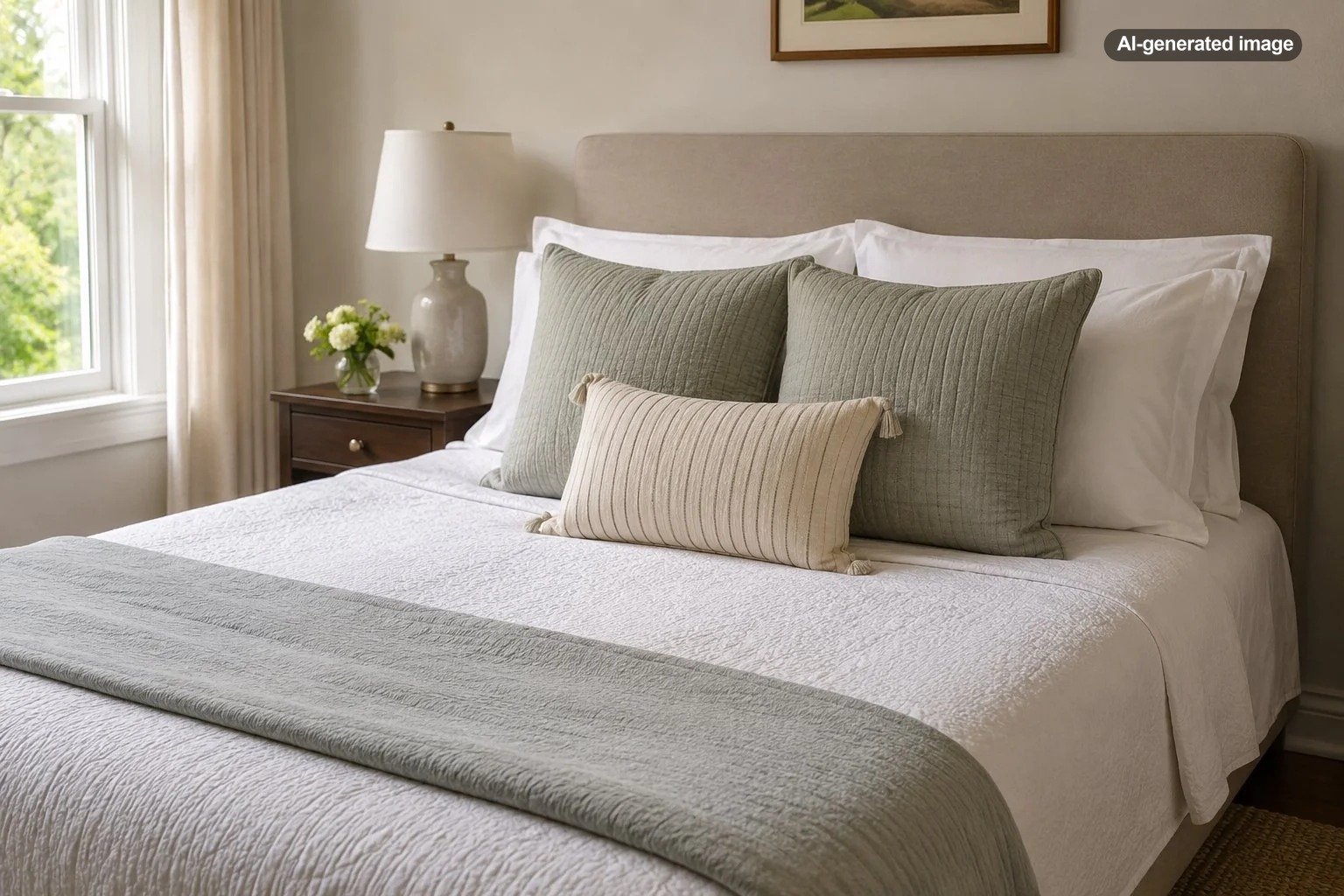
One decorative pillow is enough to make most guest beds feel considered. A single lumbar pillow works especially well because its horizontal shape bridges the sleeping pillows and creates a clear focal point. Two square accent pillows can add color or pattern, but they also create more pieces to remove and store.
For an easy queen-bed arrangement, place four sleeping pillows at the headboard, then center one lumbar pillow in front. For a slightly fuller look, use two sleeping pillows in back, two shams in front, and one smaller accent pillow. The second arrangement looks more formal, while the first is quicker to reset after every visit.
A guest bed feels generous when it offers useful choices, not when every inch is occupied.
Scale matters more than sheer quantity. One substantial lumbar pillow often looks more intentional than three undersized accents. If patterns are involved, let one pillow carry the strongest motif and keep the surrounding bedding quieter. This prevents a compact guest room from feeling visually busy.
Make Room for Pillows After Turn-Down
The most overlooked part of styling a guest bed is what happens to the pillows at night. Decorative pieces often end up on the floor when there is no obvious alternative. That is inconvenient for guests and needlessly exposes clean textiles to dust, shoes, and pet hair.
Before adding another accent pillow, identify a landing place. A bench at the foot of the bed is ideal, but a cleared chair, a low shelf, a luggage rack, or an open section of the closet can work. In a small room, reducing the display by one or two pillows is usually the better design decision.
Adjust the Arrangement for the Way the Bed Is Used
A dedicated guest bed can support a more layered arrangement because it stays made between visits. A sofa bed, daybed, or home-office bed should use fewer pieces that are easy to relocate. Two sleeping pillows and one structured accent pillow may be all a daybed needs to shift comfortably between seating and sleeping.
If children are the usual guests, washable covers and fewer decorative pieces simplify cleanup. For older adults or guests with limited mobility, avoid a deep wall of pillows that must be lifted or carried. Easy access to the sleeping surface is more important than a showroom-style display.
Season also has a role. Heavy velvet or faux-fur accents can feel excessive in a warm room, while breathable cotton or linen covers keep the arrangement visually lighter. This is an aesthetic and maintenance choice rather than a requirement; the goal is simply to make the bed feel appropriate to the room.
Common Guest-Bed Pillow Mistakes
- Using too many decorative pillows: If removing them takes several trips, edit the arrangement.
- Providing only one pillow per person: Guests may want a different height or extra support for reading.
- Mixing usable and display-only pillows without a clear distinction: Clean cases and obvious layering prevent confusion.
- Ignoring storage: Every removable pillow needs a clean place to go overnight.
- Choosing appearance over upkeep: Intricate trims and delicate covers can become a burden in a frequently used room.
- Keeping flattened or lumpy pillows in service: A smaller set of supportive, well-kept pillows is preferable to a larger tired collection.
A Quick Way to Finalize Your Pillow Count
Before you decide
- Allow two sleeping pillows for each likely guest.
- Add one decorative pillow, then assess whether the bed needs another.
- Check that the arrangement suits the width of the bed and the scale of the room.
- Choose a clean overnight storage spot for every decorative piece.
- Remove any pillow that is worn, difficult to clean, or unclear in purpose.
When in doubt, stop at four sleeping pillows and one decorative pillow for a queen bed. It is the most reliable balance of comfort, proportion, and easy upkeep. The result should look inviting when guests arrive and remain effortless when they are ready to sleep.
Frequently Asked Questions
Are four pillows too many for a guest bed?
No. Four sleeping pillows are appropriate for a queen or king guest bed and give two people options. On a twin bed, four would usually be excessive unless the bed also functions as seating.
Do guest beds need decorative pillows?
No. Decorative pillows are optional. Crisp bedding, comfortable sleeping pillows, and a neatly folded blanket can make a bed feel finished without any accents.
Should guest pillows match?
The cases should coordinate with the bedding, but the inserts do not need identical firmness or height. A little variety can be useful as long as the finished arrangement still looks cohesive.
Where should guests put extra pillows at night?
Provide a bench, chair, shelf, luggage rack, or clear closet space. If the room cannot accommodate a clean landing place, use fewer decorative pillows.