
Are Indoor Air Quality Monitors Worth It?
Yes, an indoor air quality monitor can be worth buying, but only if you choose one that measures something relevant to your home and you are prepared to act on what it tells you. These devices are most useful as pattern-finders: they can show how cooking, cleaning, closed windows, outdoor smoke, occupancy, or other everyday conditions change the readings in a room.
What they cannot do is give your home a single, definitive health score. Indoor air is a mixture of particles, gases, moisture, and other contaminants, and a consumer monitor only detects the pollutants or environmental conditions its particular sensors are designed to measure.
What an indoor air quality monitor actually measures
The phrase air quality monitor covers many different devices. Common consumer monitors may measure particulate matter, carbon dioxide, carbon monoxide, volatile organic compounds, formaldehyde, temperature, humidity, radon, or some combination of those factors. Two products both labeled as indoor air quality monitors can therefore be answering very different questions.
Particulate matter monitoring can be especially informative in homes where you want to see how fine-particle levels change during cooking, when outdoor smoke is present, or during other particle-producing activities. A carbon dioxide sensor can help reveal patterns associated with occupancy and ventilation. Temperature and humidity readings can add useful context, particularly when you are trying to understand comfort or moisture conditions.
Broad VOC readings deserve more caution. A general VOC sensor may react to changes in airborne chemicals without identifying the individual compound responsible. That can still be useful for spotting a pattern, but the number should not automatically be treated as a diagnosis of a hazardous condition.
The strongest reason to buy one: finding patterns you can change
The real value of monitoring appears when a reading changes your behavior. Suppose particle readings consistently rise while you cook and fall after you use an exhaust fan or increase appropriate ventilation. That pattern gives you practical information about the activity, the room, and the effectiveness of your response.
The same principle applies to other measurements. You might notice that a heavily occupied home office develops a different carbon dioxide pattern when the door remains closed for hours, or that humidity behaves differently in a bathroom when the exhaust fan is used consistently. The monitor becomes a feedback tool rather than a decorative dashboard.
The best air quality monitor is not the one with the most measurements; it is the one that helps you make a useful decision.
Where consumer monitors have important limits
Consumer air sensors are not laboratory instruments, and EPA guidance notes that there is limited information about the accuracy and precision of many low-cost monitors used indoors. Performance can be affected by placement, temperature, relative humidity, time in service, data-processing methods, and the presence of other contaminants.
That means the most productive way to use a home monitor is often to watch for repeatable trends rather than becoming fixated on tiny changes between individual readings. If the same activity repeatedly produces a large change under similar conditions, that pattern may be more informative for household decision-making than whether a display moves by a very small amount from one minute to the next.
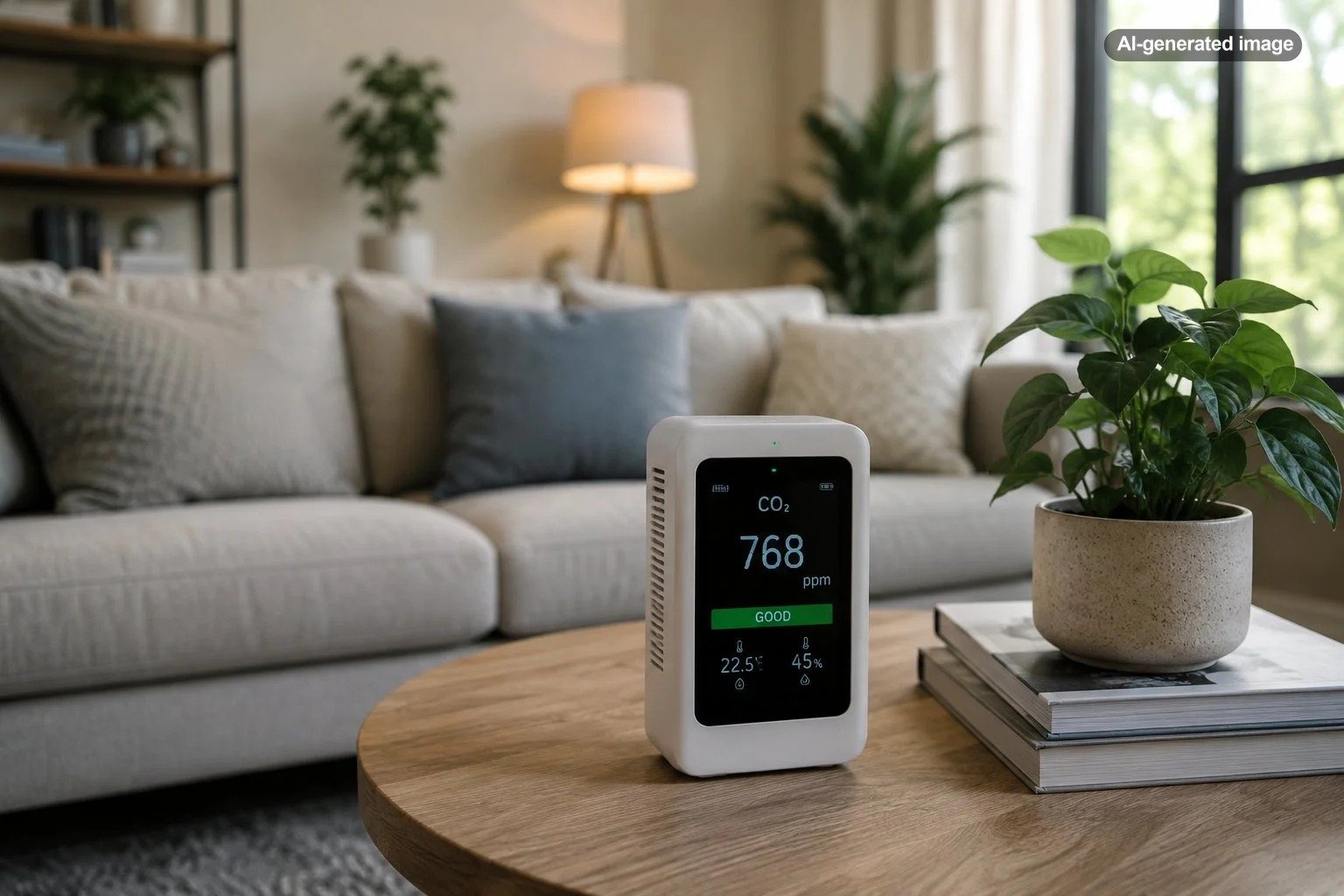
There is another complication: for many indoor pollutants, there are no broadly accepted indoor concentration limits that consumer devices can use as universal alert thresholds. Manufacturers may therefore determine how their displays, colors, notifications, and warning levels are presented. A green screen should not be interpreted as proof that every relevant pollutant has been measured or that the room is risk-free.
Do not confuse an air quality monitor with a safety alarm
This distinction matters. General low-cost air pollution monitors are not designed to replace certified household safety devices such as smoke detectors and carbon monoxide alarms. An air quality dashboard that happens to display carbon monoxide information should not be assumed to serve the same life-safety function as the required or recommended alarm for your home.
What to look for before buying
Start with the problem you actually want to understand. Buying a device with six sensors is not automatically better than buying one with two relevant sensors. Extra readings can create more data without creating more useful information.
Before you decide
- Choose the pollutant first. Decide whether particles, carbon dioxide, humidity, radon, or another specific measurement is relevant to your question.
- Check independent performance information. Look for credible evaluations rather than assuming price, app design, or a premium-looking enclosure indicates better sensor performance.
- Read the placement instructions. Sensor location can affect readings substantially.
- Consider the display and data history. Historical graphs can make patterns easier to spot than a single live number.
- Look at maintenance and expected sensor life. Sensors do not remain equally reliable forever, and manufacturer guidance may specify service or replacement considerations.
- Decide what action each measurement would trigger. If you have no practical response to a particular sensor reading, that feature may not be worth paying extra for.
Placement matters more than many people realize
A poorly placed monitor can provide a distorted picture of the room. EPA guidance suggests placing a monitor where occupants breathe, generally around 3 to 6 feet above the floor for typical seated or standing adults, while keeping airflow into the device unobstructed. It should not simply be tucked onto a crowded shelf because that is where the nearest outlet happens to be.
Avoid placing the monitor immediately beside a stove, fireplace, open window, HVAC supply vent, or stored cleaning products unless your specific goal is to investigate that source. A device inches from the source may tell you a great deal about the air immediately beside it while telling you much less about typical exposure elsewhere in the room.
What should you do when a reading rises?
First, look for a plausible source or activity. Did the reading change when cooking began, when several people entered the room, when a cleaning product was used, or when outdoor air conditions changed? Repeatable timing can help narrow the possibilities.
Then focus on the standard indoor-air strategies appropriate to the situation. EPA identifies source control, improved ventilation, and supplemental filtration or air cleaning as the three basic approaches to improving indoor air quality. Source control is often the most effective starting point because reducing or eliminating the source addresses the problem rather than simply trying to manage the resulting pollution.
Ventilation can help dilute indoor pollutants, but it is not automatically the right response in every circumstance. Opening windows during heavy outdoor smoke, for example, could introduce the pollutant you are trying to avoid. Filtration can be useful for particles when appropriately selected and maintained, but an air cleaner does not solve every gaseous-pollutant or source problem.
So, are indoor air quality monitors worth the money?
For a household that enjoys data, wants to understand recurring air-quality patterns, or is trying to evaluate the effect of practical changes, the answer is often yes. A thoughtfully chosen monitor can turn an invisible household condition into information you can observe over time.
For someone seeking a device that certifies the entire home as healthy, identifies every contaminant, or replaces dedicated safety alarms and appropriate testing, the answer is no. No consumer monitor can provide that level of certainty.
The sensible buying rule is simple: identify the question first, choose the sensors second, and decide what you will do with the readings before paying for extra features. A monitor earns its place in the home when the information leads to better source control, ventilation, filtration, maintenance, or further investigation.
FAQ
Can one air quality monitor measure everything?
No. Consumer monitors detect only the pollutants or environmental factors supported by their installed sensors. Other pollutants may still be present.
Are more expensive air quality monitors automatically more accurate?
No. EPA notes that price does not necessarily indicate performance. Cost can also reflect features such as displays, connectivity, housing, power options, and the number of sensors.
Should I pay attention to trends or individual readings?
For ordinary household investigation, repeatable trends can be especially useful. Comparing conditions before, during, and after an activity may help you determine whether a source or ventilation change is affecting the measurement.
Can an indoor air quality monitor replace carbon monoxide and smoke alarms?
No. General indoor air pollution monitors should not be treated as replacements for dedicated household carbon monoxide alarms or smoke detectors.