Why Does My Dishwasher Smell Even After a Cleaning Cycle?
A dishwasher can still smell after a cleaning cycle because the cycle may wash the visible tub without removing debris from the filter, drain area, door gasket, spray arms, or connected plumbing. In other cases, dirty water is flowing back into the machine after the cycle ends. The lingering odor is therefore less about whether the dishwasher ran and more about whether the source of the odor was actually reached.
Start with the removable parts and accessible crevices before assuming the appliance needs repair. Food residue, grease, labels, bits of plastic, and stagnant water can hide in places that ordinary wash water does not fully flush.
The cleaning cycle may not clean the filter
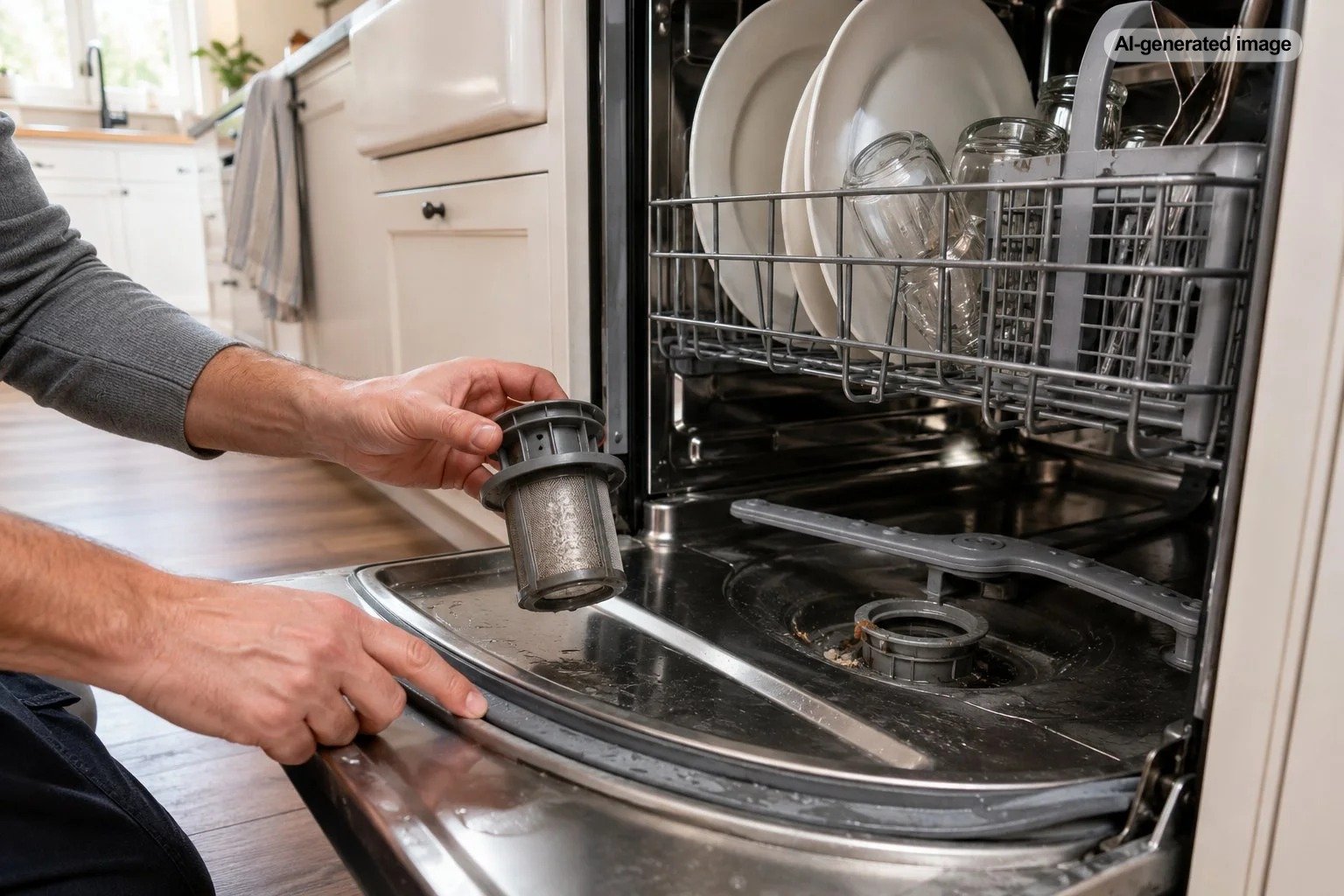
Many modern dishwashers have a filter assembly at the bottom of the tub. Its job is to catch food particles before they reach the pump or return to the dishes. That also makes it one of the first places odors develop.
A machine-cleaning cycle may loosen grease around the tub, but it cannot always dislodge food packed into the filter mesh or trapped beneath the filter assembly. The dishwasher may look clean while the filter still contains the remains of several dinners.
Remove the lower rack and locate the filter according to the owner’s manual for your model. Twist or lift it out only as directed. Rinse it under warm running water and use a soft brush with mild dish soap for stubborn residue. Avoid abrasive pads that could damage fine filter screens.
Debris may be hiding beneath the filter
Once the filter is removed, inspect the recessed area below it. This lower section is sometimes called the sump. Small bones, fruit pits, broken glass, paper labels, pasta, and fragments of packaging can collect there.
Disconnect power to the appliance before reaching into areas near moving or electrical components, and use caution around glass. Remove only loose debris that is clearly accessible. Do not dismantle the pump housing or internal hardware unless the manufacturer’s instructions specifically describe that task for homeowners.
If water remains in the sump immediately after a cycle, a small amount may be normal for some models. A noticeable pool of dirty water, especially one that grows between uses, points toward a drainage problem rather than simple surface grime.
The door gasket and lower lip are easy to miss
The wash spray reaches the main tub, but it may not thoroughly clean the folds of the door gasket, the hinge area, or the narrow ledge along the bottom of the door. Grease and food drips can settle there and remain untouched through repeated cycles.
Wipe these areas with a soft cloth and warm, mildly soapy water. Gently open the gasket folds without stretching or pulling them out of place. Check for a dark film, sticky residue, crumbs, or moisture trapped behind the seal.
A damaged, loose, or persistently moldy gasket may need professional evaluation or replacement. Scrubbing harder is not a meaningful solution if water is entering a section that should remain dry.
Clogged spray arms can leave residue behind
Spray arms distribute wash water through small openings. Seeds, mineral deposits, paper fibers, or food particles can block those openings, reducing the force and coverage of the wash.
When circulation is weak, residue remains on dishes and inside the machine, where it can develop an odor between cycles. Rotate each spray arm by hand when the dishwasher is off. It should move freely without striking a tall plate, pan handle, or utensil.
If the arms are removable according to the manual, rinse them and clear accessible openings with a nonmetallic tool. Do not enlarge the holes or use a sharp object that could alter the spray pattern.
The odor may be coming from the drain connection
If the dishwasher smells unpleasant shortly after it has been cleaned, inspect what happens after the wash water leaves the tub. The drain hose generally connects to a garbage disposal, sink drain, or air-gap fitting. Grease and food buildup at any of those points can produce an odor that seems to come from the dishwasher.
Run the garbage disposal, if present, and make sure the sink drains normally. If water backs up in the sink or the odor becomes stronger when the sink is used, the problem may involve household plumbing rather than the dishwasher interior.
The dishwasher drain hose also needs to be installed in the configuration specified for the appliance and local plumbing arrangement. A missing or improper high loop, a clogged air gap, a kinked hose, or a poorly draining disposal can allow dirty water to move back toward the dishwasher.
A tub-cleaning product cannot fix every cause
Dishwasher cleaners are designed to help remove grease, detergent residue, and mineral buildup from surfaces reached by circulating water. They can be useful, but they are not substitutes for cleaning a packed filter or correcting a blocked drain.
White vinegar is sometimes recommended for odor control, but it should not be poured directly into the detergent dispenser or mixed with other cleaners. Acidic products can also be inappropriate for certain components or repeated use. Follow the care instructions for the specific model and any cleaner being used.
Never mix vinegar with chlorine bleach or combine multiple cleaning products. More chemistry does not mean more cleaning, and incompatible products can create hazardous fumes.
Use the odor itself as a troubleshooting clue
| Odor | Likely area to inspect first | Useful next step |
|---|---|---|
| Old food or sour odor | Filter, sump, gasket, lower door edge | Remove debris and hand-clean accessible parts |
| Sewage-like odor | Drain hose, air gap, sink drain, disposal | Check for backflow, blockage, or plumbing problems |
| Wet or musty odor | Gasket folds, damp interior, standing water | Dry the interior and investigate poor drainage |
| Burning plastic | Heating area and lower rack | Stop the cycle, disconnect power, and allow the unit to cool |
| New plastic or manufacturing odor | Recently installed appliance | Check the manual and monitor whether it fades with normal use |
The odor category is only a clue, not a diagnosis. Different materials and food residues can smell surprisingly similar, particularly inside a warm, humid appliance.
A practical troubleshooting sequence
What to do
- Empty the dishwasher and disconnect power before inspecting internal areas.
- Remove and wash the filter according to the owner’s manual.
- Clear visible debris from the accessible sump area.
- Wipe the gasket, hinge area, detergent cup, and lower door lip.
- Check that spray arms turn freely and that their openings are clear.
- Run the sink and garbage disposal to identify a shared drainage problem.
- Look beneath the sink for a kinked hose, an overflowing air gap, or signs of backflow without altering the installation.
- Run an approved empty cleaning cycle only after the physical debris has been removed.
After cleaning, allow the interior to dry. Leaving the door slightly ajar between uses can help moisture escape when the manufacturer’s instructions and household safety considerations permit it. In homes with young children or pets, an open appliance door may create a climbing, access, or trip hazard, so use judgment.
How to keep the smell from returning
Scrape off large food scraps, but do not assume every dish must be washed by hand before loading. Excessive prewashing can waste time and water, while heavy scraps can overwhelm the filter. The useful middle ground is to remove bones, pits, labels, thick sauces, and large pieces of food.
Load items so they do not block the detergent dispenser or spray arms. Run the dishwasher often enough that damp food residue is not left sitting for many days. If a partial load must wait, a rinse function may help on models that provide one.
Check the filter regularly, with frequency based on the appliance manual, household use, and the amount of food left on dishes. A family running daily loads may need to inspect it more often than a household using the dishwasher twice a week.
A fresh-smelling dishwasher depends as much on drainage and hidden surfaces as it does on the cleaning cycle itself.
When the dishwasher may need service
Arrange appliance service or plumbing help when the odor returns within a day or two of thorough cleaning, dirty water reappears in the tub, the dishwasher does not drain completely, the sink backs up, or the machine produces unusual noises while draining.
A technician may need to inspect the drain pump, check valve, hose routing, internal seals, or electrical components. A plumber may be the better choice when the sink, disposal, air gap, or shared drain is also affected.
The useful distinction is persistence. A filter odor usually improves once the debris is removed. An odor caused by wastewater backflow or a failing component tends to return because the underlying condition has not changed.
Frequently asked questions
Why does my dishwasher smell worse when it is empty?
With no dishes inside, air moves more freely from the filter, sump, drain, and gasket areas. The smell may seem stronger even though the source has not changed.
Can I run another cleaning cycle instead of removing the filter?
Another cycle may help with surface residue, but it is unlikely to remove debris embedded in a manual filter. Hand-cleaning the filter is usually the more direct step.
Why does the smell return after the dishwasher sits overnight?
Food residue may remain damp, or wastewater may be flowing back into the tub after the cycle. Check for standing water and inspect the sink-side drain arrangement.
Should there be any water at the bottom of the dishwasher?
Some models retain a small amount of clean water in a recessed area. A visible pool of dirty or foul-smelling water is different and warrants drainage troubleshooting based on the owner’s manual.
Is a sewage smell always a dishwasher problem?
No. The odor may originate in the sink drain, garbage disposal, air gap, or household plumbing. If the sink drains slowly or smells as well, plumbing evaluation may be appropriate.