
What Makes a Good Emergency Lighting Setup for Power Outages?
A good emergency lighting setup does not depend on one heroic flashlight buried somewhere in a kitchen drawer. It uses several types of battery-powered or rechargeable lights, placed where people can reach them immediately, with enough backup power to cover hallways, bathrooms, stairs, sleeping areas, and essential tasks.
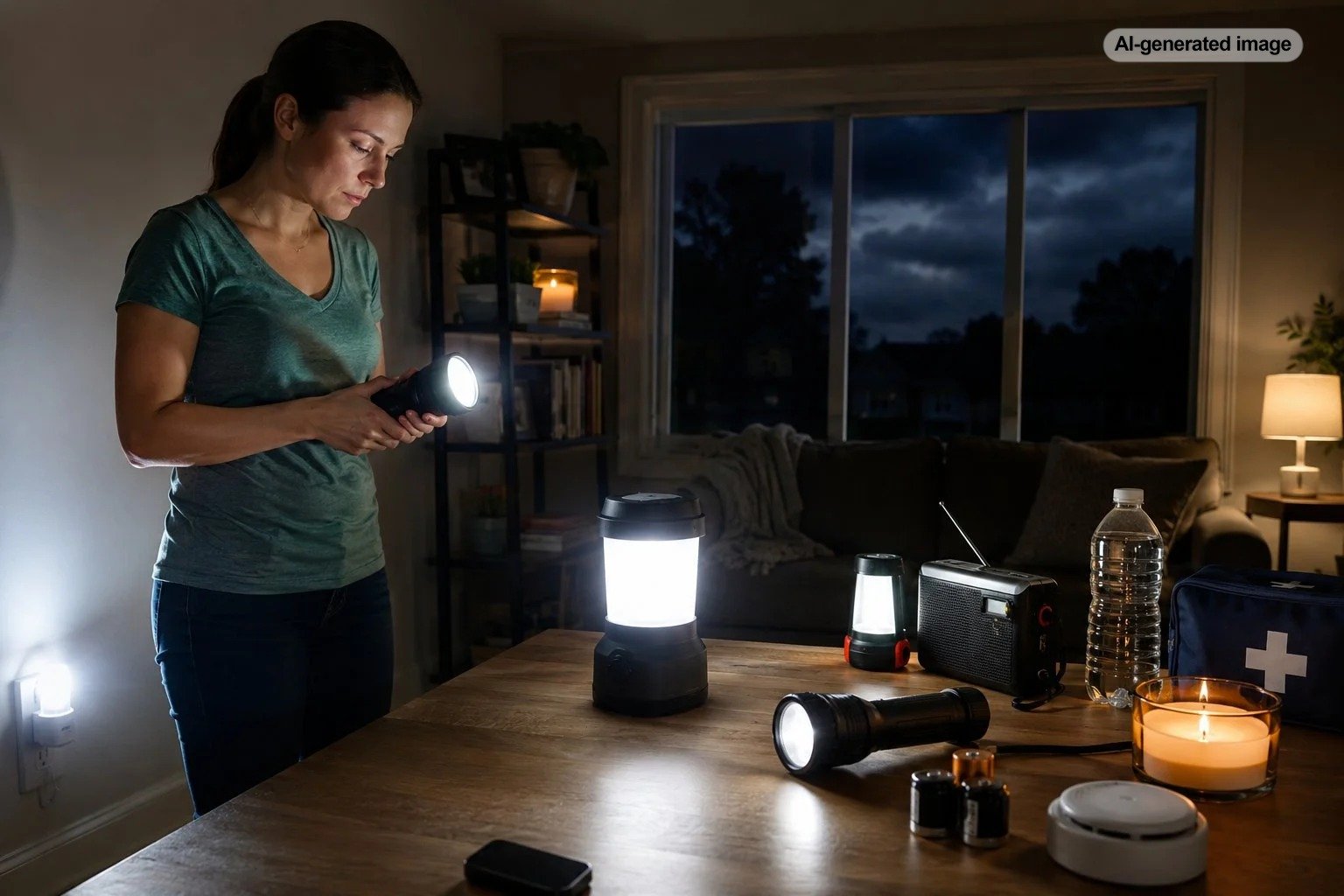
The most useful setup is layered: small automatic lights help during the first confusing seconds, portable lanterns illuminate rooms, flashlights provide a directed beam, and personal lights keep both hands free. Candles should not be the primary plan because open flames introduce an avoidable fire risk during an already disrupted situation.
Start with light that turns on immediately
The first moments of an outage are often the least orderly. Someone may be on the stairs, cooking, showering, or walking through a cluttered room when the lights disappear. Your first layer should therefore require little or no searching.
Plug-in emergency lights with an internal battery can illuminate automatically when utility power fails. They are especially useful in hallways, near stairs, beside the electrical panel, and along the route between bedrooms and bathrooms. Some can also be removed from the outlet and used as handheld lights.
These lights should supplement portable equipment rather than replace it. Their batteries and light output are limited, and a blocked outlet or failed battery can leave a gap in the plan. Test them periodically according to the manufacturer’s instructions and avoid placing every automatic light on the same branch circuit.
Use lanterns for rooms and shared spaces
A flashlight is excellent for finding a breaker panel or inspecting a dark corner, but its narrow beam is tiring when several people are trying to cook, talk, read instructions, or organize supplies. A battery-powered lantern spreads light across a larger area and can be placed on a table, counter, or shelf.
Choose stable lanterns that are difficult to tip and simple enough to operate by touch. Adjustable brightness is valuable: a low setting conserves power and reduces glare, while a brighter setting can support meal preparation or first-aid tasks. A diffuser that softens the light is generally more comfortable indoors than a bare, intensely bright LED.
Affiliate disclosure: CraneManor.com may earn a commission when you purchase through links on this page. This does not affect the price you pay. Learn more.
For ordinary room use, portable rechargeable lamps can also make an outage feel less institutional. A pair of rechargeable cordless table lamps can provide movable light on a dining table or nightstand, provided they are kept charged and are not treated as the household’s only emergency lights.
Keep flashlights where they will actually be needed
Instead of storing every flashlight in one emergency bin, distribute them around the home. A sensible placement plan includes one beside each bed, one near the main exit, one in the kitchen, one near the electrical panel, and one with emergency supplies. Homes with multiple floors should have lights on every level.
Choose locations that remain accessible when doors are closed or furniture has shifted. A flashlight inside a garage cabinet is not especially helpful when the electric garage-door opener is unavailable and the entry door is locked. Likewise, a light stored under a sink may be difficult to reach if that room is dark or wet.
Headlamps deserve a place in the kit because they leave both hands free. They are useful for checking a breaker panel, assisting a child, walking a dog, carrying supplies, or moving through a dark stairwell. Keep the beam aimed downward around other people to avoid temporarily blinding them.
Match lighting to specific areas of the home
| Area | Best lighting layer | Why it helps |
|---|---|---|
| Bedrooms | Bedside flashlight or headlamp | Can be reached without crossing a dark room |
| Hallways and stairs | Automatic outage lights plus portable lantern | Marks changes in level and common walking routes |
| Kitchen | Wide-beam lantern and task flashlight | Supports food handling without relying on an open flame |
| Bathroom | Low-glare portable light outside wet areas | Improves visibility without placing equipment near water |
| Electrical panel | Dedicated flashlight or headlamp nearby | Keeps both hands available and avoids searching in darkness |
| Entry and emergency supplies | Lantern and spare flashlight | Helps with evacuation, utility updates, and supply checks |
Stairs deserve particular attention. Place light so it reveals the edge of each tread without shining directly into a person’s eyes. Loose lanterns should sit on a stable surface away from the walking path, not on a step where someone could kick or trip over them.
In bathrooms and other damp areas, keep portable electrical devices away from sinks, tubs, showers, and wet counters. Follow the manufacturer’s placement and charging instructions rather than improvising with extension cords in wet locations.
Plan for battery life without chasing impressive numbers
Maximum brightness and maximum runtime are usually competing goals. A light advertised for very long operation may achieve that figure only on its lowest setting, while its brightest mode may run for a much shorter period. Read the product instructions so you understand the available modes and expected behavior.
Standardizing battery sizes can make the household kit easier to manage. If several important lights use the same common battery type, fewer packages need to be stored and rotated. Keep batteries in their original packaging or in a suitable organizer so their terminals cannot contact loose metal objects.
Do not mix old and new batteries or different battery types in the same device unless the manufacturer explicitly permits it. Inspect stored lights for leakage, corrosion, swelling, damaged charging cables, or excessive heat. Follow local requirements for battery recycling and disposal.
Before you decide
- Can the controls be found and operated in total darkness?
- Does the base remain stable on a table or counter?
- Are low, medium, and high brightness settings available?
- Can the light run on replaceable batteries, recharge, or both?
- Is the charging cable stored with the device?
- Can older adults and children use it without complicated menus?
- Does the household have a backup if that light fails?
Add communication without confusing it with lighting
Lighting helps people move and work safely, but an extended outage also creates an information problem. Phone service may be unreliable, batteries may run down, and local conditions may change. A battery-powered or multi-power weather radio can provide another way to receive official alerts.
An emergency crank weather radio combines alert access with backup power options and an integrated flashlight. The built-in light should be considered a secondary feature rather than the main source of household illumination.
Keep charging cables, a written list of important phone numbers, and any necessary adapters together. People who rely on powered medical equipment should have a separate, device-specific outage plan developed with the equipment provider, clinician, utility, or local emergency-management resources as appropriate.
Avoid candles and unsafe backup-power shortcuts
The American Red Cross recommends flashlights or battery-operated lanterns instead of candles during power outages. If a candle is used despite that guidance, it should never be left unattended or placed near curtains, bedding, paper, pets, children, or a route where it can be knocked over. A flame is not a sensible default when safer portable lighting is available.
Generators require an entirely separate safety plan. The U.S. Consumer Product Safety Commission warns that portable generators must never be operated inside a home, garage, basement, crawlspace, shed, porch, carport, or other enclosed or partly enclosed location. CPSC advises operating them outdoors at least 20 feet from the home, with exhaust directed away from windows, doors, vents, and nearby buildings.
Working smoke and carbon monoxide alarms remain essential during an outage, particularly when generators or other fuel-burning equipment may be operating nearby. Test alarms and replace batteries in accordance with the manufacturer’s instructions. Leave the home and call emergency services if an alarm sounds or anyone experiences possible carbon monoxide symptoms.
Test the setup before you need it
The best way to find weak points is to conduct a brief household drill after dark. Turn off ordinary lights without interfering with essential equipment, then note whether everyone can reach a flashlight, navigate the stairs, find the bathroom, locate emergency supplies, and illuminate the electrical panel.
What to do
- Assign a reachable light to each sleeping area and floor.
- Place automatic outage lights along important routes.
- Set up one or more lanterns for shared rooms.
- Add headlamps for hands-free tasks.
- Store spare batteries, cables, and a backup light together.
- Label charging dates or schedule a recurring inspection.
- Repeat a short nighttime drill with everyone in the household.
Adjust the plan for mobility limitations, poor night vision, pets, young children, and the layout of the home. An older adult may benefit from simple one-button controls and low-glare path lighting. A household with pets may need heavier lanterns that cannot be easily knocked over. Renters can focus on plug-in outage lights, portable lanterns, and removable placement rather than hardwired changes.
Emergency lighting works best as a small system of dependable layers, not a single device expected to solve every problem.
Frequently asked questions
How many emergency lights should a home have?
There is no universal number. The better approach is to cover every floor, sleeping area, stairway, bathroom route, main exit, and essential task area, with at least one backup device available if a primary light fails.
Are rechargeable lights better than battery-powered lights?
Neither is universally better. Rechargeable lights are convenient and reduce the need for disposable batteries, while replaceable-battery lights can be restored quickly during a long outage. A mixed setup provides useful redundancy.
Should emergency lights stay plugged in all the time?
Only when the product is designed for continuous plug-in use. Follow the manufacturer’s charging and placement instructions, and periodically confirm that the battery still operates when household power is unavailable.
Where should spare batteries be stored?
Store them in a cool, dry, accessible location, protected from loose metal objects and separate from extreme heat or moisture. Keeping a small supply near the emergency kit is practical, but avoid placing every spare in one hard-to-reach room.
Can a phone flashlight replace emergency lighting?
A phone light is useful briefly, but it consumes power needed for communication and alerts. It should be a temporary bridge to a dedicated flashlight or lantern, not the household’s primary lighting plan.