Can Carpet Make Indoor Air Quality Worse?
Yes, carpet can make indoor air quality worse under certain conditions, but the carpet itself is only part of the story. Its fibers can collect dust, pollen, pet allergens, soil, and other particles that enter a home, while moisture problems can create a more serious concern. How much carpet affects the air you breathe depends heavily on cleaning, ventilation, humidity, water exposure, household activity, and the sensitivities of the people living there.
That does not mean every carpeted room has poor air quality or that replacing carpet is automatically necessary. A dry, regularly cleaned carpet in a well-maintained home is very different from old carpeting that has accumulated years of debris, been repeatedly exposed to moisture, or sits in a room with inadequate ventilation.
Why carpet can affect indoor air quality
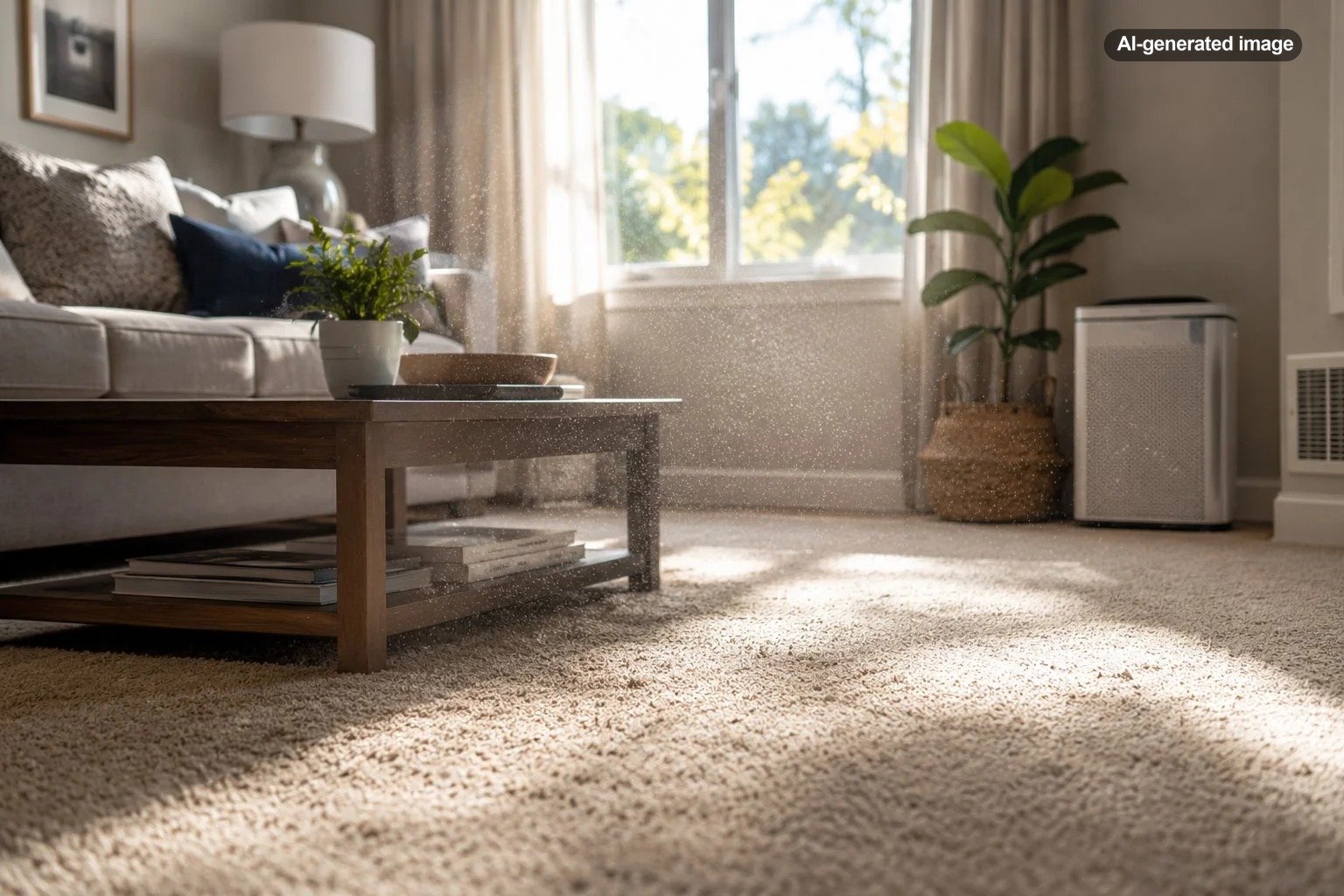
Carpet has a three-dimensional fiber structure rather than the smooth surface of wood, tile, or resilient flooring. That gives particles more places to settle. Research reviews have found that carpet can serve as a reservoir for dust, allergens, microorganisms, and other environmental contaminants.
Some of those particles remain embedded until they are removed through effective cleaning. Others can be disturbed by walking, children playing on the floor, pets moving through a room, or vacuuming. The U.S. Environmental Protection Agency notes that poorly maintained carpet can accumulate substantial dust and debris and that normal activity may return some particles to the air.
This is one reason two homes with visually similar carpet can have very different indoor environments. The condition underneath the visible surface matters as much as whether the fibers look clean.
Dust and allergens are usually the everyday issue
Ordinary household dust is a mixture of material from indoors and outdoors. Carpet can collect pollen, pet-related allergens, soil tracked in on shoes, fibers, and other fine particles. EPA guidance recommends routinely vacuuming carpets and fabric-covered furniture as one part of controlling biological contaminants indoors.
For households with asthma or allergies, the cleaning routine may need to be more deliberate. EPA guidance also suggests considering a vacuum with a HEPA filter because it can help keep some collected dust from escaping back into the room. People who are particularly sensitive to dust may prefer to leave the room while vacuuming because the process itself can temporarily stir particles up.
Moisture changes the equation
A dry carpet that needs better vacuuming is primarily a maintenance problem. A carpet that stays damp after a leak, flood, plumbing problem, wet cleaning, or persistent condensation deserves more attention.
EPA guidance emphasizes moisture control as the key to preventing indoor mold growth and recommends drying water-damaged materials quickly, generally within 24 to 48 hours when possible. Carpet is porous, and water can reach the backing, pad, subfloor, or adjacent materials even when the top surface begins to feel dry.
If carpet has become moldy or cannot be thoroughly cleaned and dried, replacement may be necessary. The important step is also to correct the source of the moisture. Installing fresh carpet over a recurring leak or persistently damp floor simply resets the problem rather than solving it.
What about new-carpet odors and VOCs?
New carpet systems can release volatile organic compounds, or VOCs, from components such as carpet materials, backing, cushion, and installation adhesives. EPA guidance for schools notes that emissions from new carpet systems can be reduced substantially through proper ventilation after installation.
Carpet is not unique in this respect. Paints, finishes, cleaners, furnishings, adhesives, and other building materials can also contribute VOCs indoors. If you are replacing flooring, it makes more sense to consider the entire flooring and installation system than to assume that every hard floor is automatically emission-free.
Ventilating during and after installation, following manufacturer instructions, and selecting products with appropriate low-emission characteristics can all be sensible considerations when planning a flooring project.
Carpet versus hard flooring for air quality
Hard flooring has one obvious maintenance advantage: settled debris is easier to see and can generally be removed from the surface by vacuuming or damp cleaning. Carpet can hold particles deeper within its pile, so cleaning quality and frequency matter more.
| Consideration | Carpet | Hard flooring |
|---|---|---|
| Settled dust | Can collect within fibers | Stays mostly on the visible surface |
| Routine cleaning | Requires effective vacuuming | Usually vacuumed, swept, or damp cleaned |
| Water exposure | Fibers, backing, and pad can retain moisture | Surface may dry more easily, although moisture can still reach seams or subfloors |
| Comfort and acoustics | Soft underfoot and absorbs sound | Typically firmer and more reflective acoustically |
| Allergen management | Maintenance quality is especially important | Settled material is generally easier to remove from the surface |
This does not make hard flooring a universal winner. Rugs, upholstered furniture, bedding, pets, HVAC filtration, outdoor pollution, cooking, humidity, and cleaning habits also influence indoor air. Removing carpet while ignoring a moisture problem or rarely changing an HVAC filter is unlikely to address the whole picture.
How to keep carpet from becoming an air-quality problem
What to do
- Vacuum carpet routinely rather than waiting until visible debris accumulates.
- Consider a well-maintained vacuum with HEPA filtration when fine dust or allergens are an important concern.
- Address spills, leaks, and water intrusion promptly, and make sure the carpet, padding, and underlying materials actually dry.
- Keep indoor humidity and moisture under control, especially in damp climates or rooms with recurring condensation.
- Maintain HVAC filters and portable air cleaners according to their manufacturers’ instructions.
- Use entrance mats and practical shoe-management habits to reduce the amount of outdoor soil carried onto carpet.
- Investigate recurring musty odors instead of masking them with fragrance.
Professional carpet cleaning can also be useful when routine vacuuming is no longer removing embedded soil, but the carpet should be allowed to dry thoroughly afterward. More cleaning solution is not automatically better; residues and prolonged dampness can create problems of their own.
When replacing carpet may make sense
Replacement becomes more reasonable when carpet has experienced significant water damage, cannot be dried or cleaned adequately, has persistent contamination, or creates an ongoing maintenance burden that does not fit the household. A family with substantial allergy concerns may also prefer smooth flooring in frequently used rooms because surface dust is easier to remove consistently.
By contrast, carpet that is dry, intact, regularly cleaned, and not associated with an unresolved moisture problem does not necessarily need to be removed solely in the name of better air quality.
The more useful question is not simply whether a room has carpet, but whether that carpet is dry, clean, maintainable, and appropriate for the household using it.
Frequently asked questions
Does carpet trap dust?
Yes. Carpet fibers can collect settled particles, including ordinary household dust and allergens. Effective and regular vacuuming is important because carpet can hold debris below the visibly clean surface.
Is carpet bad for people with allergies?
It can be more challenging to maintain in households where allergens are a major concern because carpet can act as a reservoir for particles. Individual health needs vary, so persistent respiratory or allergy symptoms should be discussed with an appropriate medical professional rather than diagnosed from flooring alone.
Can wet carpet affect indoor air quality?
Yes. Persistent moisture is a more serious concern than ordinary dry dust because damp porous materials can support microbial growth. Water-damaged carpet should be dried promptly, and the underlying source of moisture should be corrected.
Should I remove all carpet to improve air quality?
Not automatically. Consider its condition, moisture history, cleaning requirements, household sensitivities, and the other sources of indoor pollution in the home. Improving ventilation, filtration, moisture control, and cleaning may be equally important.
Sources & further reading
- U.S. Environmental Protection Agency: Sources of Indoor Particulate Matter
- U.S. Environmental Protection Agency: Does Carpet Cause Indoor Air Quality Problems in Schools?
- U.S. Environmental Protection Agency: A Brief Guide to Mold, Moisture and Your Home
- National Library of Medicine: Do Carpets Impair Indoor Air Quality and Cause Adverse Health Outcomes: A Review