Can You Put an Air Purifier Near an Air Conditioner Vent?
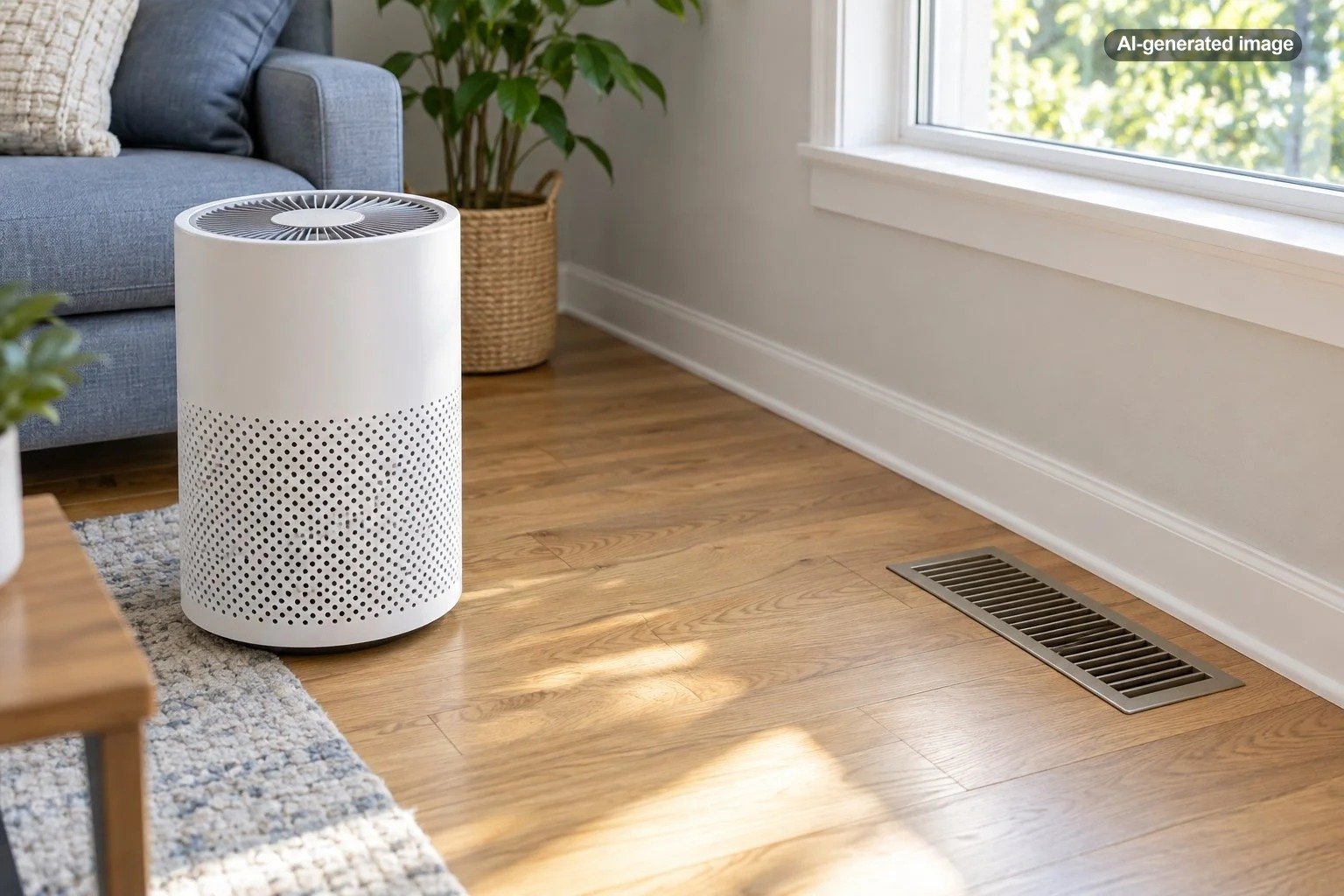
Yes, you can put an air purifier near an air conditioner vent, but placing it directly in the vent’s airflow is usually not the best arrangement. A portable air purifier needs room to draw in surrounding air and release filtered air back into the space. A strong stream of conditioned air can interfere with that circulation, particularly when the two appliances are pointed toward each other.
The better approach is to keep the purifier outside the vent’s strongest airflow while leaving its intake and outlet unobstructed. You do not need to put the purifier on the opposite side of the room simply because an AC vent is nearby.
Why the Air Conditioner Vent’s Location Matters
Air conditioners and portable air purifiers move air for different purposes. An air conditioner circulates air to manage indoor temperature and, during cooling operation, remove some moisture. A portable air purifier draws air through its filters to reduce certain airborne pollutants, then releases filtered air into the room.
These functions can complement one another. However, putting the appliances too close together does not automatically improve filtration.
A portable purifier works best when it can continuously process a useful volume of room air. Its effectiveness depends on factors such as filter performance, clean air delivery rate, fan speed, operating time, and the way air circulates through the space.
If an AC supply vent blows directly across the purifier, the airflow patterns may become less predictable. Depending on the purifier’s intake and exhaust configuration, conditioned air could be pushed toward the intake, disrupt the purifier’s discharge pattern, or leave parts of the room less effectively mixed.
This does not mean that every nearby vent causes a measurable loss of purification. The effect depends on the particular room, equipment, and airflow direction. It simply means that proximity to a vent is not a reliable shortcut to better filtration.
Supply Vents and Return Vents Are Not the Same
Before deciding where to put the purifier, identify which type of vent you are dealing with. This distinction is more useful than measuring distance from the nearest grille without considering its function.
| Vent type | What it does | Placement advice |
|---|---|---|
| AC supply vent | Delivers conditioned air into the room | Keep the purifier out of the strongest direct air stream. |
| HVAC return vent | Draws room air back toward the HVAC system | Do not position the purifier where it obstructs the return grille or its airflow. |
| Window AC outlet | Discharges cooled air directly from the unit | Keep the purifier away from the discharge path and follow both appliances’ clearance instructions. |
Near a supply vent
A ceiling or wall supply vent pushes cooled air into the room. Placing a purifier directly below it may expose the purifier to a concentrated stream of moving air. Depending on how the devices are oriented, that stream could change how efficiently filtered air spreads into the rest of the room.
For example, a floor-standing purifier positioned directly beneath a ceiling register might receive a strong downward draft during cooling cycles. Moving it sideways, beyond the most noticeable stream of air, may provide a more consistent arrangement.
A nearby location can still work perfectly well if the vent is not blowing directly into the purifier and both devices have unobstructed airflow.
Near a return vent
A return vent is designed to pull room air back into the central HVAC system. Placing a portable purifier directly in front of that grille is generally unnecessary and could restrict the airflow the HVAC system needs.
There is also little reason to deliberately place the purifier so that its freshly filtered exhaust immediately enters the return. The goal is to circulate filtered air through the occupied room, not to send it straight back toward the ductwork.
Keep furniture, appliances, and other obstructions away from return grilles. If a return is partially blocked, correcting that restriction is more important than adjusting the purifier to compensate.
How Far Should an Air Purifier Be From an AC Vent?
There is no universally correct minimum distance between an air purifier and an air conditioner vent. Neither appliance category uses a single spacing rule that applies to every manufacturer, room layout, and airflow configuration.
Instead of relying on an arbitrary number of inches or feet, consider three separate questions:
- Is the purifier inside the vent’s strongest airflow? If you can feel a concentrated draft striking its intake or outlet, try another position.
- Does the purifier have its required clearance? Follow the product manual’s instructions for spacing around air inlets, outlets, walls, furniture, and curtains.
- Can filtered air circulate through the occupied room? Avoid arrangements that trap exhaust behind furniture or direct it immediately into another appliance.
A purifier several feet from a ceiling vent might still sit directly in its discharge path. Another purifier relatively close to a wall register might operate without noticeable interference because the vent blows in a different direction.
Airflow orientation matters more than a distance chosen without reference to the actual equipment.
Where Should You Put the Purifier Instead?
For most rooms, start with an open location where the purifier can draw in surrounding air and discharge filtered air without obvious obstructions. The ideal position does not necessarily have to be the exact center of the floor.
Consider the following arrangements based on how your room is used.
Living rooms
Choose an open section of floor away from tightly grouped furniture, curtains, and the strongest airflow from supply registers. An area beside a media console or near the edge of a seating zone might work, provided there is adequate clearance around the unit.
If a central AC vent blows toward the main seating area, try placing the purifier to the side of that airflow rather than immediately under the register.
Bedrooms
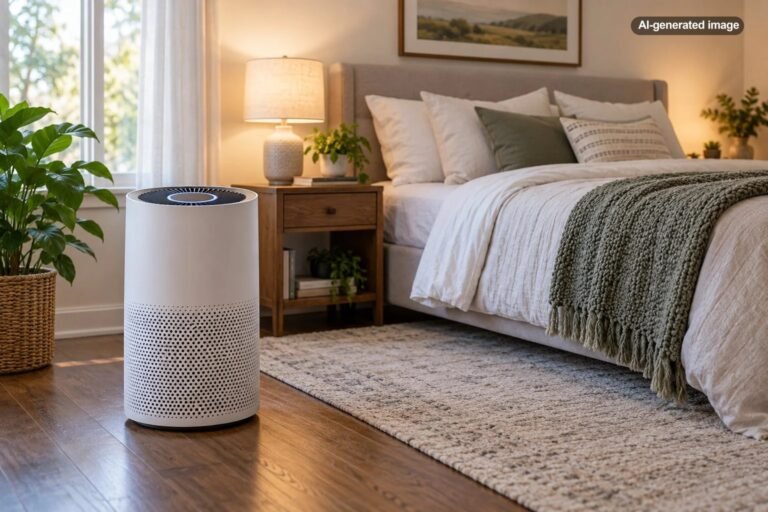
Locate the purifier where it can circulate air through the sleeping area without blowing an uncomfortable stream of air directly at the bed. Avoid pushing the unit into a narrow space behind a nightstand or hiding it under a desk.
A quiet fan setting may be more comfortable overnight, but lower speeds generally filter less air. Choosing a properly sized purifier that you can comfortably operate for long periods is often more useful than choosing the closest possible location to the bed or vent.
Small apartments and home offices
In a compact room, you may have only one or two practical locations. Focus first on unobstructed airflow, stable placement, and access to a suitable electrical outlet.
There is no need to sacrifice a large amount of floor space simply to keep the purifier far from a nearby vent. A carefully chosen position along a wall can work if it meets the purifier’s clearance requirements and is not directly in the AC discharge path.
Can an Air Purifier and Air Conditioner Run at the Same Time?
Yes. Running a portable air purifier while the air conditioner operates is a normal arrangement. The devices perform different functions, and neither requires the other to be switched off during ordinary use.
The central HVAC filter primarily protects equipment and, depending on its efficiency and system operation, can also reduce airborne particles moving through the duct system. A portable air purifier provides additional filtration in the room where it operates.
One important difference is operating time. Many HVAC systems cycle according to heating or cooling demand, while a portable purifier can continue running independently. That makes room-level filtration useful when the thermostat is satisfied and the air conditioner stops circulating air.
However, the purifier does not replace the need for an appropriate HVAC filter, effective ventilation, or controlling pollution sources. It also does not dehumidify a room the way an operating air conditioner may.
How to Check Whether Your Placement Is Working
You do not need specialized airflow testing equipment to make a reasonable first adjustment. A simple observation-based check can help identify obvious placement problems, although it cannot measure actual pollutant removal.
Try this placement check
- Identify the vent. Determine whether it supplies conditioned air or returns room air to the HVAC system.
- Run the AC. Observe the direction of the supply airflow or check for obvious airflow obstruction around a return grille.
- Inspect the purifier. Locate its intake and exhaust openings and check the manual for required clearances.
- Move the purifier if needed. Choose an open, stable position outside any strong vent discharge path.
- Run both devices normally. Check that neither produces an uncomfortable draft, unusual noise, or apparent obstruction.
- Review the arrangement over time. Make sure furniture, curtains, and other objects do not shift into the airflow openings.
If the purifier includes a built-in air-quality indicator, it can be useful for following general changes, but its sensor reading alone cannot prove that a particular position is optimal. Readings can respond to local conditions and do not necessarily represent pollutant levels throughout the room.
For a more meaningful performance comparison, room size, purifier CADR, operating speed, and consistent runtime are better starting points than subjective impressions of airflow alone.
Does the Type of Air Purifier Change the Answer?
Yes, particularly because purifier designs use different intake and exhaust locations.
Some appliances draw air through openings along their sides and discharge filtered air upward. Others have front or rear intakes, or direct their exhaust horizontally. A location that works for one design may interfere with another.
For an upward-exhaust model, the space above the unit matters. For a rear-intake design, placing its back too close to a wall or curtain may be a problem even when the top is completely clear.
When choosing a purifier, look beyond its general room-coverage marketing. The U.S. Environmental Protection Agency recommends choosing a clean air delivery rate, or CADR, appropriate for the room size. A higher CADR generally means greater particle removal capacity at the tested operating speed.
Affiliate disclosure: CraneManor.com may earn a commission when you purchase through links on this page. This does not affect the price you pay. Learn more.
For example, a purifier with automatic operation and an air-quality indicator may be convenient in a bedroom or living room. One available example is a Coway Airmega purifier, which offers those features. Regardless of the model, its airflow openings and manufacturer instructions should guide placement rather than the location of the nearest air conditioning vent.
Common Placement Mistakes to Avoid
Several placement choices can undermine filtration or create unnecessary household problems.
- Putting the purifier directly against the vent: A concentrated AC discharge is not guaranteed to improve filtration and may disturb the purifier’s intended airflow pattern.
- Blocking a return grille: HVAC return airflow should not be obstructed by a purifier or other furniture.
- Hiding the purifier behind curtains: Fabric can obstruct intake or exhaust openings, reducing effective circulation.
- Placing it beneath a leaking or sweating AC unit: Protect the electrical appliance from water and address the condensation or leak problem separately.
- Ignoring the manufacturer’s spacing instructions: Clearance requirements depend on the purifier’s design and should take priority over general placement advice.
- Running the purifier only when the AC starts: Portable filtration can continue independently of cooling cycles.
- Using a purifier that is too small for the space: Perfect placement cannot fully compensate for inadequate particle-cleaning capacity.
What About Window Air Conditioners and Mini-Splits?
The same general principle applies to other cooling systems, but the equipment layout changes where a purifier can fit.
Window air conditioners
A window AC unit typically sends conditioned air directly into the room from a relatively concentrated outlet. Avoid placing a portable purifier immediately in front of that discharge, especially if the arrangement blocks the AC’s airflow or exposes the purifier to moisture.
A position to the side of the window unit, with enough room for both appliances to operate as intended, is generally more practical.
Ductless mini-splits
A wall-mounted mini-split has its own fan and adjustable discharge direction. If the indoor unit sends air downward toward a purifier, redirecting the discharge vanes or moving the purifier may help avoid competing air streams.
Do not block the mini-split’s intake or outlet. The purifier should operate as an independent room appliance rather than being treated as an attachment to the cooling system.
Frequently Asked Questions
Should an air purifier face an AC vent?
Not necessarily. Facing the purifier directly toward a supply vent does not guarantee better particle removal. Orient the purifier according to its intake and exhaust design so it can circulate air freely through the room.
Can you put an air purifier under a ceiling vent?
It is possible, but generally better to move the purifier out of a strong downward stream of conditioned air. If the ceiling vent does not direct significant airflow toward the purifier and required clearances are maintained, proximity alone is not necessarily a problem.
Will an air purifier make the air conditioner work harder?
Simply operating a portable air purifier in the same room does not inherently make an air conditioner work harder. However, blocking HVAC supply or return airflow can interfere with system operation. Keep grilles unobstructed, and remember that the purifier uses its own electricity.
Does the AC filter make a portable air purifier unnecessary?
Not always. HVAC filters and portable purifiers serve overlapping but distinct roles. HVAC filtration depends on system operation and filter compatibility, while a portable purifier can target a particular room independently. The usefulness of additional filtration depends on indoor pollution sources, existing filtration, and household needs.
Is it better to put an air purifier near a window or an AC vent?
Neither location is automatically superior. Prioritize unobstructed airflow and the room’s occupied areas. Avoid open windows when outdoor air quality is poor, and do not place a purifier where rain, condensation, or strong drafts could interfere with its operation.
The Bottom Line
An air purifier can sit near an air conditioner vent, but it should not obstruct HVAC airflow or be positioned where a strong supply draft interferes with the purifier’s intake or exhaust. The best arrangement allows both appliances to circulate air without competing for the same narrow space.
Start with the purifier manufacturer’s placement instructions, choose an open location, and keep the equipment appropriately sized and maintained. A few thoughtful adjustments are usually more valuable than trying to place the purifier as close to the vent as possible.
Sources & Further Reading
- U.S. Environmental Protection Agency: Guide to Air Cleaners in the Home – Guidance on purifier selection, clean air delivery rate, placement, airflow obstruction, and HVAC filtration.
- U.S. Environmental Protection Agency: Air Cleaners and Air Filters in the Home – Explanation of portable and central HVAC filtration and their limitations.
- U.S. Environmental Protection Agency: How to Create a Cleaner Air Room at Home – Practical guidance on room filtration, equipment sizing, and compatible HVAC filters.