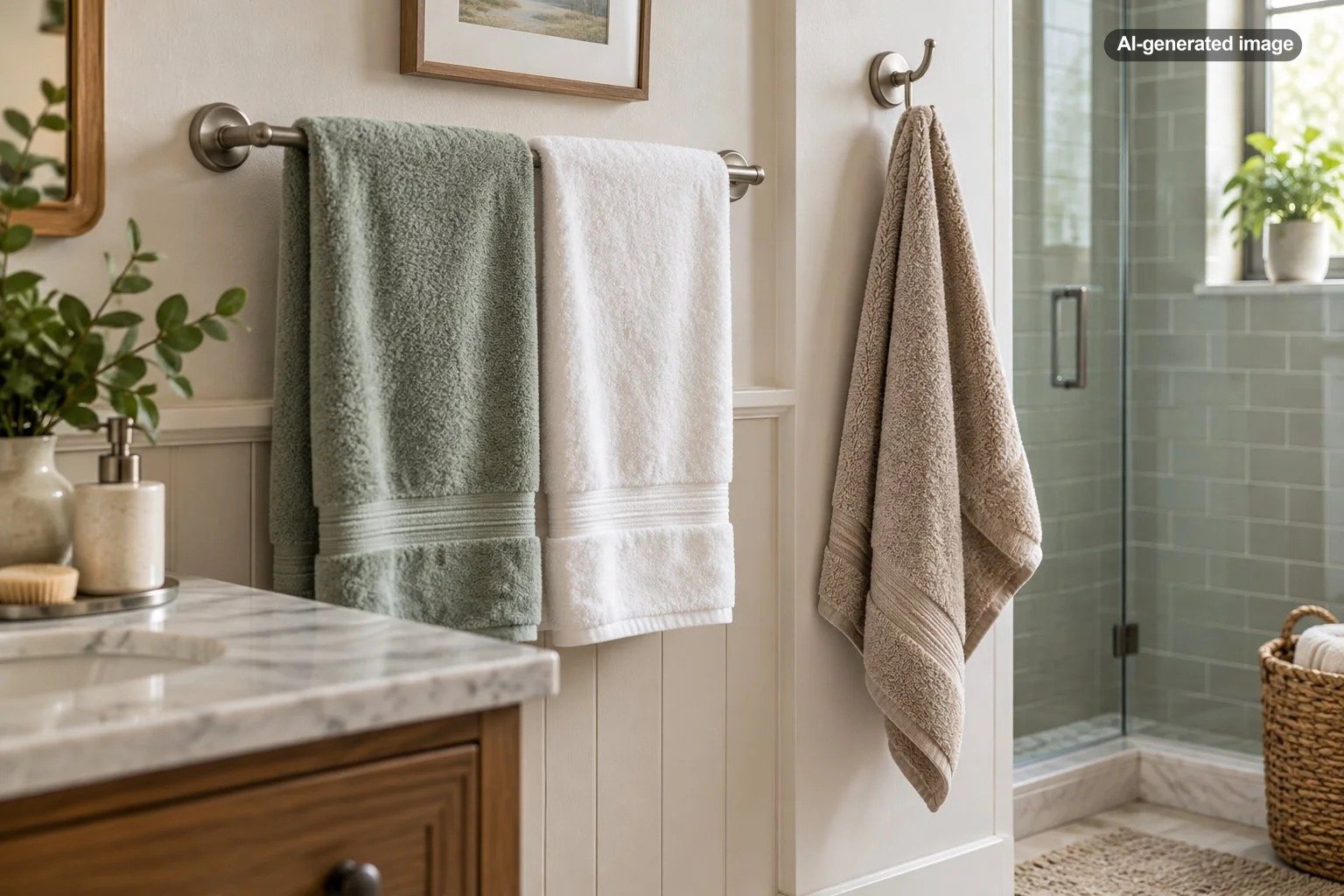
Should You Hang Towels on Hooks or Bars to Dry?
If your main goal is getting a bath towel dry efficiently between uses, a towel bar is usually the better choice. It lets more of the towel’s surface stay exposed to moving air instead of bunching the fabric together. Hooks, however, are often more convenient in small bathrooms and for households that need to hang several towels without devoting an entire wall to bars.
The best choice is not strictly about hooks versus bars. Bathroom ventilation, spacing, towel thickness, and whether people actually hang towels neatly all matter. A perfectly placed towel bar does little good if the towel is folded into a dense bundle over it.
Why towel bars generally dry towels better
A towel dries as moisture leaves the fabric and disperses into the surrounding air. Spreading the towel over a bar exposes more fabric instead of allowing multiple damp layers to press against one another.
For that reason, the most effective setup is usually a bar wide enough to hold the towel with minimal folding. A towel doubled several times over a short bar loses much of the airflow advantage that made the bar useful in the first place.
Bars can also make it easier to see whether a towel is still damp. The fabric hangs relatively flat, so persistently wet sections are less likely to stay hidden inside folds.
The best towel hanger is the one that gives damp fabric both room and air.
Why towel hooks are still a practical choice
Hooks win on simplicity. Hanging a towel takes one quick motion, and several hooks can fit into the wall space that might otherwise accommodate only one or two bars. That can make them especially useful in shared bathrooms, children’s bathrooms, small apartments, and compact guest baths.
They also tend to work better when household habits are less than meticulous. A bar theoretically offers excellent drying space, but only if people spread the towel across it. A hook may produce more bunching, yet it is much more useful than a bar that regularly ends up empty while damp towels land on the floor.
The compromise is airflow. A heavy towel hung from a single point naturally forms folds. The inner surfaces of those folds may take longer to dry, especially in a bathroom that stays humid after showers.
| Consideration | Towel bar | Towel hook |
|---|---|---|
| Drying potential | Better when the towel is spread out | Good when the towel hangs loosely, but more prone to bunching |
| Wall space | Requires more horizontal room | Uses very little wall width |
| Multiple towels | May require several bars | Easy to arrange several separate hooks |
| Everyday convenience | Requires a little more effort to hang neatly | Very quick and easy |
| Visual appearance | Usually looks tidier when towels are arranged well | More casual and relaxed |
Bathroom ventilation matters as much as the hanger
A towel bar cannot compensate for a bathroom that remains damp for hours. After a shower, moisture from the towel is joining moisture already suspended in the room, so drying slows when humid air has nowhere to go.
Use the bathroom exhaust fan when available and allow the room to air out after bathing. Keeping the bathroom door open after the steamy part of the routine can also help when privacy is no longer needed and doing so works for the household.
Placement matters too. Avoid squeezing a wet towel tightly between a wall and another object. Whether you choose a hook or bar, some open space around the fabric helps air circulate.
Which option works best in a small bathroom?
Hooks are often the easiest solution when usable wall space is scarce. They can fit on narrow wall sections, beside a vanity, or on the back of a door where an adequately sized towel bar might be awkward.
If drying performance is a concern, consider giving each bath towel two nearby hooks instead of one. Draping the towel more broadly can reduce some of the dense folding created by a single hanging point. Another option is a compact bar reserved for the towel currently in use while hooks handle robes, hand towels, or dry spare towels.
Does towel thickness change the answer?
Yes. Thick, plush towels hold more moisture within their fibers and folds, so they benefit especially from being opened up while drying. If you prefer heavyweight towels, a generously sized bar or another arrangement that keeps the fabric spread out can make everyday drying easier.
Thinner towels are generally more forgiving on hooks because there is less dense fabric folded against itself. Even then, avoid twisting or knotting the towel around the hook. Let it hang as openly as the space permits.
What about hand towels?
Hooks are usually less troublesome for hand towels because the smaller piece of fabric does not create the same large, heavy bundle as a bath towel. A small ring or bar can still keep a hand towel looking neater and more open, particularly in a powder room where appearance may matter as much as drying speed.
For frequently used hand towels, focus on keeping them accessible and allowing them to dry between uses. A decorative arrangement that leaves the towel permanently compressed is less practical than a simple holder with adequate space.
How to decide between hooks and bars
Before you decide
- Count how many damp bath towels regularly need hanging space at the same time.
- Measure the usable wall width rather than assuming a standard bar will fit comfortably.
- Consider whether household members will realistically spread towels over a bar after every use.
- Give thick towels more open drying area whenever possible.
- Keep hooks far enough apart that wet towels do not overlap.
- Factor in bathroom ventilation, because neither option works especially well in persistently humid air.
For many bathrooms, the best answer is actually a combination. A primary bath might use bars for the towels currently in rotation and hooks for robes or occasional overflow. A family bathroom may favor individual hooks because assigning one to each person keeps the room organized, even if the towels dry a little less efficiently.
There is no need to choose the theoretically perfect arrangement at the expense of how the bathroom is actually used. If you have enough wall space and want the best chance of faster drying, choose bars. If convenience and capacity matter more, hooks are perfectly reasonable when they are spaced well and paired with good ventilation.
Frequently asked questions
Do towels get musty faster on hooks?
They can if thick towels remain tightly bunched and stay damp for long periods. Giving each towel plenty of room, improving ventilation, and laundering towels regularly are more important than the hardware alone.
Should you fold a towel over a bar?
A single loose fold is usually more drying-friendly than several layers. The more surface area you can expose, the better the opportunity for moisture to leave the fabric.
Can two people share one towel bar?
They can, but avoid overlapping two damp bath towels. If the bar is not wide enough for both towels to hang separately, individual bars or hooks will generally be more practical.
Are hooks better for children’s bathrooms?
They often are because they are simple to use and make it easy to give each person a designated spot. Position them at an accessible height and leave enough spacing to prevent damp towels from piling together.