
Can You Put a Mini Fridge Inside a Cabinet?
You can put a mini fridge inside a cabinet only if the refrigerator is approved for that type of installation and the cabinet provides the clearances and ventilation specified by its manufacturer. A typical freestanding mini fridge should not simply be pushed into a tight, closed cupboard. Its cooling system releases heat, and trapping that heat can reduce performance, increase run time, and shorten the appliance’s working life.
The safest approach is to begin with the refrigerator’s model-specific manual rather than relying on a universal gap measurement. If the manual describes the appliance as freestanding, leave it open to the room unless the instructions specifically allow an enclosed or undercounter installation. For a seamless cabinet installation, a purpose-built built-in compact refrigerator or beverage center is usually the better choice.
Why a mini fridge needs room to breathe
A refrigerator does not create cold so much as move heat. The cooling system absorbs heat from inside the compartment and releases it into the surrounding room. Depending on the model, that heat may leave through the back, sides, top, or a front ventilation grille.
When a freestanding unit is boxed tightly into cabinetry, warm air can collect around it. The compressor may then run longer while trying to maintain the selected temperature. The cabinet interior can also become noticeably warm, particularly when the fridge is first cooling down, the door is opened frequently, or the surrounding room is already hot.
Clearance requirements vary considerably. GE Appliances, for example, advises owners to check the installation instructions for their exact refrigerator and provides only broad general ranges for refrigerators. Whirlpool manuals likewise show that spacing can differ by model, with some calling for space at the sides, top, and rear. These variations are precisely why a measurement copied from another refrigerator is not reliable for yours.
A cabinet opening should be designed around the refrigerator’s installation instructions, not around the appliance’s visible dimensions alone.
Freestanding and built-in models are not interchangeable
The most important distinction is not whether the appliance is called a mini fridge, compact fridge, or beverage cooler. It is whether the unit is designed for freestanding or built-in use.
| Feature | Freestanding mini fridge | Built-in compact refrigerator |
|---|---|---|
| Typical heat release | Often relies on open space around the cabinet | Commonly directs warm air through a front grille |
| Cabinet placement | Only when expressly permitted by the manual | Designed for an undercounter or enclosed opening when installed as directed |
| Visible gaps | May require noticeable side, rear, or top clearance | Usually allows a more integrated appearance |
| Best fit | Dorm rooms, offices, basements, and open beverage stations | Kitchens, wet bars, islands, and finished cabinetry |
| Planning priority | Generous airflow around the appliance | Exact cutout dimensions and an unobstructed front grille |
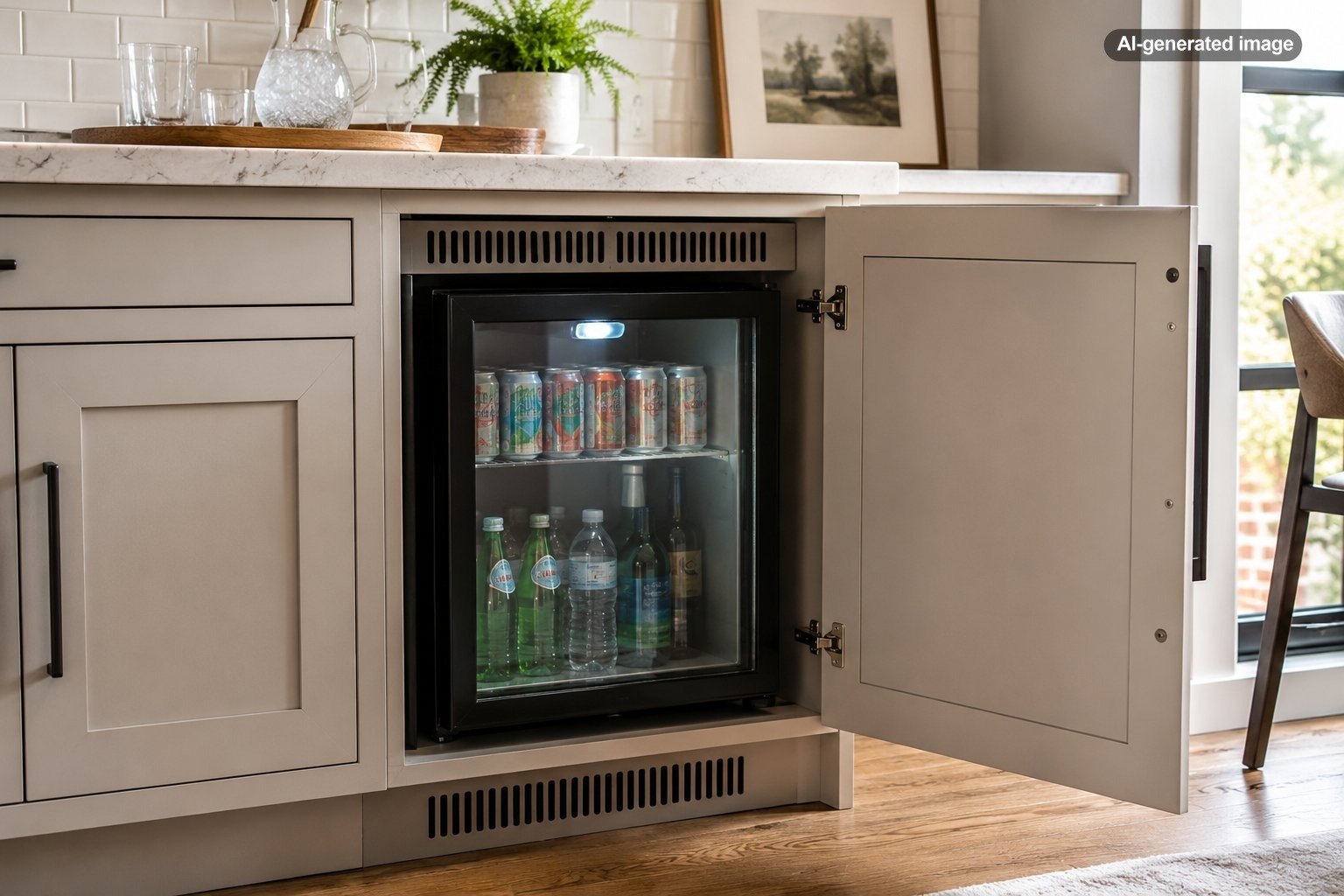
A built-in model is not automatically clearance-free. It still needs the specified cabinet opening, electrical arrangement, and unobstructed ventilation path. A decorative toe kick, trim panel, rug, or cabinet door must not cover a front intake or exhaust grille.
What to check before placing a fridge in cabinetry
Before you decide
- Find the full model number and download the official owner or installation manual.
- Confirm whether the appliance is freestanding, built-in capable, or approved for both arrangements.
- Measure the required opening rather than measuring only the fridge body.
- Identify where the refrigerator releases heat and keep that ventilation path open.
- Allow enough space for the door, hinges, handle, shelves, and drawers to operate normally.
- Provide access to a properly grounded receptacle without pinching the power cord.
- Plan how the appliance can be pulled out for cleaning, defrosting, inspection, or service.
Measure more than width and height
Record the fridge’s width, case height, overall height, and depth with the plug and door included. Then add every clearance required by the manufacturer. Check the depth with the door closed and the space needed when the door is open far enough to remove shelves or bins.
Door swing is a frequent source of frustration. A fridge can slide neatly into an opening yet fail to open properly because a thick countertop edge, adjacent wall, cabinet pull, or hinge-side panel interferes with the door. Reversible hinges can help on some models, but only when the manual provides a procedure for reversing them.
Give warm air a way out
A few holes drilled into the back of a cabinet do not necessarily create effective ventilation. Air needs both an entry path and an exit path, and those openings must be appropriately located for the refrigerator’s cooling design. An opening low in the cabinet may admit cooler room air, while an opening higher up may allow warm air to escape, but this arrangement should not be treated as a substitute for the manufacturer’s requirements.
Do not assume that removing the cabinet’s back panel solves every problem. Side and top clearances may still matter, and pushing the appliance against the wall can restrict airflow or bend the power cord. The unit should also stand level and stable on a surface capable of supporting it when fully loaded.
Keep the electrical setup straightforward
Follow the appliance instructions for electrical supply and grounding. Refrigerator manuals commonly direct owners to use a grounded three-prong outlet and warn against removing the grounding prong or using an adapter. Avoid routing the cord where it can be crushed between the refrigerator and cabinet, exposed to water, or trapped against hot components.
The outlet should remain accessible enough that the refrigerator can be disconnected for cleaning or service. Do not build the unit permanently into place with caulk, adhesive, fixed trim, or millwork that prevents removal.
Can you hide a mini fridge behind a cabinet door?
Usually, a standard cabinet door placed directly in front of a freestanding mini fridge creates more problems than it solves. The door can restrict ventilation, make the fridge awkward to use, and trap additional warm air whenever both doors are closed.
A cabinet door may also prevent the refrigerator door from opening wide enough. Users must open one door and then the other, which is inconvenient for daily use and makes it more likely that the fridge door will be left slightly ajar.
A pocket, retractable, or ventilated furniture-style door may appear more workable, but it still does not override the refrigerator’s installation instructions. For the cleanest look, consider an appliance designed for integrated cabinetry or allow the fridge itself to remain visible within a properly sized opening.
Where a cabinet installation works best
A purpose-built built-in compact refrigerator can work particularly well beneath a kitchen counter, in a dry bar, or within a home office beverage station. It can also be useful in a small apartment when full-size refrigeration is unnecessary, provided the appliance is installed in an appropriate location and used for the foods or drinks it is designed to store.
A freestanding fridge is usually happier at the end of a cabinet run, beneath an open counter with generous clearance, or on an open shelf engineered for its weight and dimensions. These placements can look intentional without enclosing the appliance on every side.
Common installation mistakes
- Buying by exterior dimensions alone: The cutout must include manufacturer-required breathing room.
- Blocking a front grille: A toe kick or decorative trim can interfere with a built-in unit’s airflow.
- Using a solid cabinet door: Closing a second door around the fridge can trap heat and complicate access.
- Placing it beside a heat source: Ovens, ranges, heating vents, direct sun, and other warm locations can increase the cooling load.
- Forgetting service access: The refrigerator should be removable without dismantling the cabinet.
- Ignoring the room environment: Garages, porches, and other spaces outside the appliance’s approved ambient conditions may affect operation.
- Using improvised electrical connections: Extension cords, damaged receptacles, pinched cords, and adapters introduce avoidable risk.
How to make the installation look intentional
Once the functional requirements are settled, the opening can be finished neatly. Align the refrigerator with adjacent cabinet faces when the manual permits, but do not sacrifice ventilation to achieve a perfectly flush appearance. Use removable trim rather than permanent filler pieces, and preserve any required openings above, below, or beside the appliance.
A contrasting fridge can look deliberate in a home office or bar, while a finish that coordinates with nearby hardware can help it recede visually. The surrounding cabinet interior should be easy to clean because dust around ventilation areas can accumulate over time.
For new cabinetry, choose the appliance before finalizing the millwork. That allows the cabinetmaker or installer to work from the official cutout drawing and account for ventilation, hinges, plugs, flooring, and countertop overhangs. Designing the opening first and trying to find a fridge that almost fits later is far less forgiving.
FAQ
How much space should be left around a mini fridge?
Use the exact spacing in the manual for your model. Requirements differ by cooling design and may include clearance at the sides, top, and rear. General refrigerator guidance should not replace model-specific instructions.
Can a freestanding mini fridge be installed under a countertop?
Only when its manual permits that placement and every required clearance remains open. A countertop above the unit can reduce heat escape, so an appliance that fits physically may still be unsuitable.
Can I add a fan to ventilate the cabinet?
A cabinet fan may improve airflow in a properly designed installation, but it does not convert an unapproved freestanding refrigerator into a built-in model. Fan size, placement, airflow path, electrical safety, noise, and maintenance all matter.
Should the back of the cabinet be removed?
Removing or opening the back may help in some layouts, but it is not a universal solution. Follow the manufacturer’s required clearances and make sure warm air can actually leave the surrounding space rather than collect behind the cabinetry.
What is the best option for a fully enclosed look?
Choose a built-in-capable compact refrigerator or beverage center with installation instructions that match the planned cabinet opening. This generally provides a cleaner appearance with fewer airflow compromises.