How Do You Keep a Generator From Being Stolen During an Outage?
Keeping a portable generator from being stolen during an outage usually requires several layers of protection rather than one oversized lock. The most sensible approach is to keep the generator in a safe operating location, physically secure its frame to a substantial fixed object, improve visibility around it, document the unit before an emergency, and make opportunistic removal inconvenient without creating a carbon monoxide, fire, or electrical hazard.
The safety part matters more than the security part. A generator should never be moved into a garage, shed, basement, porch, or other enclosed or partially enclosed space simply because it feels easier to protect there. The U.S. Consumer Product Safety Commission advises operating portable generators outdoors at least 20 feet from homes and buildings, with the exhaust directed away from doors, windows, vents, and other openings.
Start with a safe operating location
During an outage, the most convenient security location is not necessarily a safe generator location. Putting a portable generator behind a closed garage door, inside a shed, under an enclosed porch, or immediately beside the house may make it less visible from the street, but it can introduce severe carbon monoxide risks.
CPSC guidance says portable generators should be operated outdoors only, at least 20 feet away from the house, with the exhaust pointed away from the home and other occupied buildings. The American Red Cross likewise warns against operating a generator inside a home, garage, basement, crawlspace, shed, or other partially enclosed area.
That means security planning should begin with the safe generator location and work outward from there. Do not begin by selecting the most hidden corner of the property and then try to make generator operation fit that location.
Secure the generator by its structural frame
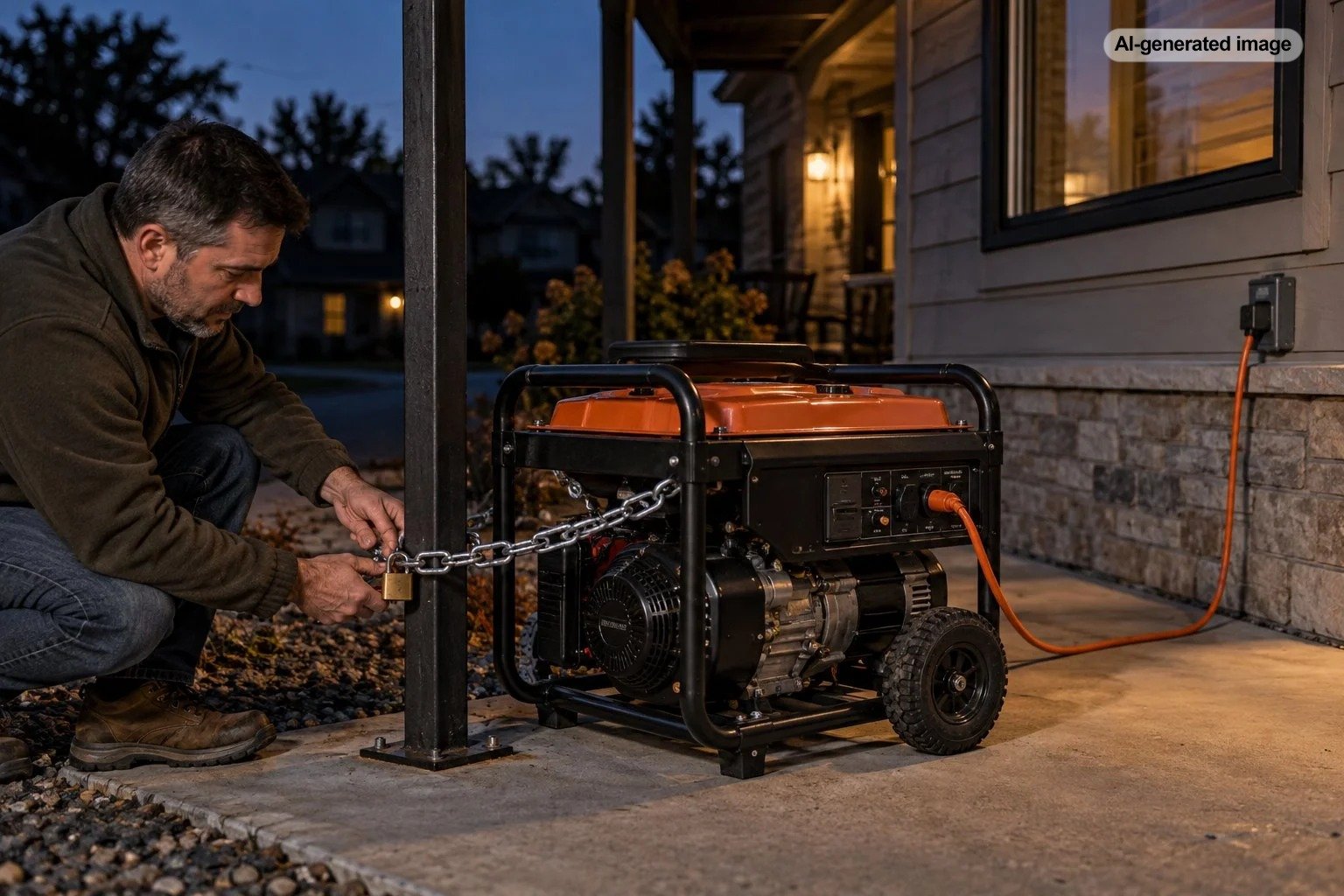
A visible physical restraint can make a portable generator substantially less convenient to grab and carry away. When the generator design permits it, a heavy-duty chain or security cable can be routed through a strong structural portion of the frame and connected to a substantial fixed anchor.
The exact attachment point depends on the generator. Avoid fastening security hardware around fuel lines, wiring, handles not designed to bear that load, control panels, hot exhaust components, or parts that could be damaged by tension. Consult the generator’s manual before attaching anything that could interfere with operation, cooling, servicing, or safe movement.
The anchor matters as much as the lock. A chain around an object that can simply be lifted, unscrewed, or carried away does little good. An existing substantial structural anchor may be useful when it can be reached without moving the generator into an unsafe operating position. Permanent anchors should be appropriate for the surface and location; homeowners who are uncertain about installation should use a qualified professional rather than improvising around utilities, concrete, electrical equipment, or building components.
The goal is not to make a generator impossible to steal; it is to remove the quick, quiet, low-effort opportunity while preserving safe operation.
Keep the security setup clear of heat, airflow, and cords
A generator is operating equipment, not a suitcase that can simply be wrapped in hardware. Chains, cables, anchors, cameras, covers, and other security measures should not obstruct engine cooling, block exhaust flow, touch hot components, or create a place where electrical cords are crushed or sharply bent.
Think about walking paths as well. Outages often mean darkness, extension cords, wet ground, storm debris, and people moving around with flashlights. A security cable stretched across a path can become a trip hazard. Route the restraint as directly as practical between the generator and its anchor without creating a new obstacle around the home.
Make the area visible without making the generator conspicuous
Good visibility can discourage casual theft while also making generator checks easier. Battery-powered or backup-powered motion lighting can be useful when ordinary exterior lighting is unavailable during the outage. Position lighting so the generator area can be observed without aiming glaring light toward neighbors or traffic.
A security camera may add another layer if the home’s network and backup power arrangement allow it to continue operating. Local recording can be especially useful when internet service is interrupted, although capabilities vary by system. A camera should supplement physical security rather than replace it.
There is a balance between visibility and advertising. You want activity around the generator to be noticeable from the home, but you generally do not need to illuminate it like a display on the edge of the property. Avoid leaving packaging, signs, fuel containers, or other conspicuous cues near the street that unnecessarily announce valuable emergency equipment.
Document the generator before the outage
Security preparation is easier before the weather turns bad. Photograph the generator from several angles, record its make, model, and serial number, and retain purchase documentation where you can find it. Store a digital copy of the important information somewhere that remains accessible even if papers in the house are difficult to reach.
If a generator disappears, those records can help you accurately identify the property when making a police report or dealing with other follow-up. Avoid placing sensitive ownership information where it is plainly visible on the exterior of the machine.
Before you decide
- Identify a generator location that follows current safety guidance and the manufacturer’s instructions.
- Determine whether the generator frame has an appropriate structural point for a security restraint.
- Choose a substantial anchor that cannot be easily carried away.
- Keep chains and cables away from exhaust, hot surfaces, ventilation paths, fuel components, controls, and electrical connections.
- Plan backup lighting or monitoring before an outage begins.
- Record the make, model, serial number, and photographs of the unit.
Reduce unattended time when practical
An operating generator naturally attracts attention because of its sound. You cannot make it invisible, and attempts to box it in for noise control or security can create dangerous ventilation or heat problems. Instead, treat supervision as another security layer.
When practical, have an adult periodically check the generator from a safe location. During a prolonged outage, households can coordinate normal observation without hovering beside the machine. If everyone must leave the property, follow the manufacturer’s shutdown instructions rather than assuming a lock alone makes unattended operation appropriate.
Neighbors can also be helpful during widespread outages. A simple conversation among people who already know one another can increase awareness of unfamiliar activity without turning generator ownership into a neighborhood announcement.
Protect fuel separately
Fuel security deserves separate attention because storing gasoline or other generator fuel creates fire-safety considerations. The American Red Cross recommends storing generator fuel in an approved safety container, using the fuel type specified for the generator, and keeping fuel outside living areas in a locked shed or other protected location away from fuel-burning appliances.
Do not cluster spare fuel around the running generator merely because the generator itself is secured. Turn the generator off and allow it to cool before refueling, following the manufacturer’s instructions. Local rules may also affect how much fuel may be stored and where, so local fire authorities are the appropriate source for location-specific requirements.
Avoid improvised enclosures and homemade security cages during operation
A homemade box may look like an elegant answer to theft, weather, and noise all at once, but enclosing a running portable generator can interfere with exhaust dispersal, ventilation, cooling, and safe clearances. It can also conflict with the manufacturer’s operating instructions.
For wet conditions, follow the manufacturer’s specific instructions. U.S. Fire Administration guidance warns against generator use in wet areas because of shock and electrocution hazards, while CPSC guidance emphasizes following manufacturer instructions for inclement weather rather than moving the unit indoors.
If a permanent generator enclosure, fixed security cage, or purpose-built installation is being considered, it should be designed around the exact generator and applicable safety requirements. That is different from surrounding an operating portable generator with whatever materials happen to be available during a blackout.
What should you do when the generator is not running?
Once the outage is over, portable equipment is generally easier to protect because it no longer needs to remain in its outdoor operating position. Shut the generator down according to its manual and allow it to cool completely before moving or storing it. Follow the manufacturer’s storage instructions, especially those involving fuel.
A locked storage location keeps the generator less visible between emergencies and gives you more control over access. The chain, lock, lighting, and other temporary outage measures can then remain part of an emergency kit rather than becoming the generator’s only year-round security plan.
Frequently asked questions
Can I run a generator in a locked shed so nobody can steal it?
No. A portable generator should not be operated in a shed or other enclosed or partially enclosed space. CPSC guidance calls for outdoor operation at least 20 feet from homes and buildings, with exhaust directed away from openings.
Should I chain a generator to my house?
A strong fixed anchor can improve theft resistance, but safe generator placement comes first. Do not use an attachment point that requires positioning the running generator too close to the house, and do not attach security hardware to building components unless they are suitable for that load.
Is a security camera enough to protect a generator?
A camera can help with monitoring and documentation, but it does not physically prevent removal. A layered arrangement combining safe placement, a physical restraint, lighting, observation, and documentation is more practical than relying on one measure.
Can I cover a generator so thieves cannot see it?
Do not place an improvised cover or enclosure around an operating generator if it could obstruct exhaust, airflow, cooling, or safe operation. Follow the generator manufacturer’s instructions for weather protection and operating clearances.