How Often Should Kitchen Towels Be Replaced?
Kitchen towels do not need to be replaced on a rigid calendar. A good towel can remain useful for a long time if it is washed properly, allowed to dry between uses, and still absorbs water effectively. The better question is whether the towel can still become genuinely clean and do its job.
Replace a kitchen towel when it stays musty after laundering, has permanent greasy or food-related residue, has become noticeably less absorbent, develops holes or badly frayed edges, or is so stained that you no longer feel comfortable using it around clean dishes and food-preparation areas. Washing frequency and replacement frequency are two different things: towels should be rotated through the laundry far more often than they need to be thrown away.
Washing a kitchen towel is not the same as replacing it
It helps to separate two routines that are often confused. Laundering removes soil and prepares a reusable towel for another round of use. Replacing means permanently removing a towel from kitchen service because age, wear, residue, or damage has made it unsuitable.
A towel hanging beside the sink may collect moisture from wet hands, countertops, cookware, and incidental kitchen messes throughout the day. Reusing the same damp towel indefinitely is very different from owning the same towel for a year while regularly cycling it through the wash.
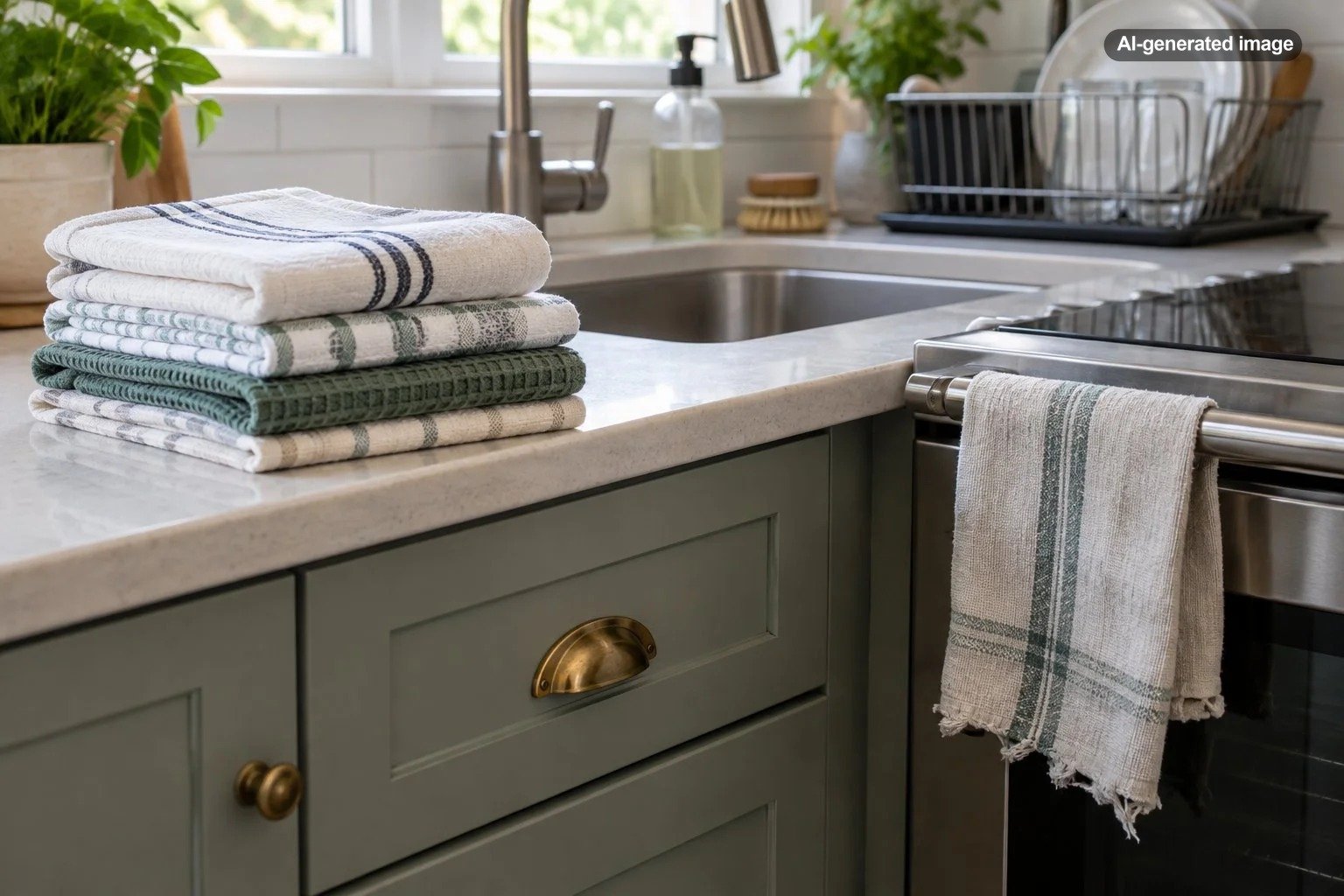
For routine kitchen use, having several towels in rotation is often more practical than trying to stretch one towel through multiple days of cooking and cleanup. A fresh towel can be brought out whenever the current one becomes wet, visibly soiled, or used during a task where cross-contamination is a concern.
Replace a towel when it no longer comes clean
One of the clearest retirement signs is a towel that still smells unpleasant after a complete wash and dry cycle. A towel may pick up odors temporarily after wiping cooking splatters or sitting damp, but proper laundering should leave it smelling clean rather than sour, greasy, or stale.
Repeated exposure to cooking oil can be particularly troublesome. Grease can become embedded in fibers, especially when a towel is repeatedly used for wiping a stovetop, handling oily pans, and cleaning countertops. If laundering no longer removes the oily feel or odor, continuing to use the towel around freshly washed dishes is not especially appealing or useful.
Loss of absorbency is another practical cutoff
Kitchen towels are working textiles. If a towel mostly pushes water across a countertop instead of absorbing it, it has stopped being particularly useful regardless of how attractive it still looks.
Absorbency can decline for several reasons. Fibers may become worn and flattened, residue may accumulate, or laundry products may coat the fabric. Before discarding an otherwise sound towel, make sure the problem is not simply caused by the way it is being washed. Excessive product buildup can make some textiles feel less absorbent.
If the towel remains poorly absorbent after appropriate laundering, moving it out of the kitchen is reasonable. It may still be useful for a less demanding household job before eventually being discarded or recycled where textile recycling is available.
Physical wear matters more than the towel’s birthday
Two towels purchased on the same day can age very differently. One might be used occasionally for drying clean hands. The other might spend every evening drying cookware, wiping counters, covering bread dough, and cleaning spills. The second towel will naturally accumulate wear faster.
Look at the fabric itself. Thinning areas, open holes, badly unraveling hems, loose loops that constantly snag, and large worn patches all indicate that the towel is approaching the end of its useful kitchen life. Minor fraying is mostly cosmetic, but extensive deterioration makes the towel less effective and increasingly annoying to use.
| What you notice | Wash and keep | Consider replacing |
|---|---|---|
| Temporary food stain | Yes, if it launders clean | Only if residue or odor remains |
| Damp after normal use | Wash and dry thoroughly | No, moisture alone is not a reason |
| Persistent musty odor | Try proper laundering first | Yes, if the odor remains afterward |
| Reduced absorbency | Check for laundry-product buildup | Yes, if performance does not recover |
| Small cosmetic stain | Usually | Optional for appearance |
| Large holes or severe thinning | Not worth repeatedly repairing for most households | Usually |
| Persistent greasy feel | Rewash appropriately | Yes, if residue remains |
Food preparation can change how quickly a towel goes to the laundry
A kitchen towel used only to dry clean hands has a different job from one used during active food preparation. Raw meat, poultry, seafood, eggs, dirty produce, food drippings, and contaminated work surfaces create opportunities for material to move from one part of the kitchen to another.
If a reusable towel contacts raw food juices or another potentially contaminated surface, stop using it for unrelated kitchen tasks and put it into the laundry. Do not keep wiping counters, drying hands, or touching clean dishes with the same towel simply because it still looks clean.
This is one reason multiple towels are so helpful. You can designate separate towels for hand drying and clean-dish work while using washable cloths or another appropriate cleaning method for messier jobs. Clear roles reduce the temptation to make one heroic towel responsible for the entire kitchen.
The useful life of a kitchen towel should be measured by cleanliness, condition, and performance rather than an arbitrary date on the calendar.
A simple rotation makes towel care easier
You do not need an elaborate household system. The easiest approach is simply to own enough kitchen towels that replacing a damp or dirty one never feels inconvenient.
What to do
- Start with a clean, completely dry towel.
- Replace it with a fresh towel whenever it becomes heavily damp, visibly dirty, greasy, or involved in a potentially contaminating food-preparation task.
- Let used towels dry if they cannot go directly into the wash rather than leaving them balled up while damp.
- Launder them according to the textile’s care instructions and dry them thoroughly.
- During folding, quickly inspect the hems, fabric, odor, stains, and absorbency.
- Remove towels that repeatedly fail the cleanliness or performance check.
Should stained kitchen towels be thrown away?
Not necessarily. A faded berry stain or old coffee mark may be purely cosmetic. If the towel has been properly cleaned, smells fresh, absorbs normally, and remains in good physical condition, discoloration alone does not prevent it from functioning as a towel.
Appearance does matter in some kitchens, especially when towels are displayed on an oven handle or brought out while entertaining. In that case, demoting a permanently stained towel to messier cooking or cleaning jobs can make more sense than discarding it immediately.
When should decorative kitchen towels be replaced?
Decorative towels often last longer because they may see lighter use. Replace them when colors or printed designs have deteriorated beyond what you enjoy displaying, when hems or embellishments become damaged, or when they develop the same odor and residue problems that would retire a work towel.
If a decorative towel is regularly used for hand drying or cooking, however, treat it as a working kitchen textile. Looking decorative does not give it an exemption from normal laundering.
How many kitchen towels make a practical rotation?
The right number depends on how often you cook and how frequently you run laundry. A household that cooks most meals at home may appreciate a larger supply than a household with a lightly used kitchen. The goal is simply to have enough clean towels available that nobody feels compelled to keep using one that is wet or dirty.
Before you keep an older kitchen towel
- Does it smell fresh after laundering?
- Does it absorb water effectively?
- Does it feel free of greasy or sticky residue?
- Are the fabric and hems still reasonably intact?
- Can it dry adequately between uses?
- Would you comfortably use it around clean hands, dishes, or kitchen surfaces?
The bottom line
Kitchen towels should be washed frequently but replaced only when their condition calls for it. There is little reason to discard an absorbent, intact towel simply because it has reached an arbitrary age. Conversely, a relatively new towel that stays greasy, smells after washing, or no longer absorbs well has already stopped earning its place beside the sink.
A generous rotation of clean towels makes the decision easier. Swap them out as they become wet or dirty, launder them thoroughly, and inspect them while folding. When a towel can no longer become clean, dry, absorbent, and pleasant to use, that is the most sensible time to replace it.