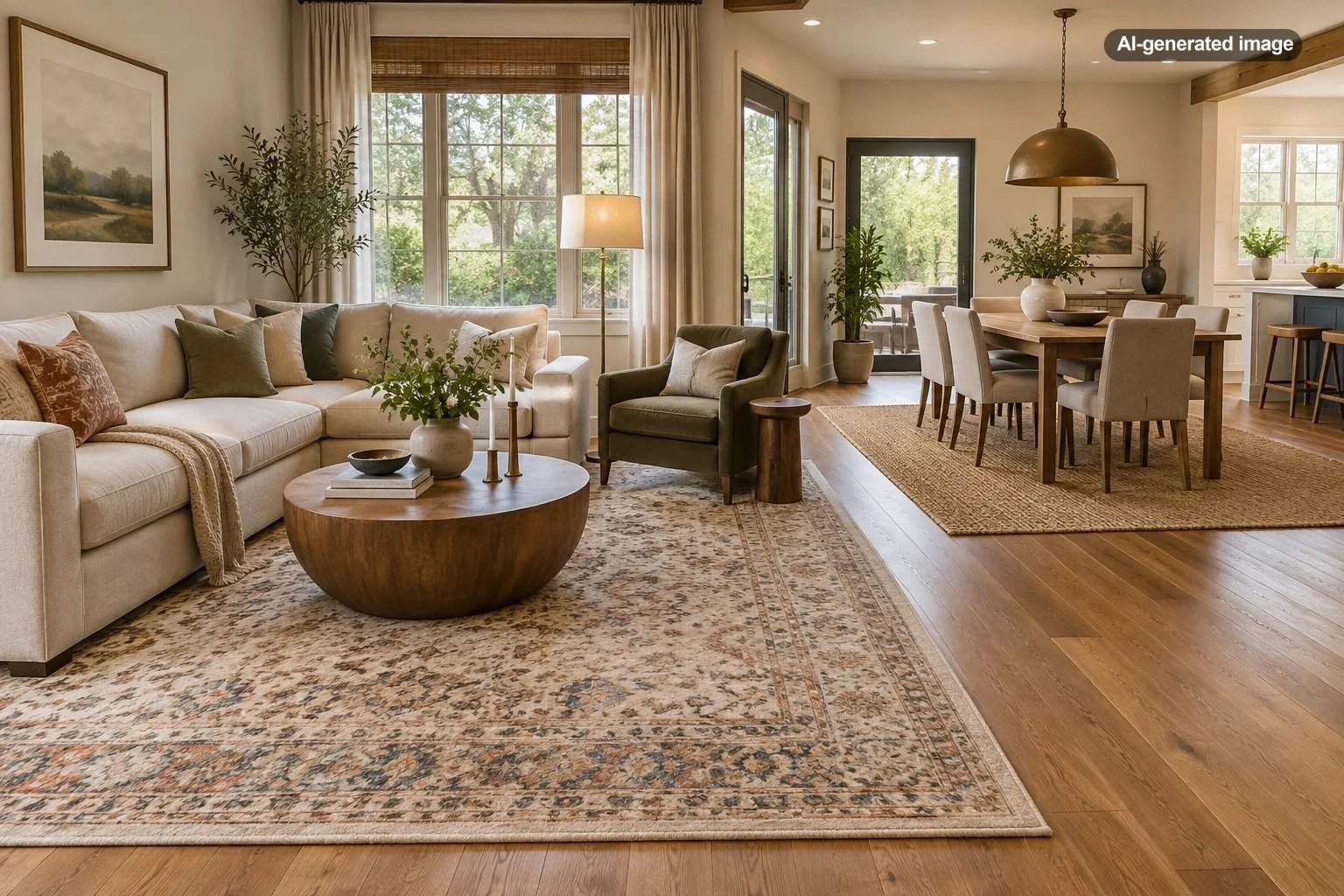
How Do You Use Two Rugs in an Open Floor Plan Without Clashing?
Two rugs can work beautifully in an open floor plan without matching exactly. The key is to make them feel related while giving each one a distinct job. Instead of searching for two identical rugs, coordinate one or two elements – such as color, texture, pattern scale, or overall mood – and let the rugs help define separate zones within the larger room.
A living-and-dining space, for example, often looks more intentional when the seating area has one rug and the dining table has another. The rugs can differ in pattern or material, but they should not compete so aggressively that the eye has nowhere to rest.
Start by treating each rug as a zone marker
In an open floor plan, rugs do more than add softness. They create invisible boundaries. A rug under the sofa and chairs can establish the living area, while another beneath the dining table makes the dining area feel like a separate destination even when there is no wall between them.
This is why rug placement should begin with furniture, not with the rugs themselves. Look at the natural groupings already present. Seating arranged around a coffee table is one zone. A dining table and chairs are another. A reading chair tucked beside a window might be a smaller third zone that does not necessarily need its own rug.
When each rug has a clear purpose, the combination tends to feel deliberate rather than scattered.
Coordinate instead of matching
Identical rugs can work, particularly in a symmetrical space, but they are not required. In many open rooms, two different rugs create more depth and make the individual zones easier to recognize.
A simple approach is to repeat one element while changing another. Two rugs might share warm rust and cream tones while using completely different patterns. They could share a similar woven texture while one is nearly solid and the other is patterned. Or they might both have geometric motifs, but with one pattern much quieter than the other.
The rugs should look as though they belong in the same conversation, not as though they came from the same box.
Color is usually the easiest connector because even a small repeated shade can visually bridge the two areas. The shared color does not need to be the dominant color in both rugs. A secondary blue in the living room rug, for example, might become the primary blue of the dining rug.
Let one rug be more expressive
Two bold rugs placed close together can make an open room feel busy, especially when upholstery, artwork, pillows, curtains, and dining chairs already contribute additional pattern. A useful strategy is to choose a visual leader.
If the living room rug has a strong Persian-inspired motif, large abstract design, or dramatic contrast, consider a quieter dining rug with a subtle stripe, restrained geometric pattern, or mostly solid surface. The reverse works just as well. A simple living room rug can provide breathing room beside a more decorative dining rug.
| If the first rug is… | Try making the second rug… |
|---|---|
| Bold and multicolored | Quieter, using one color pulled from the first rug |
| Large-scale geometric | Solid, textured, or patterned at a much smaller scale |
| Neutral and low contrast | More expressive while staying in a related palette |
| Highly textured | Smoother or more restrained in texture |
Use pattern scale to prevent visual competition
Two patterned rugs are not automatically too much. Problems usually arise when both patterns demand attention in the same way.
If one rug uses broad stripes, oversized medallions, or large geometric shapes, pair it with a smaller repeating motif or a low-contrast pattern. The difference in scale helps the eye understand that the rugs are related layers rather than competing focal points.
This principle becomes especially helpful when the rugs are only a few feet apart. The closer they are, the more clearly their patterns should differ in scale, intensity, or both.
Size each rug for its own furniture grouping
Coordinating color will not rescue rugs that are noticeably undersized for their zones. Each rug should look appropriately scaled to the furniture around it.
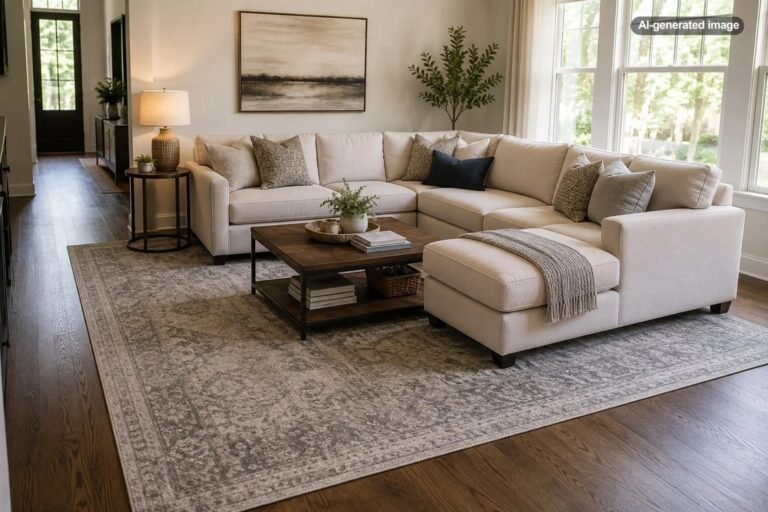
In a living area, a rug generally looks more grounded when it relates to the entire seating arrangement rather than floating beneath only the coffee table. Depending on the room and furniture configuration, the sofa and chairs may sit fully on the rug or have their front legs resting on it.
Dining areas have a different practical requirement: the rug needs enough surrounding room for chairs to move back from the table without constantly catching at the rug edge. Instead of choosing the dining rug simply because its dimensions resemble the living room rug, size it around the table and chair movement.
Pay attention to the flooring between the rugs
The exposed flooring acts as a visual buffer. Wood, tile, or another continuous flooring material can help two different rugs coexist because it creates a neutral pause between them.
If there is a generous stretch of visible floor separating the zones, you have more freedom to mix patterns and colors. When the rugs nearly touch, stronger coordination becomes important. In that situation, consider using a tighter color palette or making one rug especially simple.
Avoid forcing two rugs together solely to eliminate a narrow strip of flooring. A small but intentional gap can make each zone easier to read.
Consider texture as part of the mix
Texture can link rugs even when their patterns differ. Natural-looking woven surfaces, wool-like textures, flatweaves, and softer piles each contribute a particular visual weight.
You can use similar textures for a calm, continuous look or deliberately contrast them. A plush living room rug beside a flatter dining rug can be both visually sensible and practical because the dining area often benefits from a surface that allows chairs to move more easily.
The important point is that texture should support how the space is used. A beautiful combination that constantly interferes with furniture movement will quickly become frustrating.
Repeat colors elsewhere in the room
The rugs do not have to perform all the coordination by themselves. Furniture and accessories can create the bridge between them.
A color from the dining rug might appear again in a living room pillow, vase, lampshade, or piece of artwork. A wood tone from the dining table can echo the warm tones of the living room rug. These small repetitions make an open floor plan feel cohesive without requiring every object to match.
This also gives you more flexibility if one rug is vintage, inherited, unusually colorful, or simply a favorite you want to design around.
Before you decide
- Identify the furniture zone that each rug will define.
- Choose which rug will carry more pattern or visual contrast.
- Repeat at least one color, material, or stylistic quality between the two.
- Vary pattern scale if both rugs are patterned.
- Size each rug according to its own furniture arrangement.
- Look at the amount of visible flooring separating the rugs.
- Check the combination from several viewpoints across the open room.
What combinations commonly look awkward?
The most difficult pairings are often not technically mismatched; they are simply too competitive. Two rugs with unrelated palettes, similar high-contrast patterns, and equally strong visual weight can divide the room rather than connect it.
Another common issue is accidental almost-matching. Two beige rugs with slightly different undertones, for example, can look less intentional than one beige rug paired with a clearly contrasting patterned rug. When colors are extremely close, differences become more noticeable.
Scale can also create imbalance. A generous living room rug next to a tiny dining rug may make the dining area feel temporary or unfinished, even if their colors coordinate perfectly.
Can you use rugs from completely different styles?
Yes, provided something connects them. A traditional rug and a modern geometric rug can coexist when they share a restrained palette. A patterned vintage-style rug can sit near a simple natural-fiber-looking rug when the surrounding furniture bridges old and new elements.
Mixed-style rooms often benefit from this approach because overly coordinated rugs can make an eclectic interior feel unusually rigid. The goal is not uniformity. It is enough repetition to make the differences seem intentional.
Should open-plan rugs ever match exactly?
They can. Matching rugs can be useful when you want a very quiet, continuous look, when the architecture is highly symmetrical, or when other furnishings already introduce plenty of visual variety.
However, exact matching can make separate functional areas feel less distinct. If the purpose of the rugs is partly to define a living zone and a dining zone, related but different designs often communicate that separation more effectively.
How do you know when the combination works?
Stand at the main entrance to the open space and look at both rugs simultaneously. Neither should feel accidental, undersized, or overwhelmingly dominant. Your eye should be able to move from one area to the next without encountering a sharp visual disconnect.
Then view the rugs from the individual zones. The living room rug should still make sense when the dining rug is in your peripheral vision, and vice versa. If one continually steals attention from the other, reduce contrast, simplify one pattern, or strengthen the shared color story.
Two rugs in an open floor plan work best when they create both connection and distinction. Give each one responsibility for its own zone, repeat a few deliberate elements between them, and allow enough difference that the room feels layered rather than matched by formula.