How Much Space Should Be Between a Reclining Sofa and Coffee Table?
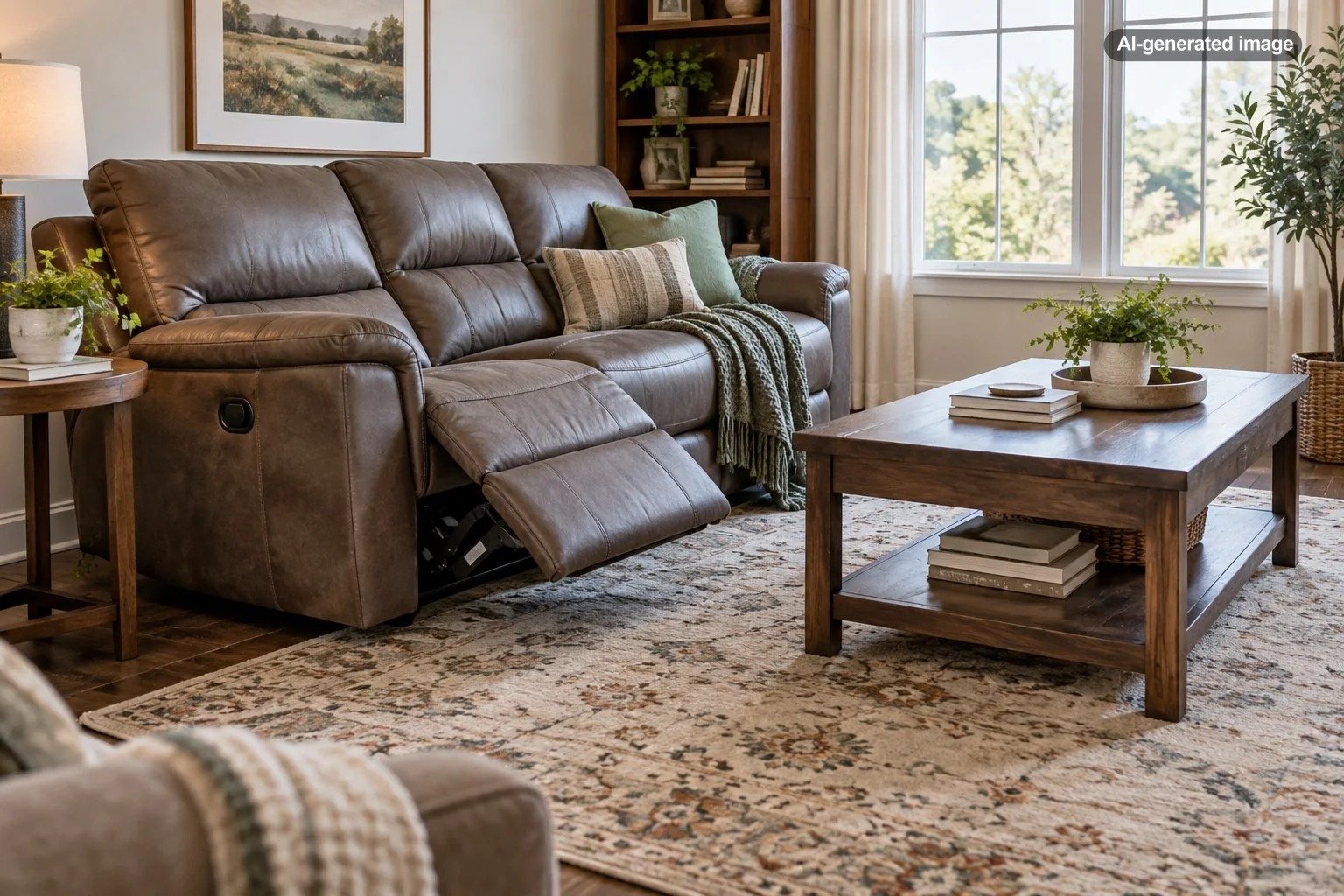
A reclining sofa needs more breathing room in front of it than a standard stationary sofa. While roughly 12 to 18 inches between a conventional sofa and coffee table is a common starting point, a reclining sofa should be spaced according to the fully extended footrest, not simply the front edge of the sofa when it is upright.
The practical rule is simple: fully recline every seat that can move, then position the coffee table far enough away that the footrest clears it comfortably. If that requires more than the usual coffee-table distance, the reclining mechanism wins. Comfort and unobstructed movement matter more than following a decorative spacing formula.
Measure the recliner when it is fully open
The most useful measurement is not the sofa’s advertised depth. It is the distance from the sofa’s normal front edge to the farthest point reached by the footrest when the seat is fully reclined.
Put the sofa where you intend to keep it, extend the footrest completely, and measure how far the mechanism projects into the room. Do this for each moving seat if the sofa has multiple recliners. Some designs extend farther than others, and the center or end seats may not necessarily move in exactly the same way.
The coffee table should sit beyond that operating zone. Manufacturers of reclining furniture commonly instruct owners to keep tables, rugs, and other objects far enough away that the legrest can extend without rubbing or interference. That makes the sofa’s actual motion more important than any generic furniture-layout number.
What to do
- Place the reclining sofa in its intended position.
- Move the coffee table temporarily out of the way.
- Fully extend every reclining seat.
- Mark the farthest reach of the footrests with removable painter’s tape.
- Place the coffee table beyond that line with a modest buffer.
- Sit down, recline, stand up, and walk around the table to confirm the arrangement feels natural.
Why the usual 12 to 18 inches may not be enough
With a stationary sofa, a coffee table positioned approximately 12 to 18 inches away is usually close enough to reach while leaving useful legroom. A reclining sofa changes the geometry because part of the seating moves forward.
If a footrest extends into that 12-to-18-inch zone, placing the table there simply because the number looks correct can prevent the sofa from opening properly. The result may also force someone to move the table every time they recline, which quickly becomes annoying in an everyday living room.
| Situation | Best spacing approach |
|---|---|
| Stationary sofa | About 12 to 18 inches is a useful starting range. |
| Reclining sofa with short footrest travel | Use the normal range only if the extended footrest still clears the table. |
| Reclining sofa with longer extension | Move the table beyond the full footrest travel, even if the gap becomes noticeably larger. |
| Multiple reclining seats | Test every moving seat and use the greatest required clearance. |
| Very small living room | Consider a smaller, narrower, lighter, or easily movable table rather than crowding the mechanism. |
Leave enough room to get in and out comfortably
Mechanical clearance is only part of the calculation. A table can technically avoid the footrest and still make the seating area unpleasant to use.
When someone lowers the footrest and stands up, there should be enough room to move naturally rather than squeezing sideways around a sharp table corner. This matters particularly with deep coffee tables, bulky upholstered recliners, and rooms where the main walking route crosses in front of the sofa.
Test the room while the recliner is open. Walk from both ends of the sofa toward nearby doors, chairs, and hallways. If opening the recliner effectively blocks the room, changing the coffee table may work better than simply pushing it farther toward the opposite wall.
Choose the coffee table around the reclining zone
If the necessary gap feels too large, the issue may be the table’s dimensions rather than the sofa placement. A narrower coffee table takes up less of the room’s center and can preserve both reclining clearance and walking space.
Round and oval tables can also be easier to navigate in tight layouts because they eliminate projecting corners near knees and feet. Nesting tables or small movable tables can make sense when the household wants a surface within easy reach while seated but needs an open zone whenever the recliners are extended.
Scale still matters visually. A table that is dramatically undersized may look disconnected from a large reclining sofa, while an oversized table can make an already substantial piece of seating feel even heavier. Before buying, outline the proposed table footprint on the floor with painter’s tape and test the recliners against it.
The right coffee-table position is the one that works when the recliner is fully open, not just when the room is perfectly arranged.
Do not forget the other side of the coffee table
Moving a coffee table farther from a reclining sofa solves one problem but can create another. Check what happens between the table and a media console, fireplace, accent chairs, or the opposite wall.
You still need a usable circulation path through the room. If pushing the table away from the sofa leaves an awkwardly narrow passage on the opposite side, the room may simply be too tight for that combination of sofa and table dimensions.
In that situation, a shallower table is often more practical than sacrificing all of the surrounding walkway. Another option is to use side tables for drinks and remotes and leave the center of the room more open.
Common placement mistakes
- Measuring with the sofa upright: This ignores the furniture’s largest operating footprint.
- Allowing the footrest to barely touch the table: Clearance should prevent rubbing and interference, not merely make operation possible.
- Testing only one recliner: On a multi-seat sofa, another footrest may project farther.
- Ignoring traffic flow: A layout can accommodate the mechanism yet still be difficult to walk through.
- Buying the table before mapping the room: Tape on the floor can reveal an awkward size before a heavy table arrives.
Before you decide
- Fully extend every reclining seat.
- Confirm the coffee table stays outside the entire moving zone.
- Leave a little additional clearance rather than positioning the table at the exact limit.
- Check that people can stand up comfortably.
- Walk through the room with the recliners open.
- Confirm the table still feels reachable when the sofa is upright.
- Consider a narrower or movable table if the room feels crowded.
FAQ
Is 18 inches enough between a reclining sofa and coffee table?
Sometimes, but not automatically. Eighteen inches can work only when the fully extended footrest remains comfortably clear of the table. Many reclining mechanisms require a larger effective gap.
Should I measure from the sofa cushion or the footrest?
For a reclining sofa, use the farthest point reached by the fully extended footrest as your critical boundary. The upright front edge of the sofa does not represent the furniture’s full operating depth.
What if the coffee table ends up too far away to reach?
Consider a narrower table, nesting tables, a movable ottoman-style surface, or side tables positioned beside the seating. Trying to force a conventional coffee table into the footrest’s operating area usually makes the room less functional.
Can a coffee table interfere with a recliner even if it does not touch it?
Yes. A very tight gap can make standing, sitting, and walking awkward even when the mechanism technically clears the table. Test the arrangement with people actually using the sofa rather than relying on measurements alone.
What is the best final spacing?
The best spacing is the smallest distance that still allows every footrest to extend fully, leaves a modest clearance buffer, permits comfortable entry and exit, and preserves reasonable circulation through the rest of the room. For some sofas that may be close to a conventional coffee-table gap; for others it will be substantially greater.