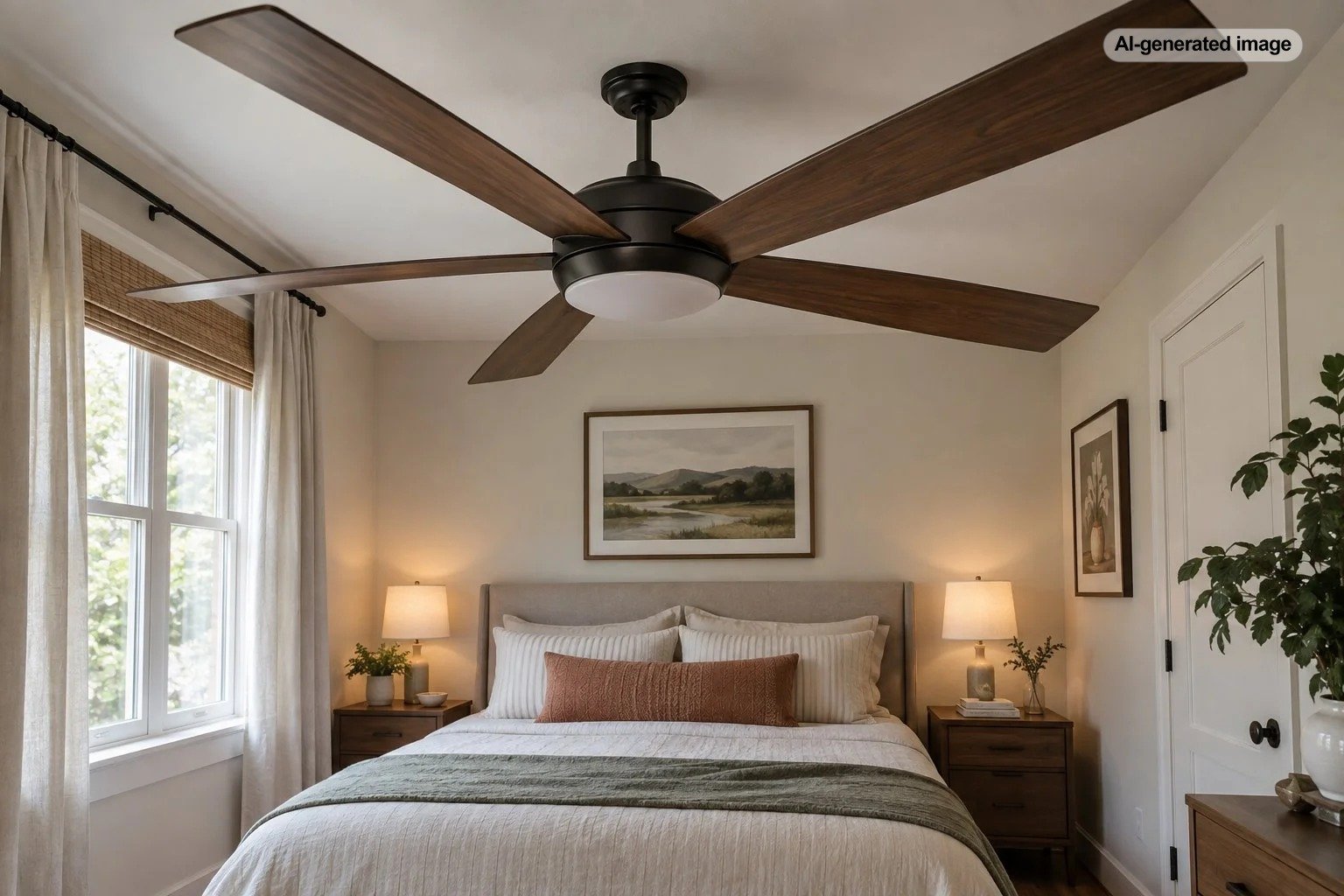
Can a Ceiling Fan Be Too Large for a Room?
Yes, a ceiling fan can be too large for a room. An oversized fan may sit uncomfortably close to walls, cabinets, doors, or tall furnishings, and its airflow can feel more forceful than the room requires. It can also dominate the ceiling so completely that the rest of the room appears underscaled.
That does not mean a large fan is automatically a mistake. A broad, quiet fan can look beautifully deliberate in an open living room or a bedroom with a high ceiling. The right decision depends on blade span, available clearance, ceiling height, room shape, and how the space is actually used.
What makes a ceiling fan too large?
Ceiling-fan size refers to blade span: the diameter of the circle created by the rotating blades. An oversized fan is not simply one that looks generous. It is one whose dimensions or performance do not suit the available space.
The clearest problem is inadequate clearance. Blade tips need open space around them, and the fan must remain safely above the floor. Doors, tall cabinet doors, sloped ceilings, beams, bunk beds, and built-ins can all reduce the usable area even when the room’s total square footage seems sufficient.
Airflow matters as well. A large fan running at high speed can create drafts, disturb loose papers, or make a small bedroom feel restless. A well-designed model with a broad range of speeds may be comfortable on its lowest setting, but size alone does not reveal how gently it will operate. Compare the manufacturer’s airflow information, speed controls, and installation requirements rather than relying only on blade span.
Start with room size, but do not stop there
Multiply the room’s length by its width to calculate square footage. For an L-shaped or divided room, measure each rectangular section separately and consider whether air can move freely between them.
ENERGY STAR offers these general starting points for residential fan sizing:
| Room area | Suggested blade span | Typical context |
|---|---|---|
| Up to 75 square feet | 29 to 36 inches | Compact office, laundry area, or small bedroom |
| 76 to 144 square feet | 36 to 42 inches | Modest bedroom or enclosed den |
| 144 to 225 square feet | About 44 inches | Medium bedroom or sitting room |
| 225 to 400 square feet | 50 to 54 inches | Large bedroom or living area |
These ranges are useful reference points, not substitutes for the instructions supplied with a particular fan. Contemporary models extend well beyond these sizes, and manufacturers may recommend different spans for their products. The room’s layout can also make a nominally correct fan feel wrong.
Check blade clearance and mounting height
Before buying, mark the proposed fan center and imagine a circle equal to the full blade span. Half the blade span is the fan’s radius. A 60-inch fan, for example, extends 30 inches from its center in every direction.
ENERGY STAR advises mounting a ceiling fan in the middle of the room, at least 7 feet above the floor and 18 inches from walls. It also notes that a blade height of approximately 8 to 9 feet can provide effective airflow when the ceiling allows it. Some manufacturers call for greater side clearance, so the selected model’s installation manual must control the final placement.
Measure before choosing
- Measure the room’s length and width, then calculate its square footage.
- Measure the ceiling height and note whether the ceiling is flat, sloped, vaulted, or interrupted by beams.
- Locate doors, cabinets, tall furniture, light fixtures, and other possible blade obstructions.
- Check the fan’s complete dimensions, including its blade span, motor housing, canopy, downrod, and light kit.
- Confirm the required floor, wall, ceiling, and obstruction clearances in the manufacturer’s instructions.
Low ceilings require special attention. A low-profile fan can preserve headroom, but its blades still need enough space below the ceiling to move air as intended. On a tall or vaulted ceiling, a suitable downrod may bring the fan closer to the occupied part of the room. Downrods, adapters, and mounting systems must be compatible with the specific fan.
Consider the room’s shape and function
A single wide fan often works best in a centered, open room. Long great rooms, combined kitchen and living areas, and irregular layouts may be better served by two appropriately spaced fans. One enormous fan is not always able to distribute air evenly around partitions, deep alcoves, or furniture groupings.
Room use changes the comfort calculation, too. In a home office, excessive air movement can flutter papers. Over a bed, a powerful draft may feel too direct even when the fan technically fits. In a living room, a wide fan operating slowly may feel calmer and look more proportional than a smaller fan spinning rapidly.
Judge visual scale as carefully as physical fit
A ceiling fan is both an appliance and a prominent fixture. Dark blades, a thick motor housing, an elaborate light kit, and a long downrod increase visual weight. Slim blades and a finish close to the ceiling color tend to recede, even at a similar diameter.
Look at the fan in relation to the room’s largest elements: the bed, dining table, sectional, rug, and ceiling architecture. A large fan can provide a useful focal point in a restrained room. In a compact room already filled with substantial furniture and decorative lighting, the same fan may make the ceiling feel busy and low.
Do not choose an undersized fan purely to make it disappear. A fan that looks delicate but must run at full speed to provide comfort may be less pleasant than a slightly larger, visually quieter design used at a lower setting. The goal is proportion, comfortable performance, and adequate clearance together.
Signs the existing fan may be too large
- The blade tips appear crowded by walls, beams, open doors, cabinets, or nearby fixtures.
- The lowest practical speed still creates an uncomfortable draft or disturbs lightweight objects.
- The light kit or motor housing hangs too low for the room and makes circulation beneath it uncomfortable.
- The fan visually presses down on the room or makes major furnishings appear unusually small.
- The installation does not meet the current manufacturer’s clearance or mounting instructions.
Should you replace an oversized fan?
Replacement makes sense when the fan cannot maintain required clearances, hangs too low, interferes with surrounding features, or remains uncomfortable at its lowest usable speed. A smaller blade span, low-profile housing, shorter approved downrod, or less visually heavy design may solve the problem.
If the concern is mainly aesthetic, first try the existing speed settings and evaluate the fan from several points in the room. A broad fan that initially looks large may feel balanced once the furniture plan, rug, and lighting are complete. Physical clearance and safe mounting, however, are not matters to finesse with styling.
Before you decide
- Calculate room square footage.
- Measure the clear ceiling area, not just the floor.
- Confirm blade height above the floor.
- Check doors, cabinets, beams, and nearby lights.
- Review the exact model’s installation manual.
- Consider airflow at low speed as well as maximum airflow.
- Compare the fan’s visual weight with the room’s furniture and ceiling height.
Frequently asked questions
Is a 60-inch fan too large for a bedroom?
It can be, particularly in a compact bedroom or one with limited wall clearance. In a spacious primary bedroom with a high, unobstructed ceiling, a 60-inch model may fit. Use the manufacturer’s room-size guidance and required clearances for the exact fan.
Can a large fan be used at a low speed?
Often, yes. A larger fan running slowly may provide gentle circulation, but only if it physically fits, is mounted correctly, and offers suitable low-speed performance. Low speed does not correct inadequate blade clearance or mounting height.
Is one large fan better than two smaller fans?
Not always. One fan can suit a centered rectangular room, while two fans may distribute air more evenly in a long, divided, or open-plan space. Each fan still needs appropriate spacing, support, wiring, and clearance.
Does blade count determine whether a fan is too large?
No. Blade span determines the rotating diameter. Blade design, motor performance, pitch, and speed also affect airflow, while finish and housing shape influence how large the fixture appears.