Can an Area Rug Be Too Large for a Living Room?
Yes, an area rug can be too large for a living room, although undersized rugs are the more common decorating problem. A rug becomes too large when it crowds the walls, interferes with doors or floor transitions, obscures nearly all of the surrounding floor, or extends well beyond the furniture grouping it is supposed to define.
The right rug should feel generous without behaving like poorly fitted wall-to-wall carpet. It needs to relate to the seating arrangement first, while still leaving enough visible floor and practical clearance for the room to breathe and function.
Judge the rug by the seating zone, not just the room
A living room rug does not necessarily need to fill the largest rectangle available. Its primary job is to define the conversational area formed by the sofa, chairs, and coffee table. In an open-plan home, that distinction is especially important because the rug may need to mark one zone without drifting into a dining area, entry path, or kitchen walkway.
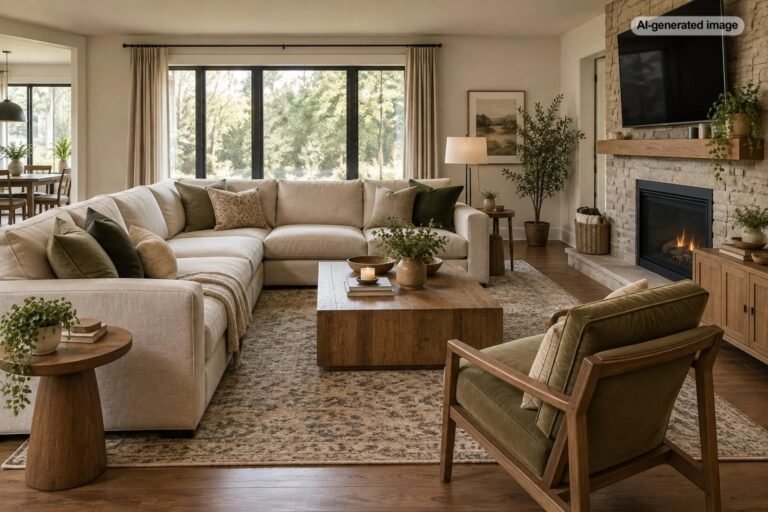
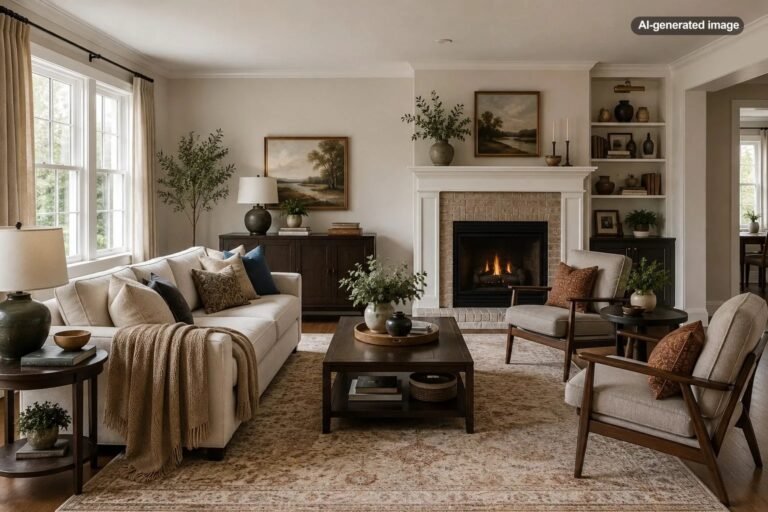
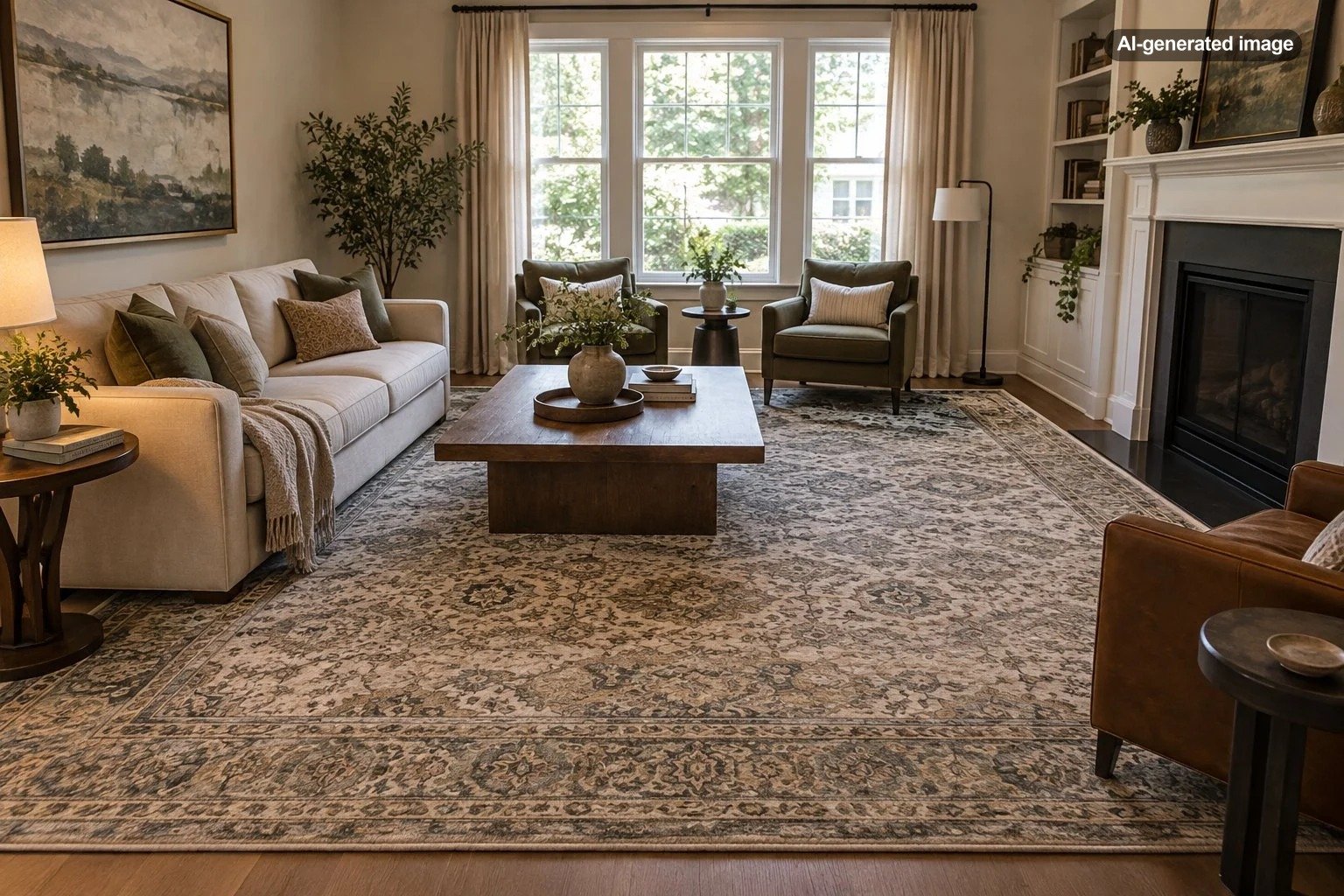
Start by looking at the outer edges of the seating arrangement. A well-proportioned rug generally reaches beneath at least the front legs of the principal seats. A larger version may hold every furniture leg, which can look calm and substantial in a spacious room. Either approach can work; inconsistency is what tends to look accidental.
If one chair sits completely on the rug, another barely touches it, and a third is several inches away, the problem may be placement rather than size. Recenter the rug on the furniture group before deciding that it is too large.
Leave a visible floor border
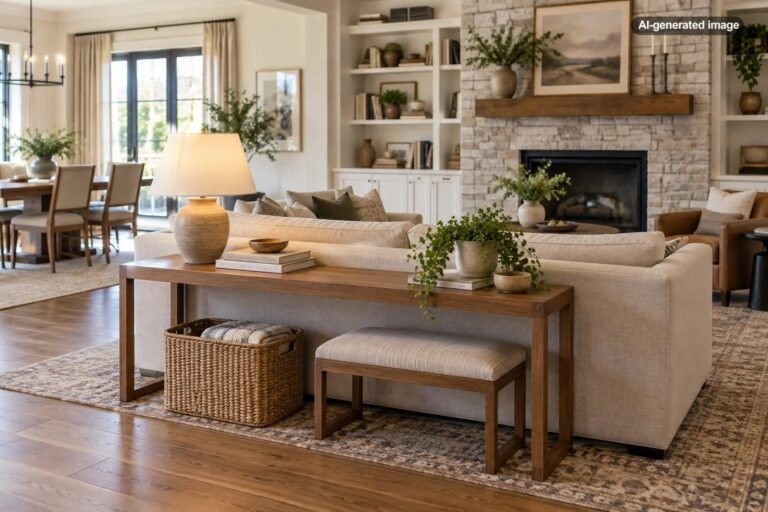
A perimeter of exposed flooring helps an area rug read as a distinct furnishing. Many rooms look balanced with roughly 12 to 24 inches of visible floor between the rug and nearby walls, but that range is a planning guide rather than a law. A compact room may need a narrower border, while a large formal room can support more space.
What matters most is that the border looks intentional. A rug sitting three inches from one wall and 18 inches from the opposite wall can seem incorrectly sized unless the furniture layout clearly explains the offset. Consistent spacing is usually calmer, though architectural features such as a fireplace, bay window, or angled wall may justify an asymmetrical arrangement.
The best rug is not the largest one that fits through the door; it is the size that makes the furniture and the room feel connected.
Compare the main living room rug layouts
| Layout | Best fit | What to check |
|---|---|---|
| All furniture legs on the rug | Large rooms and floating seating groups | Leave a clear floor border and keep the rug within the seating zone |
| Front legs on the rug | Most standard living rooms | Make sure every principal seat connects to the rug consistently |
| Sofa fully on, chairs partly on | Asymmetrical or compact layouts | Keep chair legs stable and make the arrangement look deliberate |
| Coffee table only on the rug | Very small rooms or intentional layered designs | Avoid a tiny floating rug that visually separates the seats |
A rug that supports all furniture legs is not automatically too large. This layout can make a generous room feel composed and can prevent chair legs from catching on rug edges. It becomes excessive when the rug extends far beyond the actual seating group or eliminates nearly every glimpse of the finished floor.
Look for functional signs that the rug is too large
Scale is partly visual, but daily use provides clearer evidence. Check every door that opens over or near the rug. A thick pile or pad may catch a door even when the bare rug appeared to fit. Also examine floor vents, fireplace clearance, raised thresholds, and the main paths people use to cross the room.
- Doors drag or stop: The rug may be too thick, too large, or positioned too close to the swing.
- Edges enter another room: A rug crossing a doorway or flooring transition can look misplaced and may create an uneven walking surface.
- Floor vents are covered: Adjust the size or placement rather than treating a vent as an acceptable hidden detail.
- The rug buckles under furniture: Oversizing, poor positioning, or an unsuitable pad may prevent the rug from lying flat.
- Walkways feel pinched: The rug should support natural circulation, not force people around corners or unstable edges.
Mobility needs deserve extra attention. A rug that is technically proportional may still be unsuitable if curled edges, thick transitions, or shifting corners make the route difficult for someone using a cane, walker, or wheeled mobility aid.
Consider pattern and color as part of perceived size
Two rugs with identical dimensions can feel very different. A pale, low-contrast rug often recedes visually, while a dark border or bold geometric pattern can make the perimeter more prominent. Large motifs may also lose their effect when most of the design disappears under a sectional and several chairs.
If an oversized rug feels visually heavy but functions well, changing its orientation or exposing more of its pattern may solve the problem. A quieter design can also make an expansive rug feel less dominant. Conversely, a rug with a strong border needs particularly thoughtful alignment because uneven spacing will be easier to see.
Measure before replacing the rug
What to do
- Measure the full room, including alcoves, door swings, vents, and floor transitions.
- Measure the outer footprint of the sofa and chairs in their intended positions.
- Choose whether all legs or only the front legs should rest on the rug.
- Mark the proposed rug dimensions on the floor with removable painter’s tape.
- Walk through the room, open every door, and view the outline from adjoining spaces.
- Compare the marked dimensions with the product’s actual listed size rather than relying only on a nominal size label.
Live with the taped outline for a day if possible. Morning and evening traffic may reveal issues that are not obvious while measuring, such as a frequently used path cutting across a corner. The test also shows whether the rug will relate properly to a media console, fireplace, or other fixed focal point.
What if the rug is already too large?
First, try repositioning it. Rotating a rectangular rug 90 degrees can bring the long dimension into better alignment with a sofa or sectional. Moving the seating group slightly may also create a more even floor border, provided circulation remains comfortable.
If the rug is only marginally oversized, placing all major furniture legs on it can make the scale appear intentional. However, do not crowd furniture against walls simply to justify the rug. The room should continue to support conversation, movement, and access to tables or storage.
Affiliate disclosure: CraneManor.com may earn a commission when you purchase through links on this page. This does not affect the price you pay. Learn more.
When replacement is the cleaner solution, test a slightly smaller footprint and compare it with the current one before ordering. A woven area rug may provide the texture needed to anchor the room, but its exact dimensions, material, color, care requirements, and compatibility with the intended placement should be confirmed before purchase.
Custom cutting is another possibility for certain rug constructions, but it should be handled by a qualified rug professional. Cutting can alter the border, damage the binding, or produce proportions that no longer suit the pattern.
Before you decide
- Does the rug define the seating area rather than the entire room by default?
- Is there a deliberate border of visible flooring?
- Do doors, vents, and transitions remain clear?
- Are furniture legs placed consistently and securely?
- Do the rug’s color and pattern feel balanced at this scale?
- Can people move through the room without catching an edge?
Frequently asked questions
Should a living room rug go under the sofa?
Usually, at least the sofa’s front legs should rest on the rug. In a larger room, placing the entire sofa on the rug can look polished and cohesive. The arrangement should also connect the chairs rather than serving the sofa alone.
Can an area rug cover most of the living room floor?
Yes, particularly in a large room or one with a floating furniture arrangement. It should still leave an intentional floor border and avoid interfering with doors, vents, and transitions. If it reaches nearly wall to wall, the result may resemble improperly fitted carpet.
Can a large rug make a small living room look bigger?
It can. A sufficiently large rug can create one continuous visual field and make the seating arrangement feel unified. The benefit disappears if the rug crowds the walls, bunches near doorways, or overwhelms the furniture.
Is it better for a living room rug to be too big or too small?
A slightly generous rug is often easier to style than one that is clearly too small. Even so, bigger is not automatically better. The room’s architecture, furniture footprint, walking paths, and visible floor border should determine the final size.
The final test
An area rug is too large when it stops supporting the room and starts dictating awkward compromises. If the furniture sits comfortably, the floor border looks purposeful, doors and walkways remain clear, and the rug defines the seating zone, a generous size is probably working. If those conditions fail, a smaller rug or a better orientation will give the living room more order without making it feel less inviting.