Can Salt Air Damage an Outdoor Ceiling Fan?
Yes. Salt air can damage an outdoor ceiling fan, even when the fan is designed for outdoor use. The combination of airborne salt, humidity, and repeated wet-dry cycles can encourage corrosion on exposed metal, fasteners, finishes, electrical enclosures, and other vulnerable components. How quickly that happens depends heavily on the fan’s construction, its outdoor rating, its distance from saltwater, and how sheltered it is.
The important distinction is that outdoor-rated does not automatically mean salt-air resistant. A fan that is perfectly appropriate for a humid covered porch inland may not be the best choice for an oceanfront balcony or a patio that regularly receives salty mist.
Why salt air is harder on a ceiling fan than ordinary humidity
Outdoor fans already contend with moisture, temperature changes, dust, and sunlight. Near the coast, microscopic salt particles can settle on the housing, mounting hardware, blade arms, fasteners, and other surfaces. Because salt readily attracts and holds moisture, deposits can keep metal surfaces exposed to a corrosive environment longer than ordinary dry dust would.
The fan’s movement does not necessarily protect it. Airflow may bring additional salty air across the fan whenever it operates. An oceanfront fan beneath a covered lanai can therefore face substantial salt exposure even if rain rarely reaches it directly.
Salt exposure is also not limited to houses with a literal beach in the backyard. Wind direction, storms, elevation, local geography, and proximity to bays or other saltwater can all affect how much salt reaches an outdoor structure. There is no useful universal distance at which corrosion suddenly stops being a concern.
Protection from rain and protection from salt-driven corrosion are related, but they are not the same specification.
Damp-rated, wet-rated, and coastal-resistant fans are not interchangeable
The first specification to check is the fan’s location rating. ENERGY STAR explains that damp-rated fans are intended for humid locations, while fans that may come into direct contact with water should carry a wet rating. Wet-rated construction may incorporate features such as moisture-resistant motors, rust-resistant housings, suitable hardware, and all-weather blades.
| Fan type or feature | What it addresses | Typical placement |
|---|---|---|
| Damp-rated | Humidity and moisture without direct water exposure | Well-covered porch or patio |
| Wet-rated | Direct exposure to water and outdoor weather | Open pergola, exposed patio, or similar location |
| Salt-air or coastal resistance | Added resistance to corrosion associated with salty environments | Coastal and marine-influenced outdoor spaces |
A wet rating should not be treated as automatic proof that a fan has been engineered for prolonged salt exposure. Some manufacturers separately identify models as corrosion resistant, salt-air resistant, or coastal rated. Hunter, for example, distinguishes its WeatherMax outdoor fans by stating that they are designed to resist corrosion from water and salt air in addition to being wet-rated. Other manufacturers may use different terminology, materials, tests, or limitations, so the individual product documentation matters.
What salt-air damage can look like
Coastal deterioration is not always dramatic at first. Early changes can be cosmetic, but they are worth watching because corrosion can continue beneath or around compromised finishes.
- White or crusty deposits: Salt residue may collect on housings, brackets, blades, or fasteners.
- Discoloration or finish changes: Painted, plated, or coated surfaces may begin to spot, dull, blister, or peel.
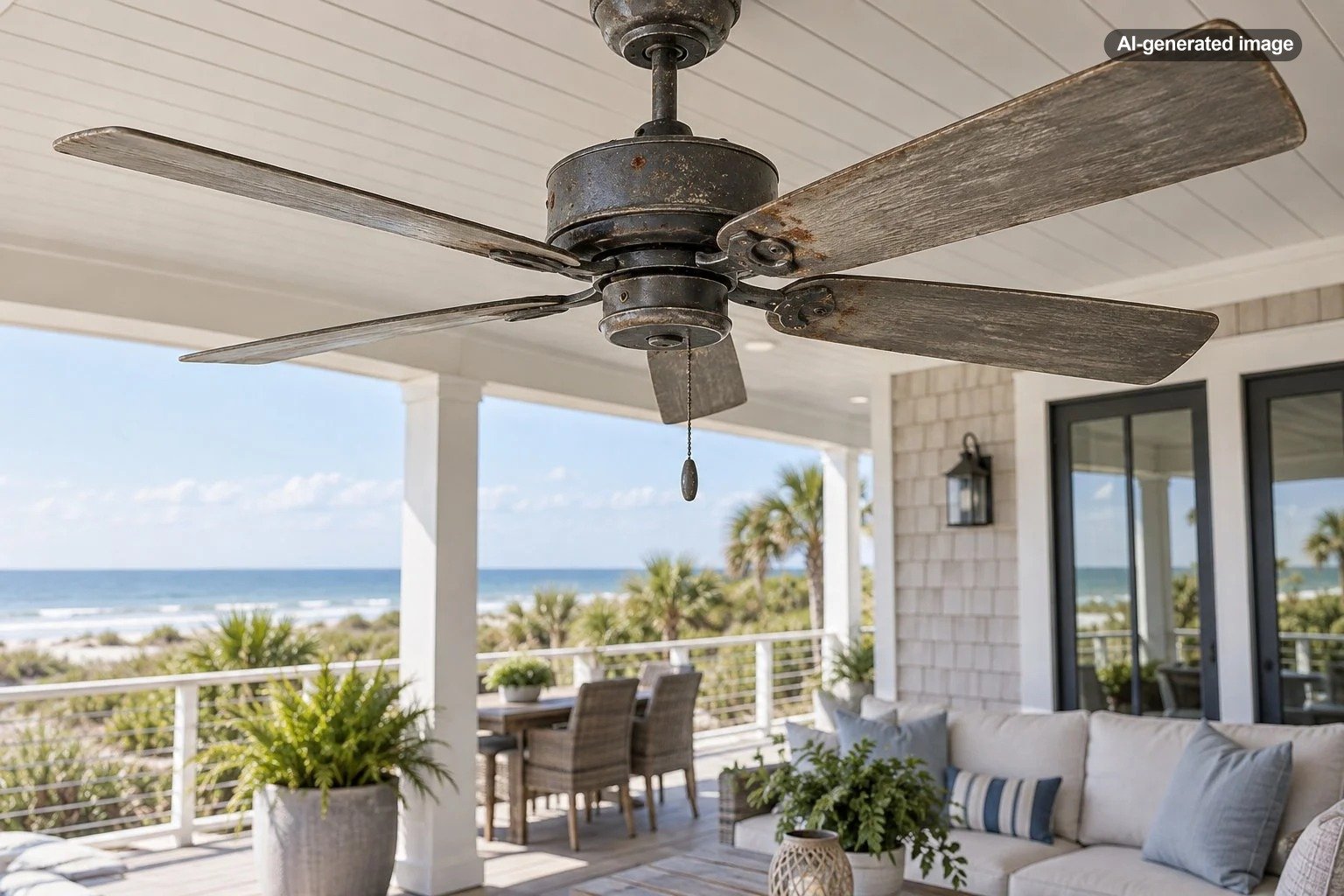
- Rust on steel components: Screws, brackets, blade hardware, or other exposed parts may develop visible oxidation.
- Pitting: Some metal surfaces can develop small localized pits rather than broad patches of rust.
- Stiff or deteriorated hardware: Corrosion around fasteners or moving connections may make maintenance or disassembly more difficult.
A cosmetic blemish on a decorative surface is not automatically an electrical emergency. However, deterioration involving the mounting system, electrical enclosure, wiring area, structural fasteners, or other functional components deserves more caution.
Can you protect an existing fan from salt air?
You can reduce buildup and spot deterioration earlier, but the manufacturer’s instructions should control how a particular fan is cleaned and maintained. Do not spray cleaners, lubricants, coatings, or water into the motor housing or electrical components unless the manufacturer specifically permits that treatment.
What to do
- Confirm the rating. Find the model information and verify whether the fan is damp-rated or wet-rated for its installation location.
- Check for coastal guidance. Review the manual or manufacturer documentation for references to salt air, coastal use, corrosion resistance, cleaning, and prohibited chemicals.
- Turn the fan off before inspection. Examine visible housing surfaces, screws, brackets, blade arms, and mounting components without opening electrical parts.
- Remove deposits as directed. Use only cleaning methods appropriate for the fan’s materials and finish.
- Inspect periodically. A coastal fan benefits from more attentive observation because deposits can reappear quickly in exposed locations.
Simply coating a standard fan with an aftermarket protective spray is not a dependable substitute for suitable construction. An added coating can be incompatible with finishes, interfere with moving parts, trap contamination, or violate the manufacturer’s maintenance instructions. It also cannot change the electrical location rating of the fan.
Placement still matters, even with a coastal-friendly fan
A highly exposed balcony facing prevailing ocean winds places different demands on a fan than a deeply covered porch on the protected side of a house. Roof overhangs, walls, screens, and architectural recesses may reduce direct weather exposure, although they do not necessarily eliminate airborne salt.
This is why buying by style alone can be frustrating in a beach house. A beautiful indoor-looking finish may be entirely appropriate if the fan was actually engineered for the environment, while another fan with a rugged appearance may still lack the rating required for its location.
When corrosion means it is time for professional evaluation
Stop using the fan and have it evaluated if you notice changes that could affect secure mounting or electrical operation, including significant corrosion around mounting hardware, looseness that was not present before, damaged electrical components, unusual electrical odors, sparking, repeated breaker trips, or other signs of an electrical fault.
If replacement is needed, inspect the installation conditions before simply buying the same type again. Repeated corrosion can be a sign that the original fan was not designed for the combination of water and salt exposure at that particular spot.
What to look for when replacing a coastal outdoor fan
Start with the environmental requirements rather than blade shape or finish color. Determine whether rain can reach the fan, how exposed the space is to salty air, and whether the manufacturer specifically supports the model for those conditions.
Before you decide
- Verify damp or wet location suitability for the exact placement.
- Look for explicit corrosion-resistant, salt-air-resistant, or coastal-use language from the manufacturer.
- Check blade and hardware materials rather than judging durability from appearance alone.
- Read the maintenance instructions before installation so routine cleaning is realistic.
- Confirm that the mounting method and electrical box are appropriate for a ceiling fan and its location.
- Do not assume a finish warranty or outdoor label means unrestricted marine exposure; read the actual product terms.
The most useful coastal fan is not necessarily the heaviest-looking model or the one with the most nautical design. It is the one whose documented construction and location rating match the real environment in which it will operate.
Frequently asked questions
Can a wet-rated ceiling fan still rust near the ocean?
Potentially, yes. Wet-rated primarily describes suitability for moisture and direct water exposure. Resistance to salt-driven corrosion may be addressed separately by the manufacturer. Check the specific product documentation rather than assuming every wet-rated fan has identical coastal durability.
Is a damp-rated fan enough for a covered coastal porch?
It can be appropriate when the fan is protected from direct water, but the salt-air question remains separate. In a strongly coastal environment, look for manufacturer guidance regarding corrosion resistance in addition to the appropriate location rating.
Does wiping a ceiling fan prevent coastal corrosion?
Removing salt deposits according to the manufacturer’s cleaning instructions can help limit prolonged surface contamination and makes developing corrosion easier to spot. It cannot compensate for a fan that is unsuitable for the location.
Should a rusty outdoor ceiling fan be replaced immediately?
Minor surface discoloration and serious structural or electrical corrosion are not the same issue. If rust or deterioration involves mounting hardware, electrical components, structural connections, or safe operation, stop using the fan and have the condition professionally evaluated.