Can You Use Two Coffee Tables With a Large Sectional?
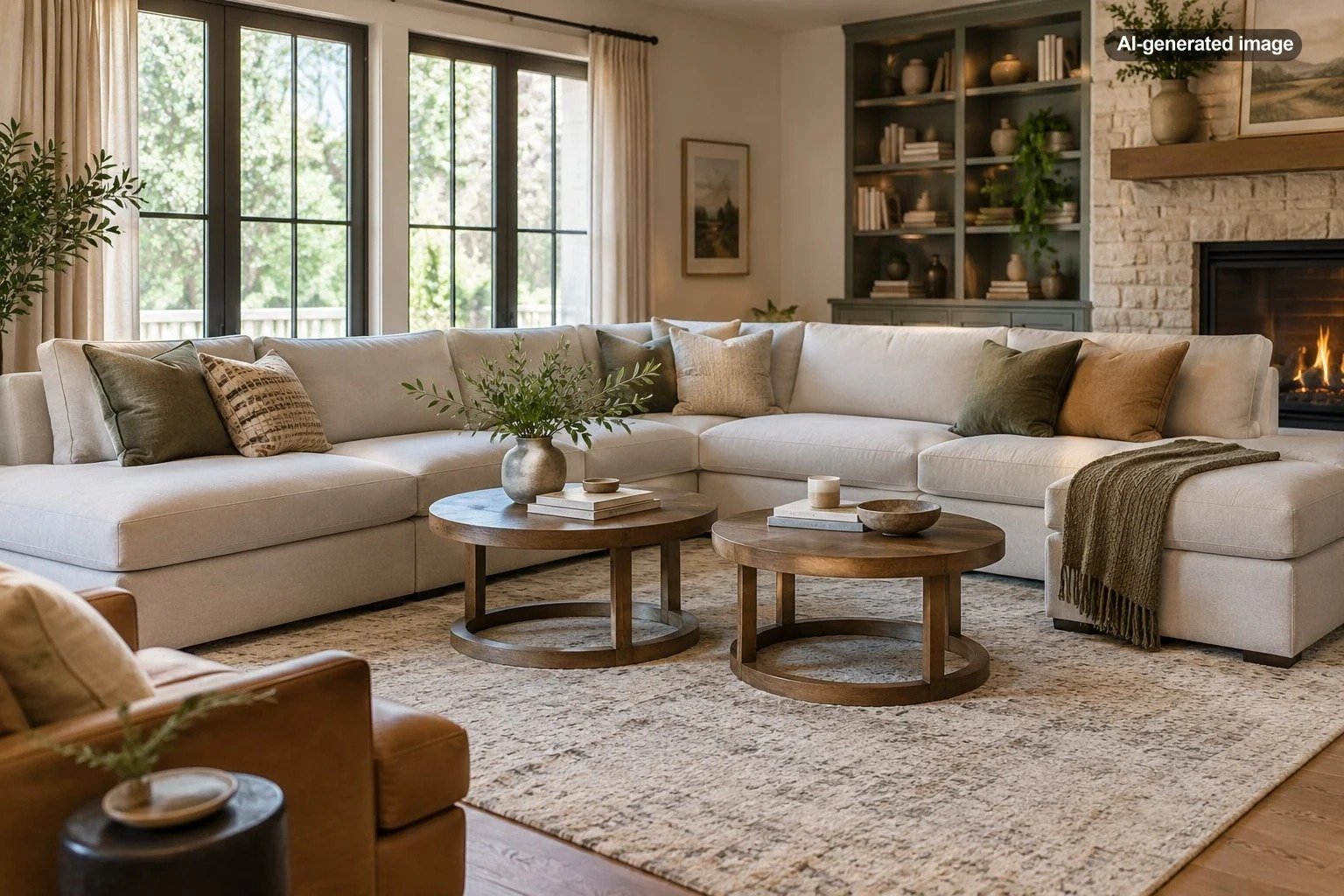
Yes, you can use two coffee tables with a large sectional, and in the right room the arrangement can actually work better than one oversized table. A long L-shaped, U-shaped, or modular sectional often creates more seating than a conventional coffee table can comfortably serve, so dividing the surface area between two tables can make drinks, books, remotes, and everyday objects easier to reach.
The trick is making the pair read as one intentional composition rather than two unrelated tables that happened to land in front of the sofa. Scale, spacing, height, shape, and circulation matter more than whether the tables are technically a matching set.
Why two coffee tables can make sense with a sectional
A large sectional changes the geometry of a living room. Instead of a simple straight sofa facing one table, you may have seating extending in two directions, a chaise projecting into the room, or several modular pieces wrapping around a central area.
One conventional rectangular coffee table can leave people at the ends of the sectional reaching farther than everyone else. A very large table may solve the reach problem but create another one by dominating the floor area or making circulation awkward. Two smaller tables give you another option: spread useful surface area across the seating zone without requiring one massive piece.
This approach is particularly useful when the sectional has a long front edge, when the room is wider than it is deep, or when different parts of the sofa are used for different activities.
With a large sectional, the best coffee-table arrangement serves the seating without turning the center of the room into an obstacle course.
Start with the sectional, not the tables
Before choosing two tables, look at the shape of the sectional from above. The open floor area inside or in front of the sectional is the real design problem you are solving.
An L-shaped sectional may work well with two tables placed side by side along its longest seating run. A U-shaped sectional can accommodate a broader two-table composition in the center. A sectional with a chaise may benefit from one table serving the main sofa portion and another smaller table positioned closer to the chaise without blocking the path around it.
Spacing matters as much as the overall footprint. Pottery Barn recommends allowing roughly 14 to 18 inches between a sofa and coffee table in its guidance for arranging sofas and sectionals. That range is a useful starting point rather than a rigid law, because cushion depth, legroom, mobility needs, and room size can change what feels comfortable. See the spacing guidance from Pottery Barn.
What to do
- Measure the open floor area in front of and inside the sectional.
- Mark the proposed table footprints with painter’s tape, cardboard, or sheets of paper.
- Check the distance from every main seating position to the nearest table.
- Walk every normal route through the room, including paths to doors, chairs, and adjoining spaces.
- Adjust the pair until both reach and circulation feel natural.
The two tables do not have to match
Matching tables are the easiest way to create visual unity, but they are not the only option. Two different tables can look more collected and interesting if they share at least one strong characteristic.
You might pair two tables with the same material but different shapes, the same finish at different heights, or similar silhouettes in slightly different sizes. For example, two round tables of different diameters can soften the strong horizontal and vertical lines of a large sectional. Two rectangular tables can create a cleaner architectural look in a long room.
What usually looks less successful is pairing tables that differ in almost every way: unrelated heights, competing finishes, dramatically different visual weights, and no obvious relationship in shape or style. Contrast can be attractive, but the eye still needs a reason to understand the pieces as a pair.
Decide whether the tables should touch
Two coffee tables can be placed directly beside one another, separated by a narrow gap, or spaced farther apart to serve different seating zones. Each arrangement creates a different effect.
Tables placed close together behave visually like one larger coffee table. This works well when you want the flexibility of two pieces but the appearance of a single central composition. A slight separation can make the arrangement feel lighter while still keeping it cohesive.
A larger gap is useful when the sectional is exceptionally long or when the tables serve distinct portions of the seating. Just make sure the space between them looks deliberate. An awkward gap that is too small to walk through but large enough to appear accidental tends to make the arrangement feel unresolved.
Pay close attention to height
Coffee tables are most comfortable when their tops relate sensibly to the sectional’s seat height. Crate & Barrel notes that a coffee table is commonly about the same height as the sofa cushions or slightly lower. With two tables, that relationship becomes even more noticeable because a major height difference can make the pair look disconnected.
The tables do not have to be exactly equal in height. A small variation can add dimension, particularly with nesting-style arrangements. But if one table is dramatically taller, it may begin to function visually as a different type of furniture rather than part of the coffee-table grouping.
Choose shapes that improve movement
The shape of the tables can solve practical problems around a sectional. Round or oval tables reduce hard corners and can make movement through a tight seating area feel easier. Rectangular tables echo the long lines of a sectional and often provide more continuous usable surface. Square tables can suit deep modular sectionals with generous open floor area.
Two small round tables are especially useful when the sectional wraps around the center of the room. They can be shifted independently when someone wants more legroom or when extra floor space is needed. Two narrow rectangular tables can be effective when the sectional is long but the room is not particularly deep.
| Arrangement | Works well when | Main consideration |
|---|---|---|
| Two matching tables | You want a clean, symmetrical look | Avoid making the combined footprint too large |
| Two different sizes | You want a relaxed, layered arrangement | Keep material or style visually related |
| Two round tables | Circulation around corners is tight | Make sure each seating zone still has useful surface area |
| Two rectangular tables | The sectional and room are long | Watch overall width and walking clearance |
| Separated tables | The sectional has distinct seating zones | Make the gap appear intentional |
When one larger coffee table may be better
Two tables are not automatically superior. A single table may look better when the room has a strong central axis, the sectional is relatively compact, or the floor plan already contains several small furniture pieces. One table also reduces visual complexity in a room with patterned upholstery, multiple accent chairs, sculptural lighting, or a busy rug.
A single substantial table can also create a stronger focal point. If that is the effect you prefer, consider one appropriately scaled statement piece rather than splitting the center into two surfaces.
Affiliate disclosure: CraneManor.com may earn a commission when you purchase through links on this page. This does not affect the price you pay. Learn more.
For example, someone comparing a two-table arrangement with one more prominent centerpiece might consider the Eichholtz Nio Coffee Table as an example of the single-statement-table approach. The important step is not choosing the largest table available, but confirming that the piece fits the sectional, circulation path, room proportions, and delivery route before purchase.
Common mistakes to avoid
The most common problem is simply using too much furniture. Two modest tables can be more flexible than one giant table, but two large tables can consume even more floor area. Measure the combined footprint rather than evaluating each table separately.
Another mistake is centering the pair in the room instead of centering it on the seating experience. A sectional is often asymmetrical, so the most functional coffee-table placement may also be slightly asymmetrical.
Finally, avoid filling every inch of open floor space simply because the sectional is large. Negative space is part of the design. The room should still feel easy to enter, cross, clean, and rearrange.
Before you decide
- Can people seated along the main parts of the sectional comfortably reach a table?
- Is there enough clearance for knees and normal movement?
- Can people walk around the arrangement without weaving around corners?
- Do the two tables share at least one visual characteristic?
- Does their combined footprint suit the room rather than merely the sofa?
- Can either table move independently when the room needs more flexibility?
FAQ
Should two coffee tables be identical?
No. Matching tables create the simplest look, but different tables can work well when they share a material, color family, shape language, height relationship, or design style.
Can you use two round coffee tables with an L-shaped sectional?
Yes. Two round tables can be particularly useful with an L-shaped sectional because curved edges soften the arrangement and may make circulation around the seating area easier.
Can one coffee table be higher than the other?
Yes, within reason. A modest height difference can create an intentional layered effect. A dramatic difference is harder to integrate unless the pieces are specifically designed as a nesting or multi-level grouping.
Is two coffee tables too much for a small living room?
Not necessarily. Two small, movable tables can sometimes occupy less usable floor area than one bulky table. Measure the full arrangement and test it against the room’s walking paths before deciding.
Should the tables be centered on the sectional?
They should primarily serve the seating rather than obey a mathematical centerline. With an asymmetrical sectional or chaise, an offset arrangement can be more functional and look more natural.