
Why Does My Door Swing Open by Itself?
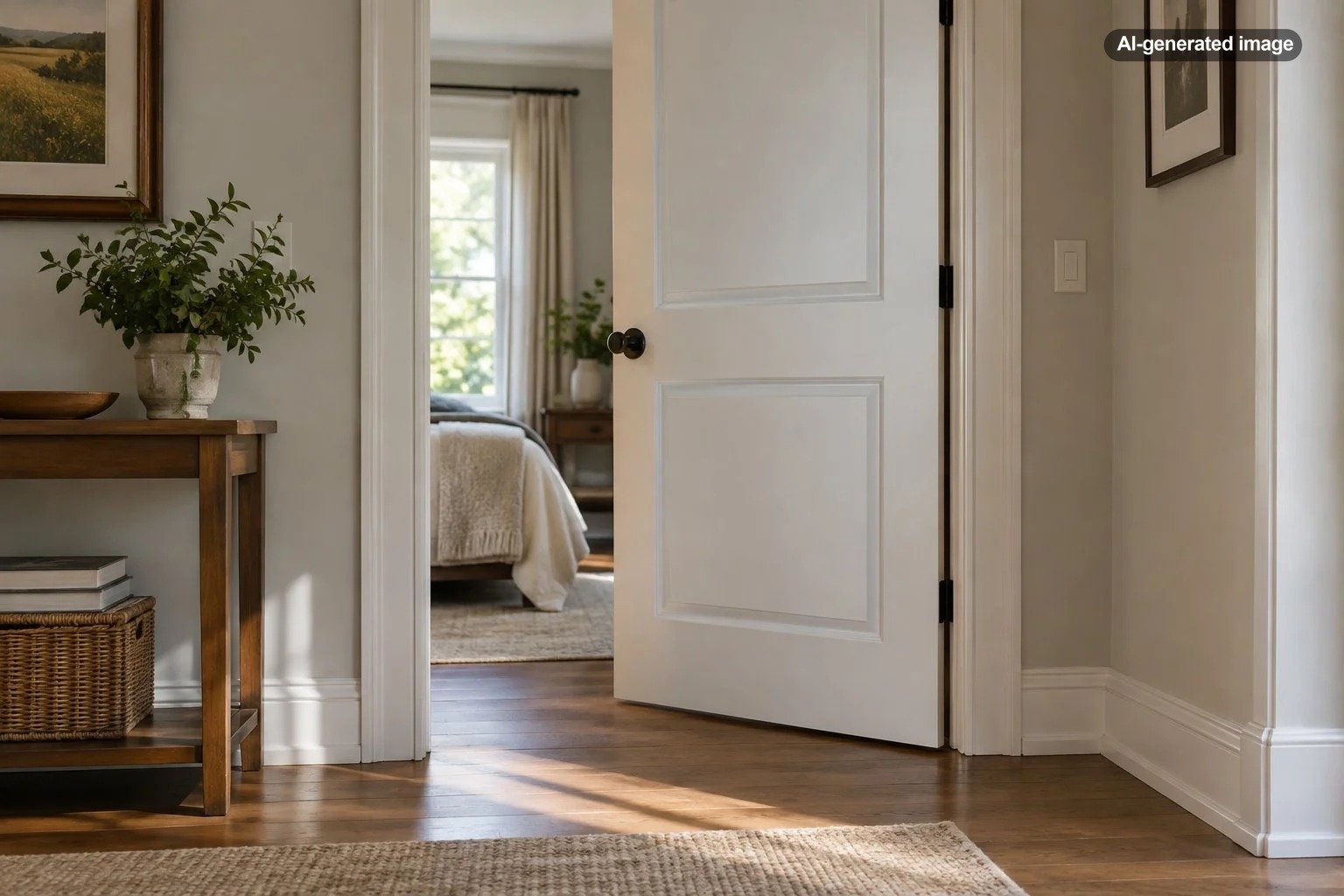
If an interior door swings open by itself, gravity is usually doing the work. The door or, more specifically, the line formed by its hinges is probably not perfectly vertical. Even a small amount of tilt can make a free-swinging door drift toward the open or closed position whenever the latch is released.
The good news is that this does not automatically mean your house has a serious problem. Loose hinge screws, a slightly misaligned jamb, an imperfect original installation, or gradual movement around the doorway can all produce the same mildly mysterious behavior.
Why a slightly tilted door moves on its own
A typical interior door rotates around a vertical line running through its hinge pins. When that line is truly vertical, gravity has little reason to pull the door toward one side, so a properly installed door should generally remain where you leave it.
If the hinge line leans, however, the door behaves a little like an object on a shallow slope. Its weight encourages it to rotate toward the position that places its center of mass lower. Depending on the direction of the lean, the door may swing open or swing closed.
This is why the symptom can be surprisingly consistent. A door that always drifts toward the wall when left halfway open is giving you a useful clue about its alignment rather than displaying an unusual talent for dramatic entrances.
Start by checking the hinges
Before assuming the frame needs adjustment, inspect the simplest possibility: loose hardware. Open the door partway and look closely at each hinge while gently lifting the door by the handle or outer edge. The hinge leaves should remain firmly against the door and jamb.
Loose screws can allow a heavy door to sag slightly, changing the relationship between the hinge pins. Look for screw heads that protrude, hinge leaves that move, or gaps between the hinge and the wood.
What to do
- Open the door and inspect all hinge screws on both the door and jamb sides.
- Tighten obviously loose screws without overtightening or stripping the wood.
- Check whether the door has dropped enough to create uneven gaps around the frame.
- Move the door to several partially open positions and see whether its behavior has changed.
- If it still swings consistently, check the alignment of the jamb before modifying the hinges.
Check whether the hinge jamb is plumb
The hinge jamb is the vertical section of the frame to which the hinges are attached. For a door to hang neutrally, that jamb and the hinge axis should be very close to plumb.
A long level placed against the hinge-side jamb can reveal an obvious lean. Check the jamb in both directions: along the wall and perpendicular to it. A frame can appear straight when viewed from the hallway while still leaning slightly into or out of the room.
Also look at the gaps, often called reveals, around the door. A noticeably wider gap at one corner, rubbing near the floor, or a latch that no longer lines up neatly with the strike plate can indicate that the door has shifted rather than merely developed a free-swinging personality.
Was the door always like this?
The timing of the problem can help narrow the cause. If a recently installed door has swung open since day one, installation alignment is a strong possibility. A prehung door depends on careful shimming and a plumb hinge jamb; simply placing the frame inside an opening does not guarantee correct alignment.
If a door behaved normally for years and only recently began moving, inspect the hardware and surrounding frame more carefully. Screws can loosen, wood can expand and contract, hinges can wear, and homes can experience gradual movement over time.
Seasonal changes sometimes make an existing alignment issue more obvious. Wood doors and jambs can respond to changes in indoor humidity, occasionally altering gaps or causing sticking. That does not necessarily mean humidity itself is responsible for the swinging motion, but it may expose an alignment problem that was already close to noticeable.
Could moving air be pushing the door?
Sometimes. Before reaching for tools, rule out air movement by repeating the test with nearby windows closed and heating or cooling equipment temporarily inactive if practical. A strong supply register, return-air pathway, ceiling fan, open exterior door, or cross-breeze can move a lightweight interior door.
The distinction is fairly simple: airflow tends to affect the door inconsistently as conditions change, while an out-of-plumb door usually drifts in the same direction from similar starting positions.
Should you bend a hinge pin to stop the movement?
One traditional workaround is to slightly increase friction at a hinge pin so the door resists moving. That can sometimes tame a minor drift, but it does not actually make a crooked jamb plumb. Think of it as a small behavioral correction rather than a true alignment repair.
It may be reasonable when the door functions normally, the frame is only slightly imperfect, and you simply want the door to stay where it is placed. More significant alignment problems deserve a closer look at the hinges, screws, shims, jamb, and surrounding opening instead of progressively increasing hinge friction.
Be particularly cautious with decorative, specialty, spring-loaded, concealed, or unusually heavy door systems. Their hardware may have adjustment procedures that differ from ordinary residential butt hinges.
When the frame itself may need adjustment
If the hinge hardware is solid but a level confirms that the jamb is noticeably out of plumb, correcting the frame may require removing trim, altering shims, or refastening portions of the jamb. That is a more involved repair because every adjustment can affect the door gaps, latch alignment, trim, and how the door meets its stop.
For an ordinary interior door, an experienced DIYer may be comfortable investigating those components. If the doorway is severely distorted, the door suddenly changed position, several nearby doors are developing alignment problems, or you see significant cracking or movement around the opening, it is more sensible to have the underlying condition evaluated rather than treating each door symptom independently.
What not to do
Avoid randomly driving long screws into the jamb, aggressively bending several hinges, planing the door, or moving the strike plate before identifying the actual cause. Each technique solves a different problem, and using the wrong one can trade a harmless swinging door for rubbing, binding, uneven gaps, or damaged hardware.
Likewise, do not judge alignment solely by whether the latch works. A latch can line up perfectly while the hinge axis is still slightly tilted, particularly if the frame was installed that way from the beginning.
The simplest way to think about the problem
A door that swings open by itself is usually telling you that its hinge axis is tilted enough for gravity to influence the swing. Start with loose screws because they are easy to identify. Then check the door gaps and hinge jamb with a level, and rule out strong airflow if the behavior is intermittent.
If everything works well and the drift is slight, a minor hinge adjustment may be all you need. If the frame is clearly misaligned or the doorway shows other signs of movement, correcting the underlying alignment is the better long-term approach.
Frequently asked questions
Why does my door swing open only when I leave it halfway?
A slight hinge-axis tilt may not generate enough movement when the door is nearly closed or fully open, but it can become obvious around the middle of its travel. Testing several positions helps reveal the pattern.
Does a swinging door mean my house is settling?
Not necessarily. Loose hinge hardware, imperfect installation, a slightly out-of-plumb jamb, and ordinary changes in the door assembly are all possible explanations. Look for additional signs before drawing conclusions about the structure.
Why does one door swing open while another swings closed?
The direction depends largely on the direction of the hinge-axis tilt. One door may be pulled toward its open position while another is pulled toward the frame.
Can a new door swing by itself?
Yes. If a newly installed door does this immediately, check whether the hinge jamb was installed plumb and whether the frame was shimmed and secured without twisting.