
What Should You Charge Before a Hurricane?
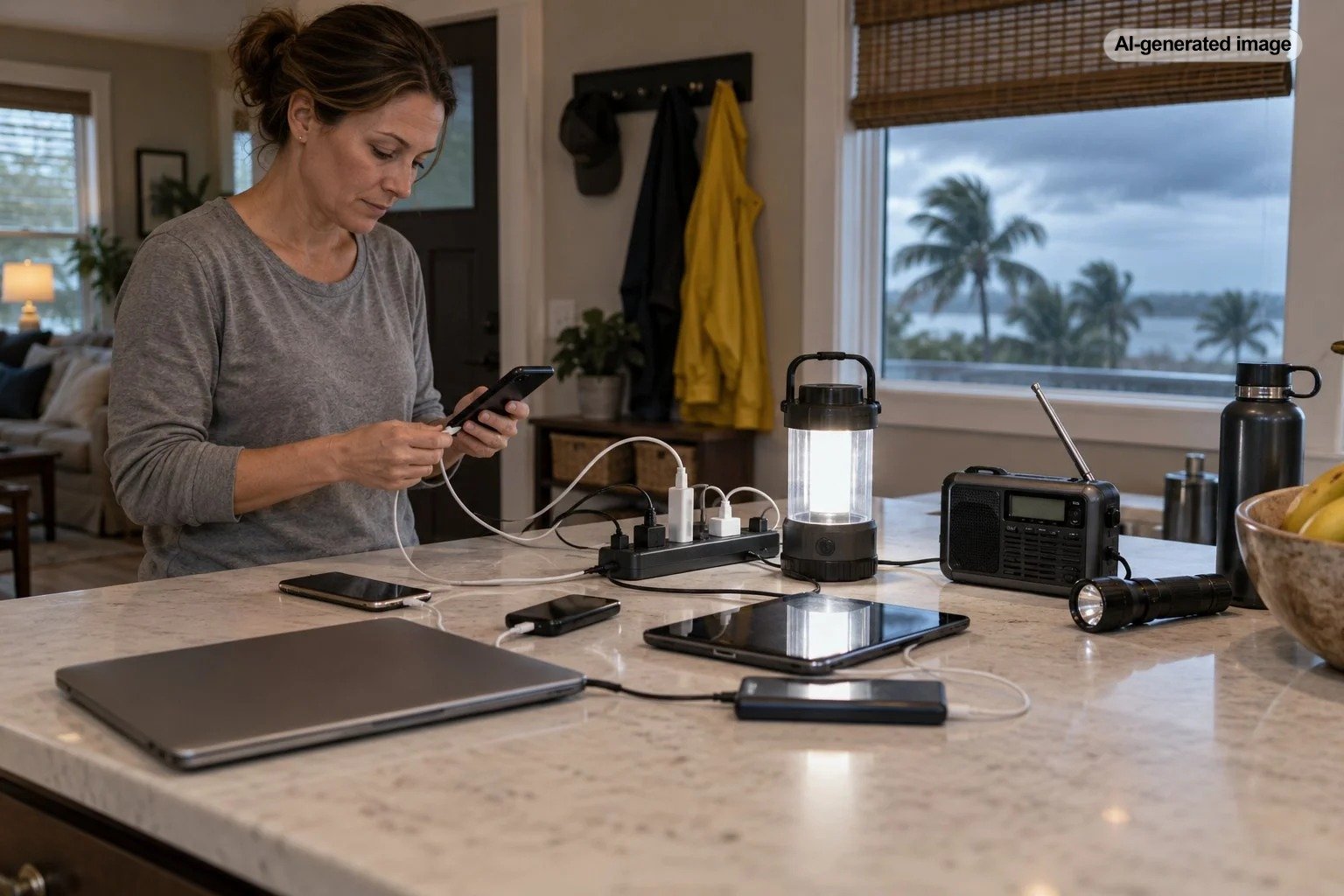
Before a hurricane, charge anything that helps you communicate, receive emergency information, see in the dark, manage essential health needs, or keep necessary household equipment available during a power outage. Start with every cell phone in the household, then move to portable power banks, rechargeable lights and radios, medically necessary battery-powered equipment, laptops or tablets you may rely on, rechargeable batteries, and any backup power stations you already own.
The useful question is not simply, “What has a battery?” It is, “What would be difficult or important to lose if the power went out tonight?” Hurricane outages can last longer than a routine thunderstorm interruption, and charging everything while electricity is still reliable gives you more options if utility service, cellular networks, or normal routines are disrupted.
1. Charge every cell phone first
Phones deserve the first available outlets because they can serve several emergency functions at once. Depending on service availability, a charged phone may provide emergency alerts, weather information, maps, family communication, a flashlight, stored documents, and access to local evacuation or shelter information.
Do not limit the charging round to the phone you use most often. Charge older working phones that household members still keep, as well as phones belonging to children, older relatives, or guests who may be staying with you. A spare device can be useful even if it is not part of your everyday routine.
Before conditions deteriorate, also consider downloading information you may want without a reliable connection: important phone numbers, local maps, evacuation information, insurance contacts, medication lists, and copies of essential documents. Charging creates battery capacity; preparing information makes that capacity more useful.
2. Fill every portable power bank
A power bank is essentially stored charging time. If you own several, charge all of them rather than assuming one large battery will cover the household. Labeling or grouping them with their correct cables can prevent a surprisingly annoying scavenger hunt after the lights go out.
Check the actual charge indicator rather than assuming a power bank is full because it has been sitting in a drawer. Rechargeable batteries gradually lose charge in storage, and an emergency is a poor time to discover that the backup you remembered is nearly empty.
3. Charge rechargeable flashlights, lanterns, and radios
Household lighting becomes a safety issue during an outage, especially around stairs, bathrooms, hallways, entryways, and rooms with obstacles. Charge rechargeable flashlights, lanterns, headlamps, and task lights before the storm. If some of your lights use replaceable batteries instead, verify that you have compatible fresh batteries stored where they can be found easily.
A battery-powered or hand-crank radio can provide another route to emergency information if internet or cellular service becomes unreliable. If your radio includes an internal rechargeable battery, give it a full charge while you still have dependable power. Do not assume a multi-function emergency device is ready simply because it has been stored with your hurricane supplies.
4. Prioritize medically necessary equipment
If someone in the household relies on battery-powered medical or accessibility equipment, that equipment moves to the top of the charging list. Fully charge the device and any manufacturer-approved backup batteries, and follow the equipment manufacturer’s instructions for charging, storage, and backup-power compatibility.
Some medical devices require much more power than a typical phone charger or portable battery can provide. Do not assume a consumer power bank, automobile outlet, inverter, or portable power station is suitable merely because the plugs appear compatible. For essential equipment, confirm backup arrangements with the device manufacturer, medical provider, utility assistance program, or other appropriate professional before a storm threatens.
5. Charge laptops and tablets that have a real job to do
A laptop is not as essential as a phone for most households, but its much larger battery can be valuable when it supports a specific need. Charge laptops used for work, school, communication, property documentation, access to downloaded records, or keeping children occupied during a long period indoors.
Tablets are similarly useful when they hold offline entertainment, books, documents, maps, or communication apps. If you are conserving energy later, however, avoid treating every charged screen as something that must remain powered on. Stored battery capacity is more useful when you spend it deliberately.
6. Charge rechargeable household batteries
If you use removable rechargeable AA, AAA, or other household batteries, run a charging cycle before the storm and place the charged sets with the devices they are intended to support. This is particularly useful for radios, flashlights, small fans, and other low-power equipment.
Keep charged batteries organized so depleted and ready-to-use cells do not become mixed together. Follow the battery and charger manufacturers’ instructions, and avoid using visibly damaged, swollen, leaking, or unusually hot rechargeable batteries.
7. Top off portable power stations if you already own one
A portable power station can provide considerably more stored energy than a pocket-size power bank, but its usefulness depends on its capacity, output, battery condition, and the electrical demands of whatever you connect to it. Charge the unit according to its manufacturer’s instructions before the storm rather than discovering a half-empty battery after an outage begins.
Think in terms of priorities rather than trying to operate the house normally. Communication, essential health needs, lighting, and critical information generally deserve stored power before entertainment or convenience devices.
Before you decide what gets backup power
- Identify devices needed for health or accessibility.
- Protect at least one reliable communication method.
- Reserve power for emergency lighting and information.
- Know which cables and adapters each device requires.
- Check the power station or battery manufacturer’s output and compatibility instructions.
- Save lower-priority entertainment devices for later if stored energy becomes limited.
8. Charge small devices that improve outage comfort
Once essential equipment is covered, a second tier of rechargeable items can make a warm, dark, disconnected house considerably easier to manage. Examples include battery-powered fans, rechargeable personal lights, e-readers, hearing-device accessories where applicable, portable speakers used for information, cameras, and children’s rechargeable devices.
In hot climates, rechargeable fans can be particularly welcome if air conditioning stops, but they should not consume power reserved for essential medical or communication needs. Families with infants, older adults, pets, or people who are especially vulnerable to heat should have a broader heat-safety plan rather than relying on a small battery fan alone.
9. Do not forget the car, but use it carefully
A vehicle may offer another way to charge a phone or small device if household power is unavailable. FEMA preparedness guidance has recommended considering vehicle charging as one alternative. Keep the appropriate charging cable or adapter with the car rather than leaving the only one buried somewhere inside the house.
However, never idle a vehicle in a garage or another enclosed or poorly ventilated location simply to charge electronics. Vehicle exhaust contains carbon monoxide. If you need to use a vehicle for charging, follow safe outdoor operation practices and any instructions from local emergency officials.
10. Charge early rather than waiting for the final warning
The easiest charging plan starts before every household in the area is simultaneously finishing storm preparations. When a hurricane watch or another credible threat puts your area at risk, begin topping things off instead of waiting until winds are approaching or utility interruptions have already started.
Charging early also gives you time to discover problems. You may find a dead cable, a power bank that no longer holds a useful charge, a flashlight with a failing battery, or a power station that needs many hours to fill. Those are ordinary household annoyances on a quiet day and much bigger problems when stores are closing and weather conditions are worsening.
The best hurricane charging plan stores electricity in the devices that will still matter when the outlets stop working.
A simple room-by-room charging sweep
One practical method is to walk through the house once with a charging checklist rather than trying to remember everything from the kitchen counter. This reduces the chance of overlooking a device that normally lives in a bedroom drawer, home office, garage, or emergency kit.
What to do
- Start with phones and medically necessary equipment.
- Collect power banks, charging cables, and adapters in one accessible location.
- Charge emergency lights, radios, and removable rechargeable batteries.
- Top off laptops, tablets, and communication equipment you expect to use.
- Charge portable power stations according to manufacturer instructions.
- Finish with small comfort devices such as rechargeable fans and e-readers.
- After charging, unplug and store devices where they can be reached easily during an outage.
What should stay plugged in during the storm?
Do not confuse pre-storm charging with a need to leave every device connected indefinitely. Once equipment is charged, you can unplug nonessential electronics and keep the device and its cable together. Ready.gov guidance for thunderstorms advises charging mobile phones before a storm and unplugging chargers when the storm arrives, while also recommending surge protection or disconnecting equipment where appropriate.
If lightning, flooding, electrical damage, or another hazardous condition is affecting your home, do not handle electrical equipment in unsafe conditions. Stay away from downed power lines and floodwater that could be electrically energized, and follow instructions from local emergency management and utility officials.
Frequently asked questions
Should I charge my phone to 100 percent before a hurricane?
Yes. When a hurricane may cause an outage, starting with a fully charged phone gives you the greatest available battery reserve. Once power fails, conserve that reserve by reducing unnecessary screen use and background activity where practical.
How many power banks should a household charge?
There is no universal number. Charge every reliable power bank you already own, then decide how they will be allocated based on the number of people, phones, essential devices, expected outage conditions, and available alternative power.
Should I charge my laptop even if I probably will not work?
If there is time and outlet capacity after essential equipment is charged, yes. A laptop’s stored battery may still prove useful for downloaded information, communication, documents, or entertainment during an extended outage.
When should hurricane charging begin?
Begin while electrical service is reliable and before dangerous weather arrives. Official hurricane guidance encourages completing preparations in advance and gathering what you may need if power is lost. Local emergency instructions and evacuation orders always take priority over finishing a charging checklist.