

What Documents Should You Protect Before a Hurricane?
If a hurricane damages your home or forces an evacuation, the paperwork you need afterward may suddenly become as important as the supplies you packed beforehand. The documents worth protecting first are those that establish identity, ownership, insurance coverage, finances, medical needs, and legal authority. Keep irreplaceable originals secure, create digital copies of critical records, and make sure at least one protected copy remains accessible even if you cannot return home.
This does not require hauling an entire filing cabinet into an evacuation vehicle. The goal is to identify the records that would be difficult, slow, or stressful to replace and organize them before a storm is approaching.
Start with identity and vital records
Your first group should contain documents that prove who you and your household members are. FEMA preparedness guidance identifies household identification as a core category of critical records. Depending on your household, this may include:
- Birth certificates
- Marriage or divorce certificates
- Adoption and child custody records
- Passports
- Driver’s licenses or state identification cards
- Social Security cards
- Permanent resident or other immigration documents
- Military identification or service records
You generally do not need to carry every original document every time severe weather appears in the forecast. Instead, decide which originals belong in protected storage and which identification documents you would need with you during an evacuation. A secure digital copy can also make it easier to locate document numbers and begin replacement procedures if an original is lost.
Protect your insurance information
Insurance records can become immediately relevant after wind, water, or other storm damage. Save copies of homeowners, renters, flood, automobile, and other applicable policies, along with your insurer’s contact information and policy numbers.
Do not assume your general homeowners or renters documents answer every question about hurricane or flood losses. Coverage varies by policy and circumstances. Before hurricane season, review the actual policies you carry and contact your insurer or agent if you do not understand your deductibles, exclusions, limits, or claim procedures.
An inventory of your belongings is useful alongside the policy paperwork. The IRS recommends documenting valuables with photographs or video before a disaster because records of property can help with insurance and tax-related recovery. Include broad room views as well as clearer records of significant possessions, and retain receipts or other ownership records when they are available.
Save records that establish your home and property ownership
Property records can be especially valuable when you are trying to document ownership, repairs, improvements, or losses. Depending on your situation, useful records may include:
- Deeds and property closing documents
- Mortgage information
- Vehicle titles and registrations
- Lease agreements
- Receipts or contracts for significant home improvements
- Home inventories, photographs, and videos
Some of these records can be reconstructed later through lenders, title companies, government agencies, contractors, or other institutions. That does not make advance preparation pointless. Having accessible copies can reduce the number of organizations you need to contact while you are also dealing with evacuation, temporary housing, cleanup, or repairs.
Include financial and tax records
Financial records can help you regain access to accounts, document transactions, reconstruct losses, and manage expenses after a disaster. The IRS specifically recommends safeguarding important documents and creating electronic copies when records exist only on paper.
Consider protecting recent tax returns and supporting records, bank and investment account information, loan documents, retirement account information, and essential business records if you operate a business from home. You do not necessarily need years of printed statements in your evacuation kit. Many statements can be retrieved again from financial institutions, so focus physical storage on records that are difficult to reconstruct and keep secure electronic access to the rest.
Be particularly careful with documents containing Social Security numbers, account numbers, tax information, or other sensitive personal data. Hurricane preparation should not create an identity-theft problem. Digital backups should be protected with appropriate passwords and security controls, and portable drives containing sensitive information should be stored securely.
Gather medical and health information
Medical information can be critical when your normal pharmacy, physician, or hospital is inaccessible. FEMA preparedness materials recommend safeguarding essential medical and prescription information as part of disaster planning.
Create a concise household record containing health insurance information, medication names, prescribing information, allergies, significant medical information needed in an emergency, physician contact details, and relevant medical-device information. Keep the information current, especially when prescriptions or treatment plans change.
For anyone who depends on medication, medical equipment, mobility assistance, or specialized care, document the information needed to maintain that care during an evacuation. Emergency planning for individual medical needs should be discussed with the appropriate healthcare provider rather than relying on a generic household checklist.
Do not forget legal and family documents
Legal papers are easy to overlook because they may spend years untouched in a drawer or safe. Yet some become important precisely when normal routines have been disrupted. Depending on your circumstances, protect copies of wills, trusts, powers of attorney, healthcare directives, guardianship records, and other legal documents that establish who can make decisions or manage affairs.
If an attorney, financial professional, executor, or another trusted person maintains an official copy of a document, record that person’s current contact information as well. A document you know exists but cannot locate is considerably less useful during an emergency.
Make a small file for children and pets
Households with children may need school information, custody documents, identification records, important contacts, and medical information. Families with pets can similarly benefit from copies of vaccination records, veterinary information, identification numbers, ownership records, and current photographs.
FEMA’s critical-document guidance specifically includes records used to establish household relationships and pet ownership. These records can become useful when households are displaced, family members are separated temporarily, or animals must be boarded or sheltered.
Use more than one layer of protection
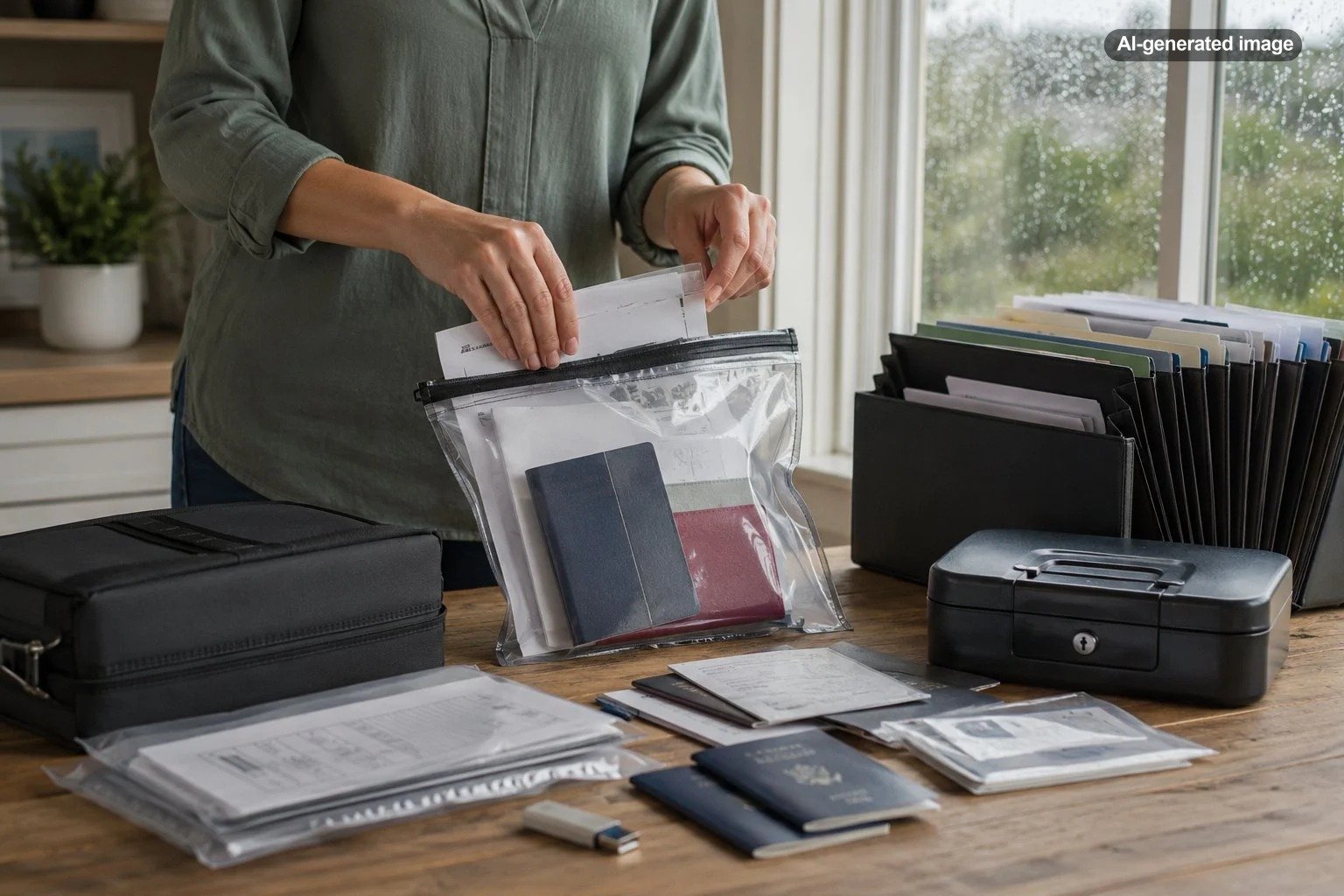
A single folder in a desk drawer is not a hurricane document plan. FEMA’s Emergency Financial First Aid Kit recommends safeguarding paper and electronic copies in safe locations. Its guidance discusses options including a fireproof and waterproof box or safe, an appropriate safe deposit box, storage with a trusted friend or relative, and protected electronic storage.
The important principle is redundancy. If the original and backup are sitting next to each other when water enters the room, you do not truly have two independent copies.
What to do
- Gather the critical records for every person in the household.
- Separate genuinely important originals from papers that are easy to replace or retrieve online.
- Scan or photograph the important records clearly.
- Store originals in an appropriately protected location.
- Keep a secure digital backup that is not dependent on access to your home.
- Make a compact evacuation file containing the information you may need immediately.
- Review the collection at least once a year and after major life changes.
Cloud storage can provide offsite access, while an encrypted or password-protected external drive can offer another copy. Each approach has tradeoffs. Cloud access depends on account security and connectivity, while a physical drive can be lost or damaged. Using more than one method avoids making any single storage system your only point of failure.
What should actually go with you if you evacuate?
Your portable document kit should be selective. Bring identification and other records you are likely to need immediately, particularly when an original is difficult to replace or necessary for your household’s circumstances. For many supporting records, a secure digital copy may be more practical than carrying bulky paper files.
Keep emergency contacts in a form that does not depend entirely on your phone. Include insurers, financial institutions, physicians, veterinarians, close relatives, and other essential contacts. If your phone is damaged, lost, or out of power, having important numbers elsewhere can be surprisingly valuable.
A clearly organized document pouch or folder is usually more useful than a miscellaneous stack of paper gathered at the last minute. Hurricane preparation works best when the system is ready before watches or warnings begin.
Review the file before every hurricane season
Preparedness records become outdated quietly. Insurance policies renew, vehicles change, children grow, prescriptions change, passports expire, and financial accounts move. The IRS recommends reviewing emergency preparedness plans at least annually.
Before you decide your file is finished
- Confirm identification documents are current.
- Replace outdated insurance information.
- Update medication and medical details.
- Add records for recently purchased vehicles or property.
- Refresh your home inventory after major purchases or renovations.
- Test that digital backups can actually be opened.
- Verify that trusted contacts still know where applicable backup records are kept.
The best hurricane document system is not the thickest one. It is the one that gives you secure access to the information you are most likely to need while keeping irreplaceable originals protected. Organize it once, maintain it routinely, and hurricane preparation becomes less about searching drawers and more about carrying out a plan you already made.
Frequently asked questions
Should I keep original documents in my hurricane evacuation bag?
Some critical originals may warrant taking with you, particularly if they are difficult to replace, but the right choice depends on the document and your evacuation circumstances. Avoid carrying unnecessary sensitive paperwork. Maintain secure backups so one lost bag does not eliminate your only copy.
Is a waterproof plastic bag enough for important documents?
A sealed bag can provide an additional moisture barrier, but it should not be treated as equivalent to storage designed for greater water or fire protection. Follow the instructions and limitations of whatever storage product you use, and maintain an offsite or digital backup as well.
Are digital copies of documents enough?
Digital copies are extremely useful for backup and recovery, but they do not automatically replace an original when an agency, institution, or legal process requires the original or a certified copy. Preserve important originals while also maintaining secure electronic copies.
How often should I update my hurricane document file?
Review it at least annually and whenever a major life change occurs, such as moving, marriage, divorce, a new child, a major property purchase, a new insurance policy, or a significant change in medical needs.