
Do You Need HOA Approval for a Smart Thermostat?
Usually, installing a smart thermostat does not automatically require HOA approval, but the answer depends on what you own, what your association controls, and whether the installation affects shared building systems or common property. A straightforward thermostat replacement inside a detached home is very different from modifying controls connected to a condominium’s central HVAC system.
Before removing the old thermostat, check both sides of the question: your association’s rules and your HVAC system’s compatibility. A thermostat may look like a small wall-mounted gadget, yet it is still a control device for heating and cooling equipment, and the equipment behind it may not belong entirely to you.
Why HOA Approval Depends on More Than the Thermostat
HOA and condominium rules are not universal. The governing documents for one community may say little about interior devices, while another association may regulate alterations involving electrical wiring, plumbing, HVAC equipment, common walls, or building infrastructure.
The first question, therefore, is not simply whether a smart thermostat is allowed. It is which parts of the heating and cooling system you are permitted to modify without association approval.
In a typical detached home where the homeowner owns the furnace, air conditioner or heat pump, thermostat wiring, and interior walls, replacing one compatible thermostat with another may be treated much like replacing another interior control. If your declaration, covenants, architectural guidelines, or alteration rules require approval for HVAC work, however, those provisions can change the answer.
Condominiums deserve extra attention because the boundary between individually owned equipment and common elements can be complicated. A thermostat may be inside your unit even though it controls equipment, valves, fan-coil components, wiring, or building systems that the association maintains.
Situations Where You Are More Likely to Need Approval
It is sensible to contact the HOA, condo association, management company, or architectural review committee before installation when any of the following applies:
- Your governing documents specifically regulate HVAC or mechanical-system alterations.
- Your heating or cooling equipment is maintained by the association.
- The building uses a central, shared, fan-coil, chilled-water, boiler, or other coordinated HVAC system.
- The installation requires new wiring, a new electrical box, wall modifications, or access to common areas.
- A contractor must work in mechanical rooms or other association-controlled spaces.
- Your community requires contractors to provide insurance documentation or follow building access procedures.
- You are uncertain whether thermostat wiring or HVAC controls are considered part of the unit or a common element.
When Approval May Be Unnecessary
Approval is less likely to be an issue when the thermostat and HVAC system are entirely homeowner-controlled, the work remains inside the home, and the association’s rules do not require review of this type of interior alteration.
For example, imagine a detached townhouse where each owner has an independent furnace and air conditioner, the thermostat uses ordinary low-voltage control wiring, and the association regulates only exterior modifications. A compatible thermostat replacement may fall outside the architectural-review process. That is only an illustrative scenario, however; the actual governing documents remain the deciding factor.
Check HVAC Compatibility Before You Buy
Association permission is only half of the decision. A smart thermostat also has to work correctly with the heating and cooling system it is controlling.
ENERGY STAR advises homeowners to verify HVAC compatibility before purchasing a smart thermostat. System type, wiring, voltage, staging, zoning, and available power can all affect which thermostat is appropriate. Some installations are simple; others are better evaluated by an experienced HVAC or electrical professional.
That is especially relevant in multifamily buildings, where the system behind the wall may be less conventional than a standard residential furnace-and-air-conditioner combination.
Affiliate disclosure: CraneManor.com may earn a commission when you purchase through links on this page. This does not affect the price you pay. Learn more.
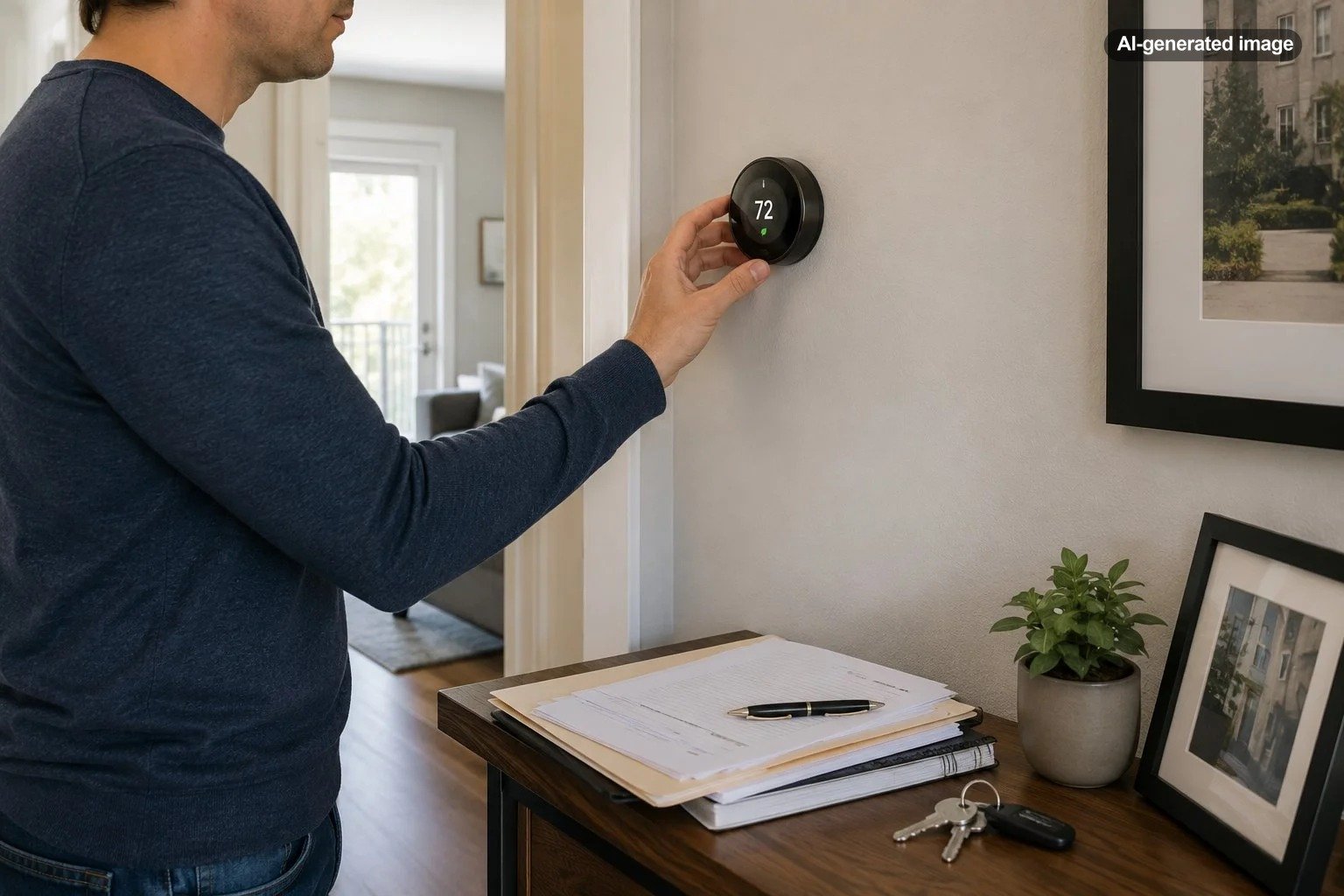
If you are considering a compatible smart thermostat such as the Google Nest Thermostat, verify your particular HVAC configuration before purchasing or installing it. Google provides a compatibility-checking process for Nest thermostats, and certain systems or wiring arrangements may require additional equipment or professional help.
Do Not Assume Every Smart Thermostat Works With Every System
A conventional thermostat often uses thin, low-voltage control wires, but wiring arrangements vary considerably. ENERGY STAR notes that many smart thermostats require a reliable source of power, commonly involving a C-wire, although requirements differ by product and system.
Google likewise states that Nest thermostats are designed for many 24-volt heating and cooling systems but are not universally compatible. Proprietary controls, unusual wiring, multiple-stage equipment, dual-fuel arrangements, and other configurations can complicate installation.
This matters for HOA approval because solving a compatibility problem can turn a simple device swap into a more substantial modification. Adding wiring, installing an adapter, opening building-controlled equipment, or changing control components may bring the project within association rules even when replacing the thermostat alone would not.
A smart thermostat is a small device, but the system it controls may cross ownership, wiring, and building-management boundaries.
What to Ask Your HOA or Condo Association
If the rules are unclear, a short, specific question to management is usually more productive than asking broadly whether smart-home devices are allowed. Explain exactly what you intend to replace and whether you expect any wiring or HVAC modifications.
Before you decide
- Who owns and maintains the HVAC equipment serving your home?
- Is the existing thermostat considered an owner-maintained component?
- Does replacing it require architectural or alteration approval?
- Are there approved thermostat types or control requirements for the building?
- May a contractor access HVAC equipment or common mechanical areas if necessary?
- Does the association require contractor insurance or building-access documentation?
- Would new wiring or an adapter change the approval requirements?
When possible, request the answer in writing or ask management to point you to the relevant section of the governing documents. That provides a clearer record than relying on an informal assumption from a neighbor or previous owner.
What to Check Before Installation
What to do
- Read the association rules. Look for provisions covering alterations, HVAC systems, electrical work, common elements, limited common elements, and contractor requirements.
- Determine who controls the HVAC system. This is particularly important in condominiums and buildings with centralized equipment.
- Identify the existing thermostat wiring and system type. Use the thermostat manufacturer’s compatibility guidance rather than assuming that matching wire colors guarantee compatibility.
- Ask management when ownership or approval is unclear. Describe the intended work accurately, including any wiring changes.
- Use professional help when the system is complicated. Zoned systems, proprietary controls, unfamiliar voltage, shared equipment, and complex heat-pump configurations can justify professional evaluation.
Can an HOA Require You to Remove an Unapproved Thermostat?
Potentially, if the installation violated enforceable association rules or altered property or systems that the association controls. The consequences and enforcement procedures depend on the community’s governing documents and applicable law, so they should not be assumed to be identical from one HOA to another.
This is one reason to resolve uncertainty before installation. Getting a simple written answer can be much easier than debating later whether the change should have been submitted for review.
What If You Rent in an HOA Community?
Renters have another layer to consider. Even when the HOA would allow a thermostat change, a tenant generally should not assume that permission from the association replaces permission required by the lease or property owner.
If you rent, check the lease and obtain the property owner’s approval when required before altering thermostat hardware or wiring. The owner may also need to handle any HOA submission.
The Bottom Line
You do not necessarily need HOA approval simply because a thermostat is smart or Wi-Fi enabled. What matters is whether the installation falls within your association’s alteration rules and whether it affects equipment, wiring, walls, or infrastructure controlled by the association.
Detached-home owners with individually owned HVAC equipment often have the simplest situation. Condo residents and anyone with shared, centrally managed, or unusual HVAC equipment should be more cautious. Confirm ownership, read the governing documents, verify thermostat compatibility, and ask management before proceeding whenever the boundaries are unclear.