
Does Opening Windows Improve Indoor Air Quality in Humid Weather?
Opening the windows can improve indoor air quality by increasing ventilation, but in humid weather it can also bring substantial moisture into the house. The practical answer is not simply to open or close every window. It is to ventilate when outdoor conditions are favorable and rely on controlled ventilation, air conditioning, exhaust fans, filtration, and moisture management when the outside air is hot or humid.
This distinction matters in humid climates. Fresh outdoor air can dilute indoor pollutants, yet uncontrolled outdoor air can also raise indoor moisture levels. The U.S. Environmental Protection Agency advises increasing ventilation when weather and outdoor air quality permit while avoiding outdoor-air ventilation during periods of extreme humidity.
Why opening a window can improve indoor air quality
Indoor air can accumulate pollutants from cooking, cleaning products, furnishings, hobbies, combustion sources, dust, and everyday household activities. Bringing outdoor air indoors can dilute some of those pollutants and increase the home’s air-exchange rate.
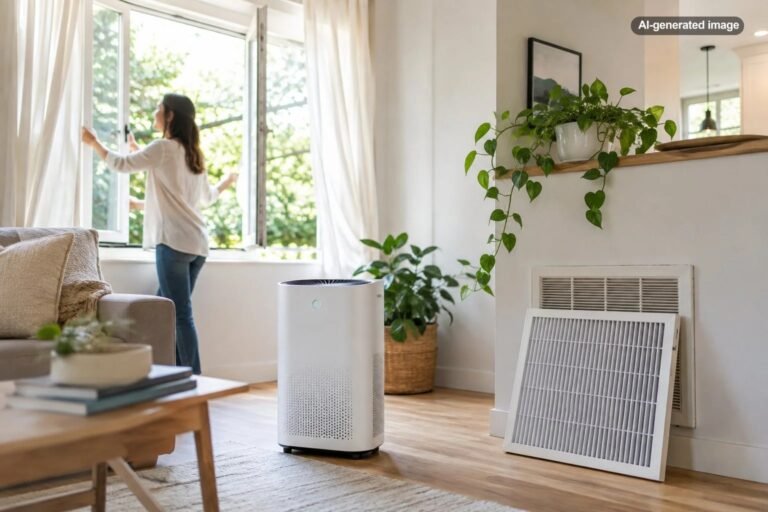
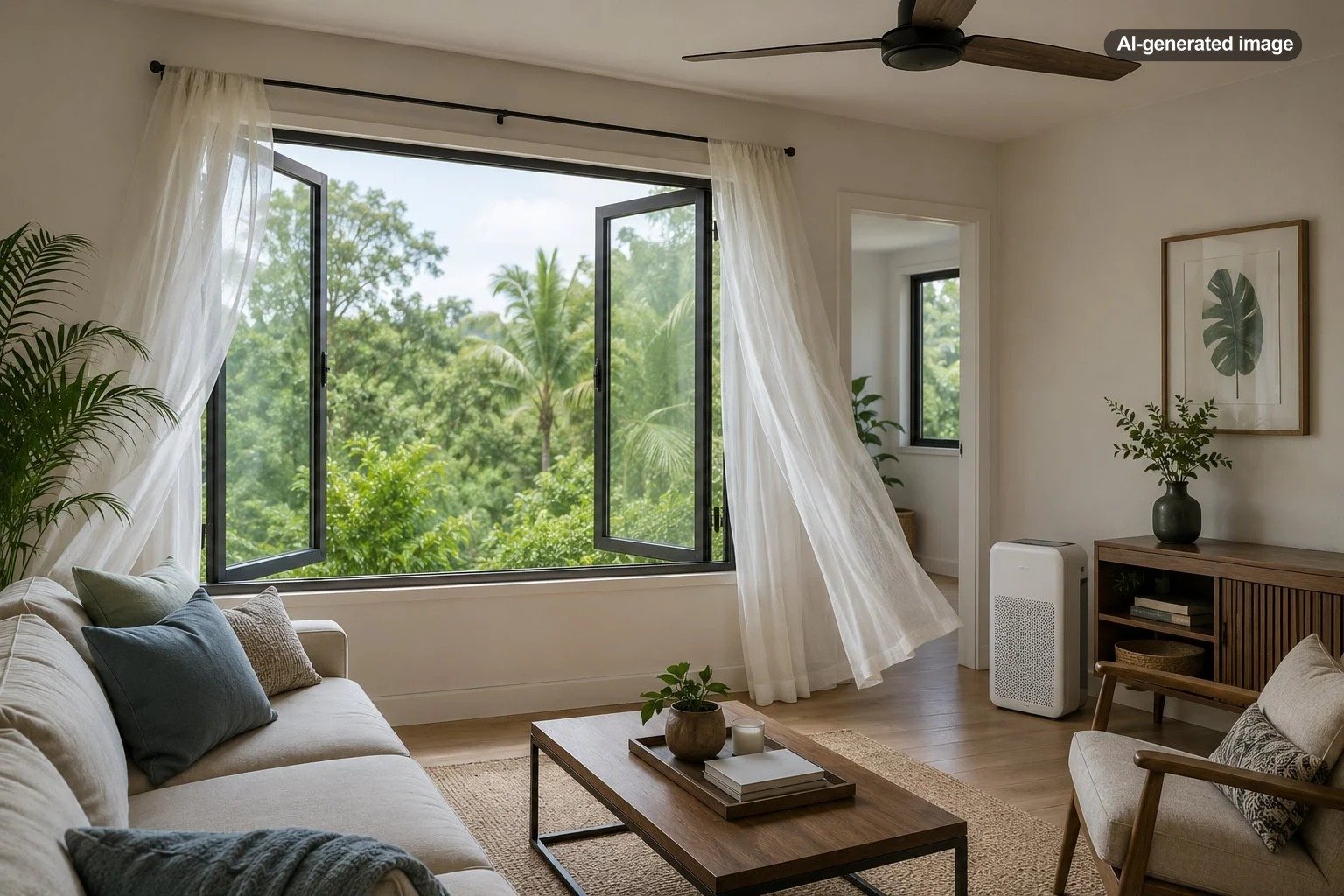
EPA guidance notes that opening windows and doors can increase natural ventilation when weather and outdoor air quality permit. Opening windows on opposite sides of a home can also create cross-ventilation, which generally moves more air than cracking a single window.
That makes an open window particularly useful during short-lived indoor activities that generate pollutants, provided the outdoor conditions are suitable. Cooking, painting, cleaning, and certain home projects are examples where increased ventilation may help remove contaminants more quickly.
Why humid weather changes the equation
Ventilation and humidity control are related but they are not the same thing. An open window may improve air exchange while simultaneously making moisture conditions indoors worse.
EPA guidance specifically cautions against ventilating with outdoor air during periods of extreme humidity. It also notes that in warm, humid climates, outdoor air can add moisture to a building even when the outdoor relative-humidity percentage does not appear dramatically higher than the indoor reading.
This is one reason simply comparing two relative-humidity percentages can be misleading. Temperature affects relative humidity, so warm outdoor air may contain considerable moisture. Once that air enters an air-conditioned home and cools, the moisture can become more consequential indoors.
Fresh air is useful only when the outdoor air is actually a good trade for the indoor air you are replacing.
How humid is too humid indoors?
EPA guidance recommends keeping indoor relative humidity below 60 percent and, where possible, within roughly 30 to 50 percent. Persistently elevated humidity can encourage moisture-related problems, while condensation on windows, pipes, walls, or other cool surfaces can be a visible warning that moisture needs attention.
Affiliate disclosure: CraneManor.com may earn a commission when you purchase through links on this page. This does not affect the price you pay. Learn more.
You do not need to judge humidity by whether the house feels sticky. A small digital hygrometer can provide a straightforward indoor relative-humidity reading and make it easier to see how opening windows changes conditions from hour to hour.
If humidity remains high despite normal air-conditioning operation, the answer is usually not to keep opening windows in hopes that the room will dry out. Depending on the home and the source of the moisture, a portable dehumidifier may be useful for a specific humidity-prone room. Larger or persistent moisture problems deserve a closer look at HVAC operation, ventilation, drainage, leaks, and other possible moisture sources rather than assuming a portable appliance will solve the entire house.
When opening the windows makes sense
The best window-opening weather is generally the kind that makes you want to be outdoors anyway: moderate temperature, manageable humidity, acceptable outdoor air quality, and no heavy rain blowing toward the openings.
Before you open the windows
- Check whether the outdoor air feels substantially hotter or more humid than the conditioned indoor air.
- Check local outdoor air quality, especially during wildfire smoke, pollution events, or other advisories.
- Consider pollen levels if household members are sensitive to outdoor allergens.
- Make sure rain cannot enter through open windows.
- Consider security, pets, children, and fall hazards before leaving windows unattended.
- Watch the indoor humidity reading if you plan to ventilate for more than a brief period.
A short period of cross-ventilation may be enough when the goal is to clear cooking odors or air out a room. There is little benefit in leaving the entire house open for hours if the outdoor air is steadily pushing indoor humidity upward.
When keeping windows closed is the better choice
On a muggy summer afternoon, keeping windows closed can protect the humidity control your air conditioner is already providing. Air-conditioning systems cool air and can remove moisture as part of normal operation. Constantly introducing warm, humid outdoor air adds another moisture load for the system to handle.
Windows are also better kept closed when outdoor air quality is poor, smoke is present, pollen is especially troublesome for someone in the home, or severe weather makes natural ventilation impractical.
Better ways to improve air quality when it is muggy outside
If outdoor conditions make open-window ventilation a poor choice, focus on the pollutant or moisture source rather than treating every indoor air problem as a need for more outdoor air.
Use kitchen and bathroom exhaust fans
Fans that vent outdoors remove contaminants and moisture close to where they are produced. Use the range hood during cooking when it exhausts outdoors, and operate an exterior-vented bathroom fan during and after showers. Recirculating fans may move air or filter some particles, but they do not remove indoor moisture to the outdoors.
Keep HVAC filters maintained
Follow the filter manufacturer’s replacement or cleaning instructions. Filtration can help reduce airborne particles, although it does not replace source control, ventilation, or humidity management.
Control the moisture source
If one room repeatedly becomes humid, look for a reason. Long showers, unvented cooking, improperly vented dryers, plumbing leaks, water intrusion, condensation, and HVAC drainage problems are examples worth investigating. Removing the source is more effective than repeatedly drying moisture that continues to return.
Use dehumidification where appropriate
Air conditioning may provide adequate moisture removal in many homes. If indoor humidity remains consistently high, EPA recommends a specific dehumidification strategy. The appropriate solution can range from a portable unit for a localized problem to professional evaluation of HVAC sizing, operation, ventilation, or building moisture issues.
What to do on a humid day
- Check indoor humidity before opening the windows.
- Check outdoor temperature, humidity, air quality, and weather.
- If conditions outside are favorable, ventilate briefly and use cross-ventilation where practical.
- Watch whether indoor humidity rises after the windows are opened.
- If outdoor conditions are unfavorable, close the windows and use exhaust fans, cooling, filtration, or dehumidification as appropriate.
- If excessive humidity persists, investigate moisture sources rather than assuming the weather is the only cause.
What about the bathroom and kitchen?
These rooms require a little nuance because they can generate substantial moisture indoors. Opening a nearby window can help under suitable outdoor conditions, but an exhaust fan that actually vents outdoors is generally a more controlled way to remove moisture at its source.
If the outdoor air is extremely humid, opening a bathroom window after a shower may exchange one form of humid air for another. An exterior-vented bathroom fan can remove the moisture generated indoors without relying entirely on outdoor weather conditions.
Watch for signs that this is more than a ventilation problem
Persistently high humidity is not always caused by closed windows. Water leaks, drainage problems, condensation, inadequate exhaust ventilation, HVAC problems, or building-envelope issues can all contribute.
If an HVAC system is not controlling humidity as expected, have a qualified HVAC professional evaluate the system rather than changing equipment settings or components based only on general online advice. System design, equipment condition, controls, ventilation, drainage, and the home’s moisture load can all affect performance.
FAQ
Should I open my windows every day for fresh air?
Not necessarily. Natural ventilation is useful when outdoor air quality and weather permit. In very humid, hot, smoky, polluted, or otherwise unfavorable conditions, keeping windows closed and using controlled ventilation or filtration may be the better approach.
Can opening windows make indoor humidity worse?
Yes. Warm, humid outdoor air can add moisture to an air-conditioned home. If indoor relative humidity rises significantly after the windows are opened, extended natural ventilation is probably not helping your moisture-control goal.
Is 60 percent indoor humidity too high?
EPA recommends keeping indoor relative humidity below 60 percent, ideally around 30 to 50 percent where possible. A persistent reading above that range is a reason to investigate moisture control.
Does air conditioning provide fresh air?
Not necessarily. Many residential heating and cooling systems primarily recirculate indoor air rather than continuously introducing outdoor air. The exact behavior depends on the system and its ventilation design.
Is a dehumidifier a substitute for ventilation?
No. Dehumidification addresses moisture, while ventilation exchanges indoor and outdoor air. A healthy indoor environment may require source control, suitable ventilation, filtration, and humidity management working together.
Sources & further reading
- U.S. Environmental Protection Agency: Care for Your Air – A Guide to Indoor Air Quality
- U.S. Environmental Protection Agency: Biological Contaminants and Indoor Air Quality
- U.S. Environmental Protection Agency: Improving Indoor Air Quality
- U.S. Environmental Protection Agency: A Brief Guide to Mold, Moisture and Your Home